
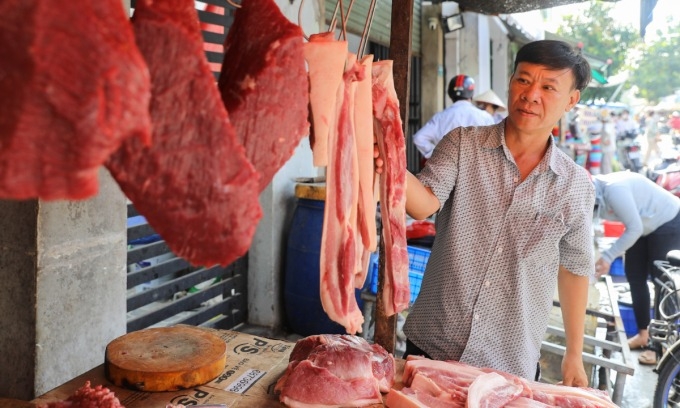

The high consumption has demonstrated that this food item continues to play a dominant role in the daily meals of Vietnamese people and its significant impact on the country’s Consumer Price Index (CPI).
Data shows that domestic pork consumption has continued to increase year after year in the country. In 2021, a person consumed about 30 kg on average; approximately 37 kg in 2024 and continued to rise to approximately 39 kg last year.
Pork currently accounts for more than 63% of the consumption structure of livestock products.
According to the department, pork has a significant impact on the food market and the consumer price index (CPI).
As Lunar New Year (Tet) approaches, the demand for pork increases by approximately 10-15%. According to the Ministry of Agriculture and Environment, last year the livestock industry experienced strong growth, producing 8.6 million tonnes of various meats, including 5.4 million tonnes of pork, sufficient to ensure adequate supply for this year’s Tet holiday.
Pham Kim Dang, deputy director of the Ministry of Agriculture and Environment’s Department of Animal Husbandry and Veterinary Medicine, said that demand for pork is very high and the country was concerned about a shortage of supply due to natural disasters and disease outbreaks last year.
However, total number of pigs currently still reaches 31.4 million, which is completely sufficient to meet the supply for the Tet holiday.
Currently, the price of live pigs on the market is trading around VND71,000-74,000 (US$2.73-2.85) per kg.
Although slightly lower than last month, experts believe the price is still very high. In January, there were times when the price was pushed up to VND81,000 per kg, which is unusual.
Nguyen Xuan Duong, chairman of the Vietnam Livestock Association, believes pork prices are influenced by speculative trading and the psychology of small traders.
With a large proportion in the Vietnamese consumer basket, pork is also one of the essential goods. Therefore, if pork price rises too high, it will not only directly impact people’s lives but also affect the national CPI.

Comments are closed.