
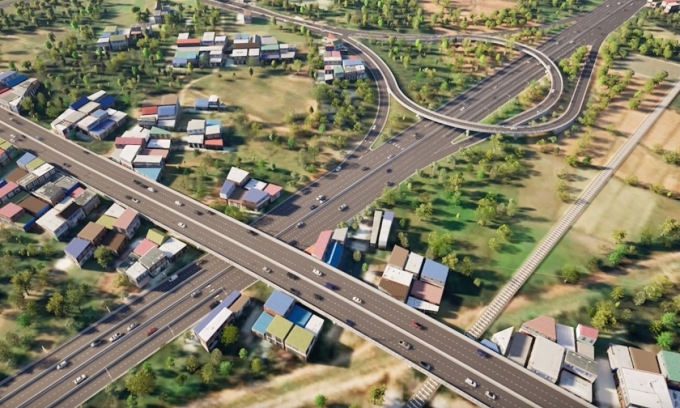

Design of the Ho Chi Minh City–Moc Bai Expressway at its interchange with Provincial Road DT.787B. Photo by Tedi South
Vietnam is moving to create a continuous high-speed road corridor between Ho Chi Minh City and Phnom Penh, proposing a two-phase plan to connect its HCMC-Moc Bai Expressway with Cambodia’s Phnom Penh-Bavet route.
The proposed link would be built at the Moc Bai-Bavet international border gate, currently the main road gateway between Vietnam and Cambodia, the Ministry of Construction said. Officials say the plan aims to improve cross-border trade, streamline freight movement and strengthen regional connectivity in the southern key economic zone.
Vietnam is developing the nearly 51-kilometer HCMC-Moc Bai Expressway, which begins at Ring Road 3 in HCMC and ends about 5 kilometers from the Moc Bai border gate. The project has been approved under a public-private partnership (PPP) model with a build-operate-transfer contract and carries a total investment of more than VND19.6 trillion (US$755 million), including VND9.674 trillion in state capital.
On the Cambodian side, construction of the 135-kilometer Phnom Penh-Bavet Expressway began in June 2023 under a PPP model. The final section currently stops around 15 kilometers from the Vietnamese border while the two governments work to finalize the exact connection point.
Under Vietnam’s proposal, the first phase would use existing infrastructure at the Moc Bai-Bavet border gate to ensure the HCMC-Moc Bai Expressway can operate efficiently once completed. This interim solution would allow goods and vehicles to move through current customs routes while long-term plans are finalized.
In the second phase, the two expressways would be directly connected near border marker 170, aligned with the cargo clearance route of the Moc Bai-Bavet border gate. Authorities say this option is consistent with transport planning and has received support from relevant ministries and local governments.
The ministry has asked the government to approve the phased approach and direct agencies to complete the necessary technical, legal and diplomatic procedures.

Comments are closed.