
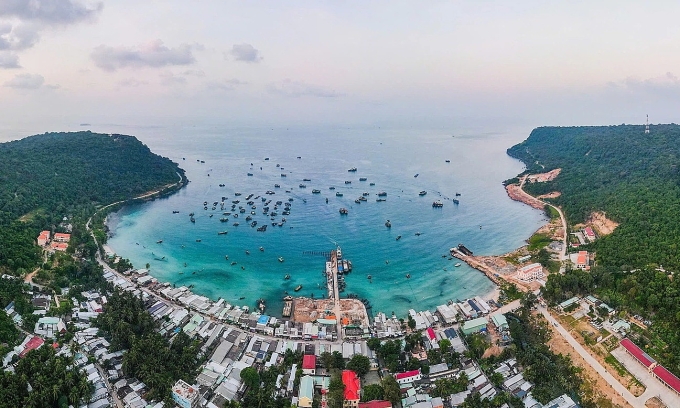

Aerial view of Tho Chau Island in southern Vietnam. Photo by Phuong Vu
Vietnam is pushing ahead with plans to build a dual-use airport on Tho Chu Island, a remote outpost in the country’s southwestern waters.
The Ministry of National Defense has completed a major research dossier and submitted it for high-level review, setting the stage for the island’s first-ever air link.
Tho Chu, more than 100 kilometers from Phu Quoc, plays a key role in regional security and is home to about 1,800 residents.
During a visit last month, Party General Secretary To Lam called the island “an anchor of peace” for the entire southwestern sea, and urged the defense ministry to study a 4C-standard airport capable of handling A320 and A321 jets, with future expansion to 4E standards for wide-body aircraft like the A350 and B787.
For now, Tho Chu can only be reached by sea, with travel heavily dependent on weather and often taking long hours. Officials say the lack of air access limits everything from medical evacuation to tourism potential, and slows defense and security operations.
The airport study was presented as part of a wider national update on Vietnam’s infrastructure boom. Major expressway projects, including sections running from Ho Chi Minh City to My Thuan in the Mekong Delta, Moc Bai at the Cambodia border gate, Bao Loc in the Central Highlands, and the coastal north, are being fast-tracked, while Long Thanh International Airport is preparing for technical test flights this month and commercial operations in 2026.
By the end of the year, Vietnam expects to complete 3,803 kilometers of expressways and about 1,700 kilometers of coastal roads.
On Dec. 19 alone, localities across 34 provinces are expected to break ground on 245 new transport projects worth roughly VND1.345 quadrillion (US$51 billion).
Prime Minister Pham Minh Chinh praised engineers and workers for pushing through recent storms and floods, and reaffirmed goals to expand the national expressway network to at least 3,000 kilometers in the near term.

Comments are closed.