
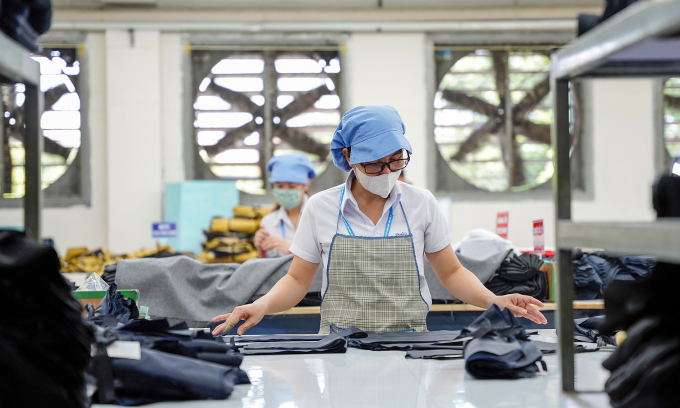

Business partners who have been buying the Vietnam National Textile and Garment Group (Vinatex)’s products for the last 20–30 years have been asking for price cuts of up to 20% since August.
CEO Cao Huu Hieu said at the end of 2025: “Almost every meeting with partners has since begun with a request for lower prices. If we do not comply, they will leave.
“After each round of negotiations, a new price at least 5% lower than before is set.”
Many Vietnamese businesses faced similar pressure last year as U.S. tariffs, geopolitical conflicts and supply chain shifts forced them to cut into profit margins.
However, 2025 was not the only difficult year, as the four preceding it were marked by the impacts of the COVID-19 pandemic, disruptions and inflation in major export markets.
Textile and garment exports, for instance, fell by as much as 11% to nearly US$40 billion in 2023 as demand slumped in key markets like the U.S. and the EU.
Vinatex had never faced such a difficult period in its three-decade history, Hieu said.
Despite the challenges, the firm reported profits of VND1.35 trillion ($51.4 million) in 2025, about 50% higher than its target for the year, with no unit suffering a loss.
He attributed the results to lean management and a willingness to make short-term sacrifices to preserve market share.
Businesses’ resilience has been one of the factors helping the economy recover from the pandemic and expand further.
Vietnam met all 15 of its socio-economic targets for 2025, including economic growth, GDP per capita, labor productivity, and urban employment.
It recorded GDP growth of 8.02%, among the highest rates globally. Average annual growth in 2021–25 was 6.3%, higher than in the previous five-year period.
The economy was estimated to be worth over $510 billion last year, making it the world’s 32nd largest. GDP per capita was at $5,026.
Dr. Le Duy Binh, director of business consultancy Economica Vietnam, said a key factor behind the rapid recovery was the government’s firm commitment to economic stability and its smart use of fiscal, monetary, trade, and investment policies.
“Strong engagement across the political system, along with the adaptability of businesses and the public, has underpinned the economy’s resilience,” he told VnExpress.
After the pandemic Vietnam built its economic recovery on three pillars: domestic market, exports and public spending.
Public spending played a leading role in stimulating flows of private capital and foreign direct investment, production and business activity.
It is estimated that every 1% increase in actual spending added 0.058 percentage points to GDP growth during 2021–25.
Vietnam’s economy compared with some Southeast Asian peers in 2025. Graphics by VnExpress/Anh Tu |
Dang Thanh Tam, chairman of industrial property developer Kinh Bac City, said: “Never have investment decisions made by ministries and local authorities been implemented as quickly as they are now.”
FDI has been flowing into a wider range of sectors, including high-value ones, thanks to the country’s comprehensive strategic partnerships with major economies, he said.
Businesses now have more opportunities to diversify export markets and strengthen their position in the global supply chain by capitalizing on free trade agreements, he said.
With consistent planning and improved policy and project implementation, “Vietnam’s GDP could rank among the world’s top 10 within the next decade,” he added.
 |
Workers at a garment factory in Da Nang. Photo by VnExpress/Nguyen Dong |
Vietnam is eyeing double-digit economic growth in 2026 and, and aims to become an upper-middle-income economy by 2030 and a high-income one by 2045.
The main growth driver this year, according to Nguyen Thi Thu Hien, CEO of brokerage Techcom Securities, will be further increases in public spending and a more visible recovery by the private sector, both of which are key to boosting production and business activity.
However, achieving this year’s target could be challenging amid intensifying competition among major economies and ongoing shifts in the global supply chain, she added.
Vinatex’s Hieu said garment businesses can no longer expect orders for “several million items,” which once formed the backbone of the industry.
They now have to position themselves in the mid- to high-end segments, which require skilled craftsmanship and flexible production.
“Businesses sometimes have to produce a new type of product every two to three days, instead of once every few weeks as before.”
To adapt, companies have been forced to adjust their strategies. Hieu said manufacturers such as Vinatex are restructuring to raise productivity and optimize costs, focusing on higher-value products rather than mass-market orders and balancing job protection with profitability.
Nguyen Duc Hung Linh, deputy CEO for investment at agricultural exporter AgriS, said ESG (environmental, social, and governance) standards and traceability requirements are increasingly important in determining the competitiveness of Vietnamese goods.
Tam said the green transition, although costly, would be mandatory for businesses to do well, as Vietnam has committed to achieving net zero emissions by 2050.

Comments are closed.