

The count reached 232 by the morning of June 19, the Dao Thanh Ward People’s Committee said, up from 218 a day earlier and just 22 when the first patients were recorded on June 16.
Most are being treated at hospitals: 112 at Tien Giang General Hospital, 90 at Military Hospital 120, 23 at the My Tho Regional Medical Center and two at an on-demand ward. Five children were sent to Children’s Hospital 1 in Ho Chi Minh City. All were reported in stable condition.
The patients had eaten meat-stuffed banh mi from Hong Ngoc 37 shop before developing abdominal pain, vomiting, diarrhea, fever, numbness in the hands, headaches and fatigue. Cases climbed as word of the outbreak spread and more people who had eaten there came forward.
Rapid tests on the shop’s pork sausage, ham sausage and garlic meat sausage came back negative for borax, a banned preservative, but inspectors could not test the food that actually made people sick.
The sausages came from several batches with different dates, and the owner could not say which had gone into the sandwiches. The liver pate, made in-house, had already sold out, leaving no sample to analyze.
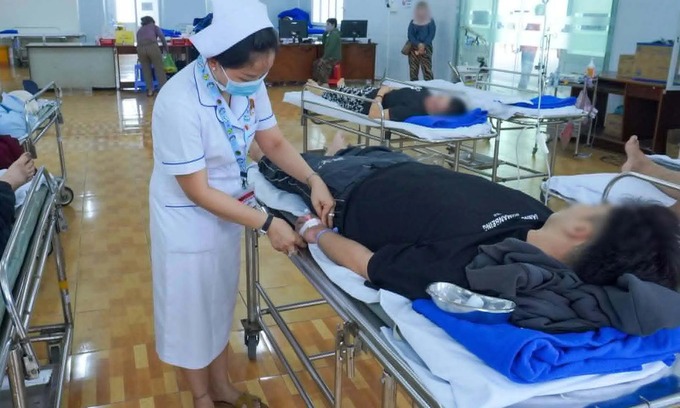
Patients with suspected food poisoning receive emergency treatment at Military Hospital 120 in Dong Thap Province, southern Vietnam, on June 18, 2026. Photo by Read/Hoang Nam |
Hong Ngoc is a major name with more than 100 outlets across the Mekong Delta, and this is the third time its banh mi has triggered mass illness. Both earlier outbreaks hit a different outlet, Hong Ngoc 12 in Hong Ngu, elsewhere in the province.
In August 2024, 149 people were sickened by salmonella traced to that outlet’s in-house liver pate, and it paid more than VND380 million ($14,400) in compensation.
Between late February and early March 2026, the same outlet sickened 86 more, again from salmonella. In April, authorities suspended it for four months, fined it VND90 million ($3,400) and ordered VND175 million ($6,650) in compensation.
Across the three outbreaks, the Hong Ngoc brand has now made roughly 470 people ill.
Patient stool samples and rectal swabs from the latest outbreak have been sent for testing, but no results have been released and the cause has not been confirmed. The Hong Ngoc 37 shop has suspended operations.
On June 18 the Food Safety Authority under the Ministry of Health ordered the Dong Thap health department to investigate urgently, trace the food source and concentrate on treatment, with explicit instructions to prevent any deaths.
The Hong Ngoc cases are part of a wider run of banh mi poisonings in southern Vietnam. A 2024 outbreak in Dong Nai Province sickened more than 560 people, and a series of incidents in Ho Chi Minh City in late 2025 affected over 300, most traced to salmonella.
Banh mi, the baguette layered with pate, cold cuts, pork roll and pickled vegetables, is the country’s most famous street food and a fixture of its tourist image. It is assembled cold and eaten without a final cooking step, which leaves it unusually exposed to bacteria when ingredients sit out in the heat.
Comments are closed.