
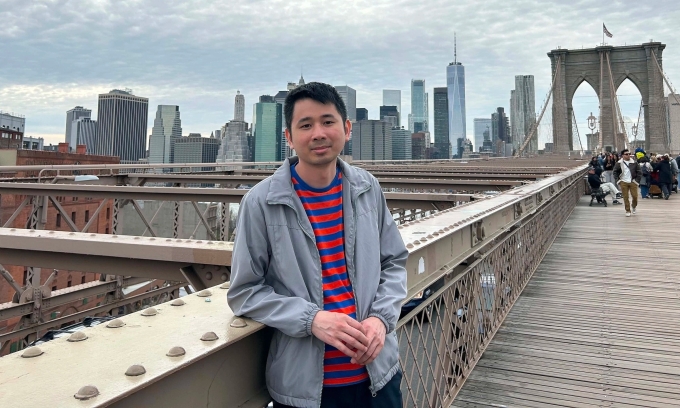
Vietnamese banker wins US PhD scholarship 3 years after landing IMF role with language hurdles

At the IMF, Hoang Huu Da, 34, tracks global economic developments, including how U.S. tariff policy and ongoing wars affect inflation and growth, and helps IMF economists develop fiscal and monetary policy recommendations for member countries. He also processes data and builds econometric models to test research hypotheses for the agency’s experts.
Before his IMF posting, Da spent nearly a decade in risk management at Vietnamese banks, holding only a bachelor’s degree. He received his UCSB admission and full scholarship offer last month.
“I’m very excited, because this is a great opportunity to train myself in how to face risk,” Da said.
Da graduated from the Faculty of Mathematical Economics at the National Economics University in Hanoi. As a student, he found the program a natural fit because it combined his favorite subject, mathematics, with probability and statistics, economics and programming. Outside class, he spent hours on knowledge-sharing websites and free online courses.
After graduating in 2014, he entered banking as a risk management specialist. The work matched his training: he gained access to large datasets and advanced statistical and econometric methods, building risk-forecasting models across industries.
His interest in teaching never faded. In 2015, Da launched a YouTube channel, “10-Minute Lessons”, on probability, statistics and economics. He wrote the scripts, designed the animations and did the voiceovers himself, setting aside one session a week for ideas and chipping away at each video over multiple days. The channel has grown to nearly 90,000 subscribers, with many videos drawing hundreds of thousands of views.
In 2022, Da published his first book, “The Art of Data-Driven Thinking”, distilling the knowledge he had been teaching. He reached out to a former professor at the National Economics University to ask her for a foreword. Published by Tre Publishing House, the book went on to win an Encouragement Prize at Vietnam’s 6th National Book Awards in 2023.
Hoang Huu Da at the International Monetary Fund headquarters in Washington, D.C. Photo courtesy of Hoang Huu Da |
That outreach also began his connection to the IMF. Impressed by his work, his former professor brought him into a research project alongside IMF experts. The deeper he went, from framing research questions to sourcing data to building models, the more engaged he became. Project members introduced him to apply for an IMF position directly. He hesitated initially, having never studied or worked abroad.
“Weighing the costs, benefits and my own risk tolerance, I saw it as the most beneficial choice, an opportunity to step out of my comfort zone and grow,” Da said. His banking experience helped him through the interview without too much pressure, and he began working in the U.S. in 2023.
The first months brought language and cultural hurdles. Da recalls awkward exchanges with colleagues who spoke too quickly, leaving him asking them to repeat themselves. He practiced English alone at home after work, used language-learning apps and made a point of initiating conversations with colleagues. After about three months, he had found his rhythm.
At the IMF, Da works alongside top economists, explores wider research questions and accesses high-quality data. The macroeconomic problems are far more ambitious than what he handled in banking.
Three years after that first research project, the experience and a recommendation from the IMF helped persuade the UCSB admissions committee. Da believes the degree will open doors to university teaching, work at international economic organizations or advisory roles at private companies.
Tran Chung Thuy, a lecturer and co-founder of the Financial Mathematics program at the National Economics University, described her former student as exceptional, with original ideas and the makings of a researcher from early on.
“Da is quiet, so people may not be impressed at first. But in a field as difficult as financial mathematics, he has persistence, drive and discipline in pursuing his own plan,” she said, noting that students who go this deep into research come along only every few cohorts.
For Da, preparation is the key to managing risk and seizing new opportunities. That means knowing yourself, including your goals and your risk tolerance, and gathering outside data to make confident, well-grounded decisions rather than relying on belief or intuition.
When learning a new topic, he says, the best approach is to study from multiple channels, including websites, podcasts and YouTube. Looking at a problem from different angles makes it easier to remember and understand deeply.
“Even though preparation is essential, young people should still embrace randomness, treat challenges as opportunities to learn, and connect with others to gain new understanding and support,” he said.
Comments are closed.