
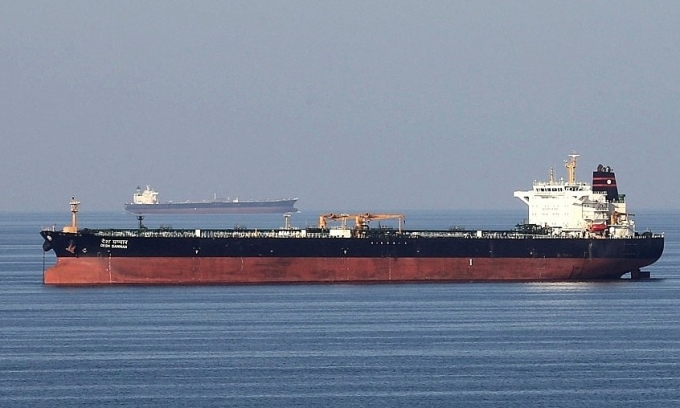

A ship seen in the Strait of Hormuz in December 2018. Photo by Reuters |
Nguyen Tien Dung, Deputy General Director of Simexco DakLak, said the Middle East is a key destination for his company’s two flagship products – coffee and pepper.
However, the conflict inflicted direct costs on trade, with spiking oil prices inflating transportation, logistics, and insurance expenses. Ocean freight rates have climbed steeply, while war-risk insurance surcharges levied by carriers have surged by up to US$2,000 per container.
Concurrent restrictions on passage through the Red Sea and the Strait of Hormuz have compelled vessels to adopt lengthy reroutes, prolonging transit times and accruing extra charges.
On product exposure, Simexco DakLak’s coffee shipments remain relatively insulated, as Middle East-bound volumes constitute only about 8% of total export revenue. Pepper, by contrast, is more vulnerable, with the region consuming up to 18% of total export volume. Any demand shock could exert near-term downward pressure on pepper prices.
The company has paused new export orders to the Middle East and several adjacent markets while tracking developments closely. It is also working with buyers to accelerate payment for goods already at ports such as Jebel Ali and Haifa. Outreach to certain Iranian partners has encountered hurdles stemming from telecommunication outages.
For cargoes already dispatched, delivered to ports or en route to transshipment hubs, the company has proactively recalled shipments to wait for more stable conditions before proceeding, aiming to minimise potential losses.
Tran Ngoc Hiep, Director of Thanh Long Hoang Hau Co., Ltd. in Lam Dong province, said dragon fruit shipments scheduled for export to the Middle East have also been put on hold due to rising logistics costs and prolonged transit times that threaten product quality. The challenge is shared by many fruit exporters, especially for those bound for the Middle East or the European Union, which must pass through affected routes and face higher costs and delivery risks.
Le Viet Anh, Secretary General of the Vietnam Pepper and Spice Association, described the Middle East as a promising market for Vietnamese spices. He urged exporters to closely monitor developments and proactively adjust production, logistics and trade plans, while seeking alternative markets with equivalent demand to mitigate potential disruptions affecting Israel, Iran and the wider region.
Dang Phuc Nguyen, Secretary General of the Vietnam Fruit and Vegetables Association (Vina Fruit), noted that during previous periods of instability, freight rates for 40-foot containers had doubled or tripled from baseline levels. War-risk premiums for Gulf-bound vessels are also advancing rapidly.
With numerous carriers diverting around southern Africa to bypass the Suez Canal, Asia-to-Europe transit times have extended by 10–14 days, imposing substantial strain on supply chains, most acutely for perishable agricultural goods.
The Ministry of Industry and Trade’s Export-Import Department advised exporters and importers to pay close attention to logistics, delivery and insurance terms when negotiating contracts.

Comments are closed.