
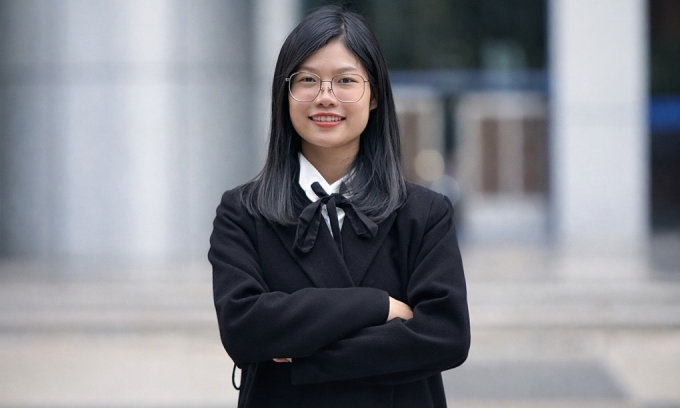

Le Thi Mai Trang, 22, from the north-central province of Thanh Hoa, is a final-year student majoring in Management Science at the National Economics University (NEU) in Hanoi.
Le Thi Mai Trang in a photo she provided. |
In late December 2025, Trang received an offer to join Tsinghua University’s interdisciplinary master’s program in artificial intelligence and innovation.
In the 2026 Times Higher Education (THE) World University Rankings by Subject, Tsinghua’s related disciplines are ranked 12th globally in Computer Science. The 2026 QS World University Rankings place the university joint 17th worldwide, while its Computer Science and Information Systems discipline ranks 11th globally in the QS subject rankings.
Trang said she overcame repeated failures and self-doubt to achieve the result, thanks to a carefully structured application with a strong interdisciplinary focus on technology, the environment, and economics –an approach she began developing systematically from her freshman year.
During high school, Trang was once obsessed with gaming. She also tried out for gifted student teams in literature, history, geography, and mathematics, but was eliminated or failed to win any awards. In her final year, despite scoring just 6 out of 20, the lowest score in her school’s Physics team to compete for the provincial exam for gifted students, she was still accepted by the teacher in charge.
The teacher encouraged her to “try her best and study with the others.” Inspired by his dedication, Trang quit gaming, focused on her studies, and went on to win a third prize at the provincial competition.
Although her family advised her to pursue economics because it was “more suitable for girls,” Trang wanted to study a field related to the natural sciences. She ultimately chose and was admitted to the Management Science program at NEU.
Before she could celebrate her admission to a top university, Trang felt overwhelmed to find that many classmates already held IELTS certificates and were studying a second foreign language. Struggling with weak English skills and a demanding curriculum, she repeatedly called home in tears, asking to transfer to another school to ease the pressure.
Her parents urged her to change her study methods rather than give up, reminding her of the effort she had invested to secure her place at NEU. Taking their advice, Trang studied intensively, actively sought help from friends and lecturers, and devoted herself to improving her English by practicing listening skills and mimicking native speakers’ intonation every day.
After her first semester, Trang earned a university scholarship and gradually regained her confidence. She then decided to pursue her long-held dream of studying abroad, which had taken shape in Grade 11, driven by a desire to see the world.
Through research, Trang learned that Tsinghua University values well-rounded candidates rather than those strong in only one or two areas. She therefore aimed to excel across the board. In addition to maintaining an outstanding GPA of over 3.9 out of 4.0, she participated in volunteer and sports activities and helped develop a logistics ecosystem for farmers. She also sat the IELTS exam and scored 7.0, overcoming her earlier insecurity about English.
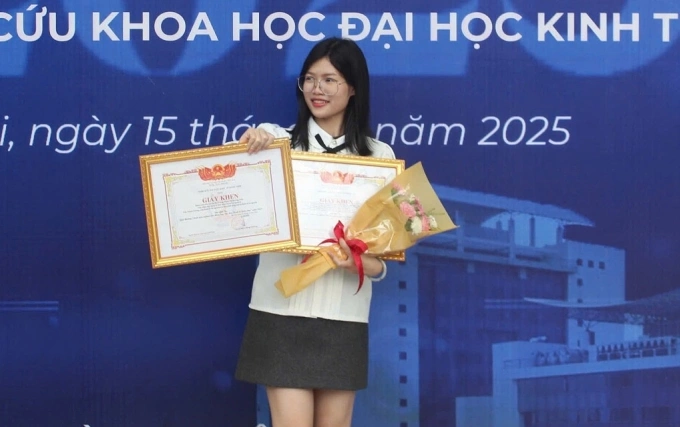 |
Le Thi Mai Trang receives a certificate of merit from the National Economics University for her scientific research achievements in 2025. Photo courtesy of Trang |
To strengthen her application, Trang conducted scientific research mainly in international trade management and sustainable development. She was responsible for data cleaning, processing datasets with appropriate tools, and analyzing results and trends. To do so, she taught herself Python and other technical skills.
After winning several university-level research awards, Trang began writing papers and submitting them to international journals but faced repeated rejections. This period proved the most challenging, as Tsinghua’s application deadline was approaching. At times, she accepted that she might no longer have a chance of being admitted.
Her spirits were lifted by encouragement from a senior student who also served as her application mentor. Realizing it would be a waste to quit after so much effort, Trang decided to apply even without international publications.
“Fortunately, I then received consecutive good news when two of my papers were accepted by Q2 journals,” Trang said.
According to Trang, the research process helped her develop logical thinking and clarify the master’s program she truly wanted to pursue.
She shared this journey in her personal statement, explaining that artificial intelligence is a defining trend of the era and that she hopes to apply AI to address challenges in economic development and environmental protection.
“All the elements of my application were aligned with this goal. I wanted to show the admissions committee that my choice of artificial intelligence and interdisciplinary innovation was not impulsive,” she said.
“Perhaps the distinctive direction of my research became a highlight in my application,” she added.
Dr. Dinh Viet Hoang, Trang’s academic advisor and research supervisor, said he was impressed by her independent and systematic thinking. He described Trang as persistent and disciplined, with a strong ability to approach problems logically, ask the right questions, and identify key research priorities.
He added that her clear learning motivation, combined with her ability to apply management thinking and interdisciplinary approaches to socio-economic issues, provided a solid foundation for her admission to Tsinghua University.
Trang is set to travel to China in August to begin her master’s program. While waiting, she is studying Chinese and foundational AI knowledge, and connecting with Vietnamese students in China and at Tsinghua University to ease her transition.
In the longer term, Trang hopes to work in digital transformation for businesses to gain practical experience before deciding whether to pursue a PhD.

Comments are closed.