
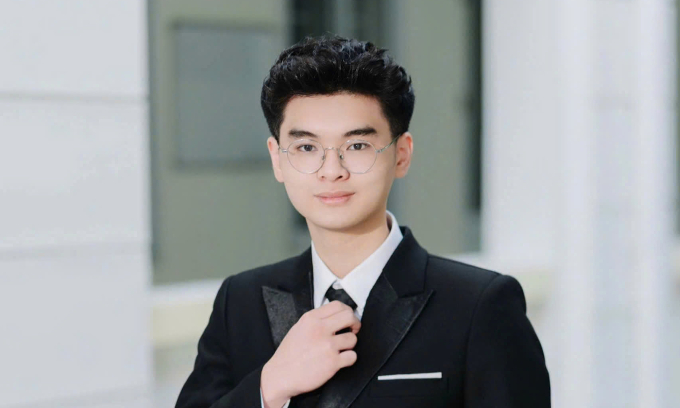

The 12th-grade informatics student at the High School for Gifted Students in Natural Sciences, part of the Vietnam National University, Hanoi, received the acceptance news in mid-February.
“I could not believe I got in,” he says. “I was rejected in the early round, so I lost some confidence.”
He plans to study computer science.
Johns Hopkins University ranked seventh in the U.S. in the 2026 rankings by U.S. News & World Report, and accepts around 6% of applicants.
It ranks among Times Higher Education’s top 16 universities worldwide.
Dang Khanh Toan provided a photo. |
Toan of Ninh Binh Province was inspired by his two older sisters, who won academic awards and later studied and worked in the U.S., and focused on his studies from a young age.
In ninth grade he won first prize in the provincial informatics competition with a perfect score of 20 out of 20.
In 2023 he passed the entrance exam to the High School for Gifted Students in Natural Sciences.
In tenth grade the school selected Toan for its national olympiad training team, but he did not win a prize.
He then decided to step away from academic competitions and focus on applying to universities abroad.
He built a strict plan and divided his goals into three groups: academic results, extracurricular activities and competitions and application essays.
At school, he broke lessons into weekly targets so he could master them gradually instead of cramming before exams. He kept his grade average at 9.6 out of 10.
He began preparing for the SAT (Scholastic Assessment Test), a standardized test widely used for college admissions in the United States, at the start of 11th grade and scored 1560 out of 1600.
He then spent a month studying for IELTS and scored 7.5. Satisfied with the result, he chose not to retake the exam and earmarked his time for other goals.
Device for grandmother
In terms of competitions and activities, he devoted the most effort to a device that measures health and environmental indicators for elderly users.
Toan developed the Eldercare Monitor project with a group of friends for WICO, the World Invention Creativity Olympics organized by the Korea University Invention Association.
When searching for ideas in February 2025 he thought about his grandmother. Because of her age and fragile health, the family had to monitor her condition often. A device that was easy to use and could track several indicators at once seemed like a practical solution. That idea became Eldercare Monitor.
The device hardware is a square panel with space large enough for a user to place one hand. The person’s blood pressure, body temperature and blood oxygen levels then appear on a website the team designed.
The system also shows environmental data such as surrounding temperature and humidity.
Toan handled the technical system. He integrated sensors, tested microcontrollers and developed the website.
He and his teammates taught themselves new skills, including web design, hardware layout, circuit programming, and sensor configuration.
The team spent four months developing the final product.
Tests on 15 elderly people from five households showed accuracy of about 95% for the main indicators.
The device went on to won a gold medal at WICO.
After the competition Toan turned back to preparing applications to U.S. universities.
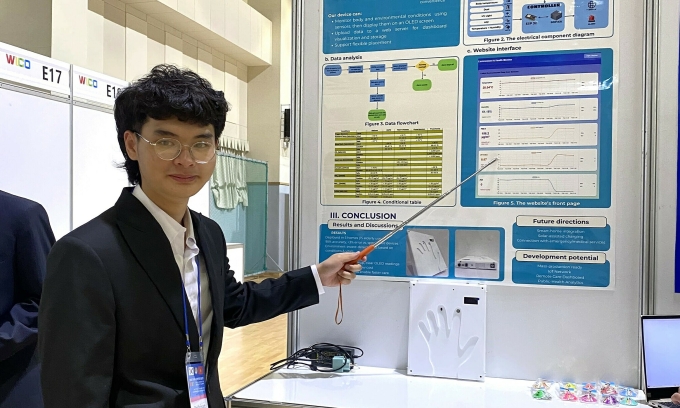 |
Dang Khanh Toan presents his health monitoring device at WICO. Photo courtesy of Toan |
He believed the device showed his strength at the intersection of technology and health, and submitted a single regular-decision application to Johns Hopkins University.
In his main essay, Toan wrote about his first months studying in Hanoi, saying living away from home for the first time made him feel like Nobita in the Doraemon comic series.
With the Internet, computers and many tools around him, he believed everything would work out. But unlike Nobita, whose stories usually end well, Toan struggled with many things, from training with the competition team to daily life.
He eventually realized that the difference did not come from Nobita’s gadgets. It came from Doraemon, who always stood beside him to guide and remind him.
The Internet can create many kinds of “magic,” but it cannot truly connect with or understand people.
Once he understood that, he began to manage himself, take responsibility and slowly become his own “Doraemon.”
For the supplemental essay, which asked about an early experience that shaped him, Toan recalled the moment he panicked after seeing unusual health readings from his grandmother on the Eldercare Monitor.
He quickly called his mother before learning the device had misread signals because it was too close to the kitchen.
That false alert pushed him to improve the device’s sensor algorithms.
It also led him to study how to narrow the gap between technologies such as artificial intelligence and real environments where people live.
Toan says he spent around two months developing ideas and completing the two essays.
The essays proved to be the hardest part, requiring reflection and careful connections to form a convincing story.
He rewrote them many times until the narrative felt clear and true to his self.
Ngo Dan Nhat Anh, an advisor at the counseling center Inception, says Toan’s approach made a technology story feel human rather than technical. And that the essays showed imagination, creativity, and thoughtful reflection.
Bui Thi Tuyet, Toan’s homeroom and math teacher in high school, says the result reflects his effort.
“Toan has strong thinking skills and creative ideas. He also has a clear study plan and a determined, persistent spirit.”
Toan is exploring specialized areas in computer science.
He plans to study some core subjects on his own so he can adapt quickly when he reaches the campus in fall this year.

Comments are closed.