
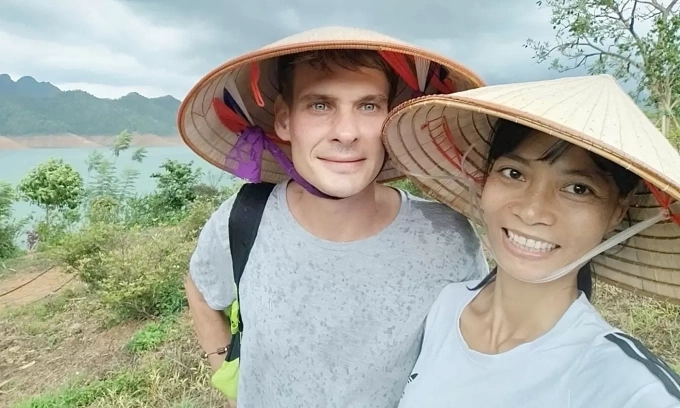

Born in the Da River reservoir area of the former Hoa Binh Province, she says she inherited “the fearlessness” common among families involved in hydropower projects.
In 2017, weary of the routine of an eight-hour office job, she quit her accounting position and moved alone to Phu Quoc Island, where she opened a homestay and seafood restaurant.
“I can sleep under bridges or at bus stations and make friends with strangers, but I’m afraid of the word ‘marriage,’” Ha, now 43, says.
Her reluctance stemmed from a deep love of freedom and a fear that her untamed personality would not adapt to life with a partner. She once told friends she planned to remain a “happily single aunt” for life.
But that plan unraveled in April 2025.
Trinh Ha (R) leads Serguei Koudriachov (L) and his friend on a hydrangea garden tour on the first day of their trip in early April 2025. Photo courtesy of Ha |
At about 3 a.m. one day, while working at her seafood restaurant on Tran Hung Dao Street in Duong Dong Ward in Phu Quoc, she noticed a group of foreign tourists outside looking lost. She approached them and struck up a conversation. With her basic conversational English and enthusiastic manner, she quickly won the group over.
“If you like nature, I’ll take you to untouched places no tour guide here knows about, and at a low price,” she offered, and the group agreed.
Later that morning she took them to a hydrangea garden, the flooded mangrove forest in Rach Vem and nearby starfish beaches.
Among the group was Koudriachov, 37, who was immediately struck by the sight of the petite woman striding confidently in front, carrying a long jungle knife “for self-defense and processing fish.” Barefaced and decisive, she was unlike any woman he had met in Paris or Moscow.
“She was wild and full of vitality, just like the island itself,” he says, and admits his heart began to race.
The turning point came after an unexpected mishap. Following a meal of grilled fish by a stream, Koudriachov suffered food poisoning and began vomiting violently. Feeling she was responsible since she recommended the dish, Ha invited him to stay in an empty room at her homestay so that she could care for him.
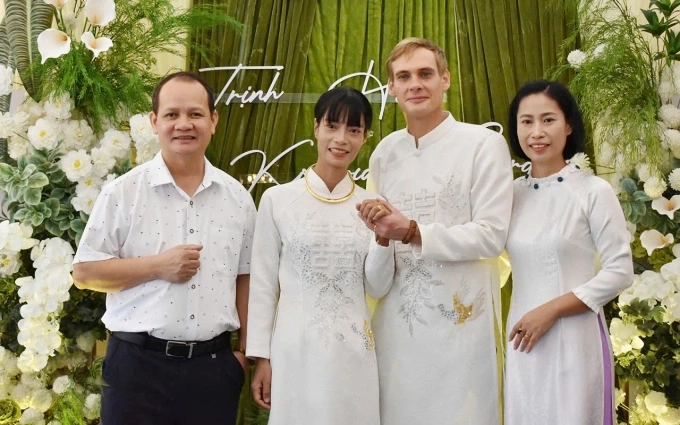 |
Trinh Ha (second from L) and Serguei Koudriachov’s (second from R) wedding in October 2025 in Ha’s hometown of Hoa Binh Province, northern Vietnam. Photo courtesy of Ha |
For two days he was bedridden, and Ha cooked porridge and bought medicines for him. Watching her being tough with staff during the day yet tenderly attentive to a stranger at night left a deep impression on him.
As soon as his fever subsided, he told her: “I’ve been searching for years, and now I know I’ve found her. I have to marry you.”
She laughed, assuming he was joking.
But he immediately made a video call to France, introducing her to his mother and grandmother as “the woman of my life.”
Only then did she hesitate.
“I’m over 40, it will be hard to have children,” she told him. “I’m in debt, my father is seriously ill. And most importantly, I don’t know how to be a proper wife.”
He replied simply: “No problem. I can handle it.”
The words from a man six years younger shook her emotional defenses. Facing someone who did not mind her financial struggles or her age, her long-standing resolve wavered.
“An unmarried man and an unmarried woman, what do we have to lose by trying?” she thought, and agreed to give love a chance, something she had long sworn to avoid.
She did not expect that tentative decision to turn into a lifetime commitment just one week later.
That day she was rushing to the market to prepare dinner after unexpected guests arrived. Koudriachov suddenly stepped in the way, blocked her motorbike, pulled a ring from his pocket, slipped it onto her finger, and declared: “That’s it. From now on, you belong to me.”
Instead of being swept away, she nodded briskly.
“Fine. Ownership accepted. But I have to go to the market now.”
Their whirlwind romance, it turned out, was bound by coincidences from the past. Koudriachov’s grandfather had once worked at the Hoa Binh hydropower plant, Ha’s birthplace, while Ha’s father had studied in Russia.
For Koudriachov, the trip also fulfilled a promise he had made to himself a decade earlier after visiting Phu Quoc.
“I loved this place so much that I promised myself I would come back to see how it had changed, and, if possible, belong to it,” he says.
In October 2025 they held a simple wedding.
The bride wore a rented ao dai costing VND600,000 (US$23) and stood beside her groom, and both families gathered to witness the ceremony.
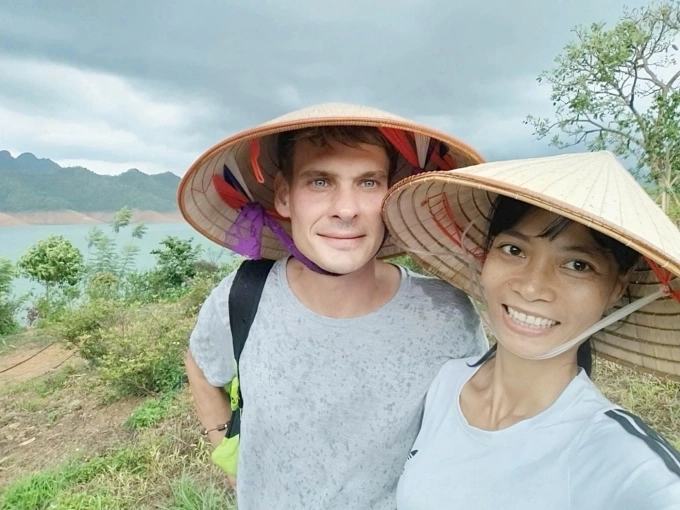 |
Trinh Ha (R) and her husband Serguei Koudriachov in Phu Quoc, 2025. Photo courtesy of Ha |
Married life has become a journey of blending cultures. Having previously worked as a manager at a five-star hotel in France, Koudriachov introduced professional service standards to his wife’s homestay, from towel folding to floor cleanliness. He learned Vietnamese habits, such as eating fried eggs with skunk vine and chewing guava buds to soothe a stomach ache.
What Ha values most is not her husband’s professional skills, but his compassion. Whenever he sees elderly lottery vendors or people selling birds for ceremonial release, he stops to help.
Now the couple are building a new homestay together in Phu Quoc.
In their small kitchen, he makes coffee each morning and gently wakes his wife. She has come to realize that “getting married is not putting a yoke around your neck.”
“I’m still a free woman,” she says. “But I’ve found a place to belong.”

Comments are closed.