
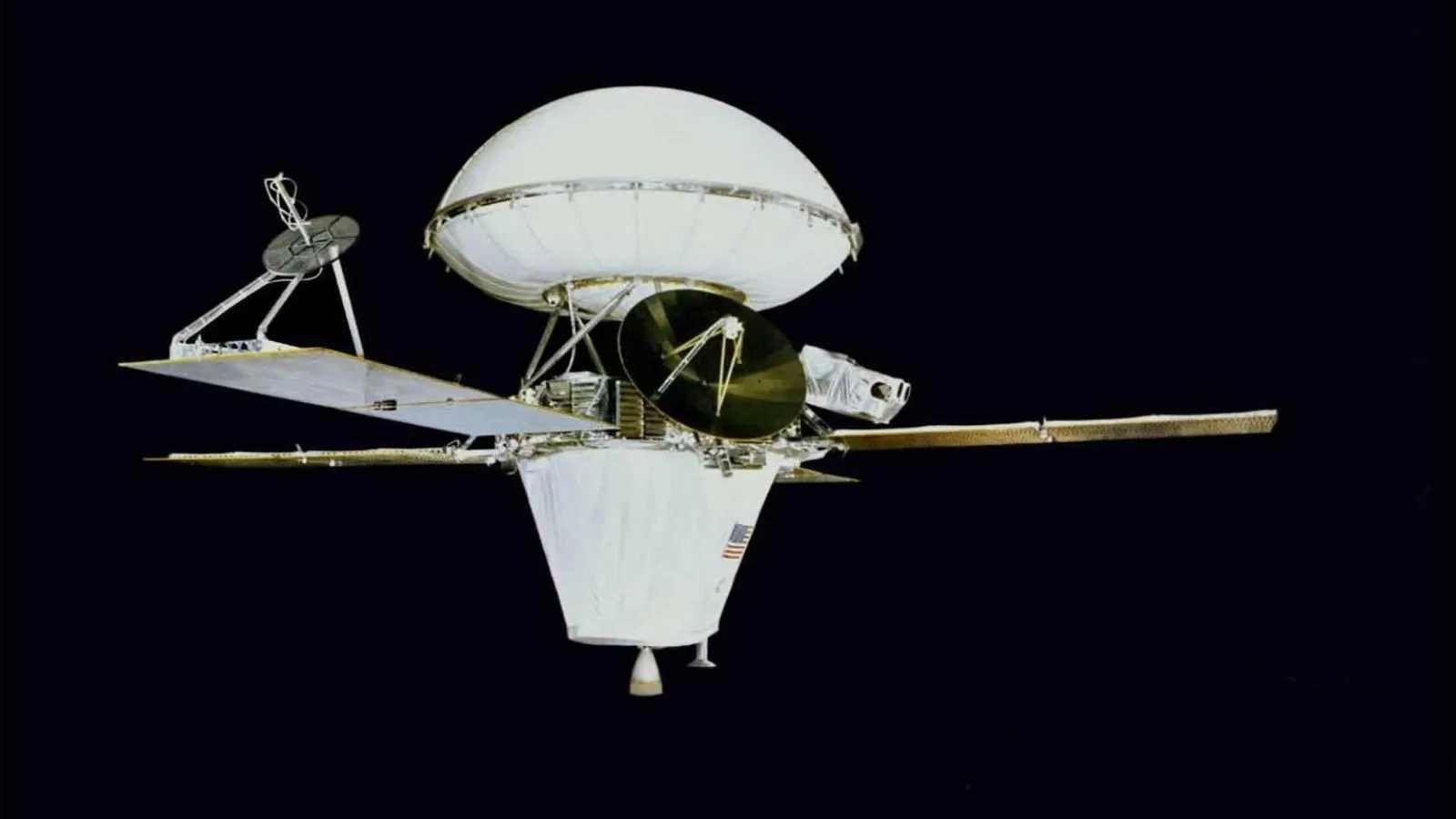

Fifty years after Nasa’s Viking 1 became the first spacecraft to land on Mars successfully, scientists are still divided over one of its biggest unanswered questions: Did it actually detect signs of microbial life?
The Viking 1 lander touched down in Chryse Planitia on July 20, 1976, followed by Viking 2 at Utopia Planitia later that year. Together, the twin missions carried out the first experiments designed to directly search for life on the Martian surface by collecting and analysing soil samples.
Although the mission was widely regarded as having found no evidence of life, some researchers continue to argue that the data may have been misinterpreted.
Why Viking’s results remain controversial
Viking carried three life-detection experiments alongside a gas chromatograph-mass spectrometer (GCMS), which searched for organic molecules in Martian soil. While one biological experiment produced results consistent with microbial activity, the GCMS failed to detect organic compounds, leading most scientists at the time to conclude that Mars was lifeless.
However, several researchers believe that conclusion may have been premature.
Some scientists still believe Viking detected life. Gilbert Levin, the principal investigator behind Viking’s Labeled Release experiment, maintained until his death in 2021 that his instrument had successfully detected living microorganisms in Martian soil.
Steven Benner, an astrobiochemist and author of the upcoming book Meet the Neighbors: Life on Mars and How to Find It, also argues that the mission’s biological data were dismissed too quickly.
According to Benner, Viking “more likely than not found autotrophic microbial life on Mars, roughly 1,000 cells per gram,” suggesting that the GCMS findings overshadowed the biological evidence.
Alternative explanations
Not everyone agrees with that interpretation. Ben Clark, a member of the original Viking science team, said the positive biological response could also be explained by unusual Martian minerals rather than living organisms. He also noted that Viking’s experiments may not have used the right nutrients to detect microbes that rely on hydrogen or sulfate-based chemistry.
Clark added that more recent Mars missions have identified organic molecules and geological features that some researchers interpret as possible signs of ancient biological activity, although none provide definitive proof of life.
Viking data still shapes Mars exploration
Scientists say Viking’s findings remain highly relevant even after five decades. Rachel Tillman, founder of the Viking Mars Missions Education and Preservation Project, said preserving the mission’s engineering records and scientific data is essential because each Mars mission contributes another piece to understanding the Red Planet.
Barry DiGregorio, an honorary research fellow at the Buckingham Centre for Astrobiology, also emphasised that Viking’s strict sterilisation procedures make its biological experiments especially valuable when compared with more recent missions, where contamination from Earth’s microbes is a growing concern.
As Nasa and other space agencies prepare future missions aimed at directly searching for life beneath Mars’ surface, the debate surrounding Viking’s results continues to influence how scientists design experiments and interpret evidence from the Red Planet.

Comments are closed.