
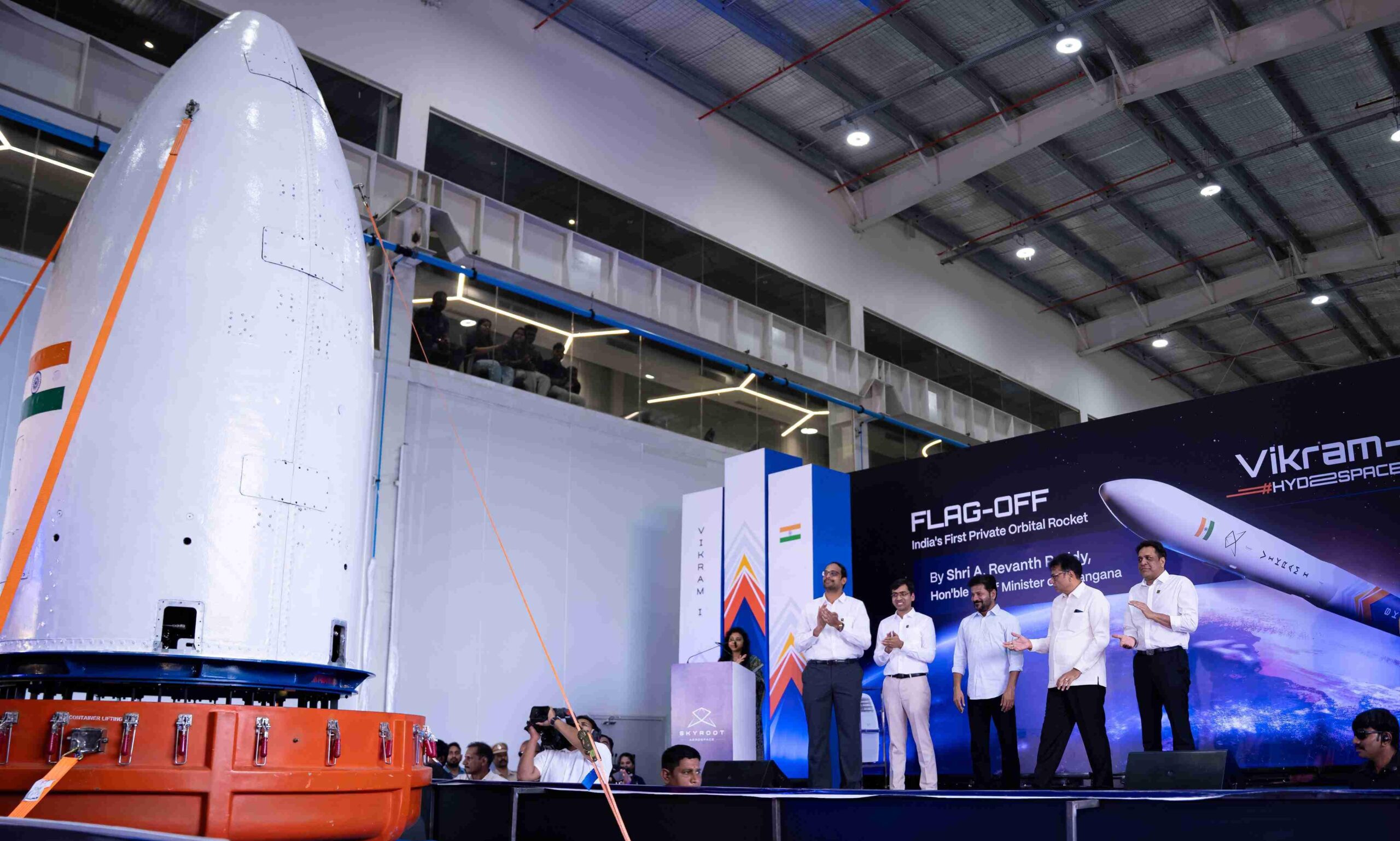

In a major boost to India’s private space sector, the Vikram-1 rocket hardware on Saturday (April 25) began its journey from Hyderabad to the Satish Dhawan Space Centre in Sriharikota, Andhra Pradesh, marking a key step towards its maiden orbital launch.
The launch vehicle was flagged off from the Max-Q campus of Skyroot Aerospace, a Hyderabad-based space-tech startup, in the Telangana capital by the state’s chief minister, Revanth Reddy. The rocket, designed in the city, will see its integration and launch in Sriharikota, with a tentative launch window expected around June, subject to clearances. Telangana IT Minister D Sridhar Babu and other dignitaries were also present on the occasion.
Why is Vikram-1 launch significant?
Vikram-1 is India’s first privately developed orbital-class launch vehicle, built to carry small satellites into low Earth orbit. It is a 20-23 metre tall rocket made with a lightweight carbon-fibre structure and powered by a mix of solid and liquid propulsion systems, including advanced 3D-printed engines. The vehicle is designed to carry payloads of around 350 kilograms, making it suitable for communication, Earth observation, and research missions.
Also read: ISRO plans to send astronauts to Moon by 2040
The startup confirmed that major pre-launch milestones have already been completed. Most notably, Vikram-1 successfully cleared the Integrated Electrical Test (IET) Campaign Phase 3, considered one of the most critical stages before launch. This phase brought together the rocket, ground software, and electrical systems to function as a single integrated unit for the first time.
Vikram-1 is headed to the spaceport. 🚀
Today, Hon’ble Chief Minister of Telangana, Shri A. Revanth Reddy garu (@TelanganaCMO, @revanth_anumula) flagged off Vikram-1 from our Max-Q campus in Hyderabad, marking the completion of the pre-flight integrated test campaign.
Grateful… pic.twitter.com/MCcoYl6FA4
— Skyroot Aerospace (@SkyrootA) April 25, 2026
During the tests, engineers verified system responses under simulated launch conditions. Sensors, actuators, and control systems were checked for accuracy, while team coordination was also rehearsed to match real launch-day scenarios. These steps ensured that all systems operate smoothly as one cohesive platform.
Broader plan
The rocket is part of Skyroot’s broader plan to offer cost-effective, flexible, and responsive launch services for the fast-growing global small satellite market. The company aims to enable quicker launch turnarounds and reduce costs, addressing increasing demand worldwide.
Named after Vikram Sarabhai, the pioneer of India’s space programme, Vikram-1 represents a significant step forward for private participation in space. The mission builds on the success of Vikram-S, a suborbital rocket launched in November 2022, which made Skyroot the first private company to launch a rocket from the Indian Space Research Organisation (ISRO) facility.
Also read: PM Modi inaugurates Skyroot campus, unveils Vikram-I rocket
Skyroot Aerospace, founded by IIT alumni and former ISRO scientists Pawan Chandana and Naga Bharat Daka, has developed the rocket over four years with a focus on affordability and rapid deployment. The effort comes as India opens up its space sector to private players through regulatory reforms led by ISRO and the Indian National Space Promotion and Authorisation Centre (IN-SPACe), encouraging startups to participate in commercial space activities.
Commercial space sector
Despite the progress, the company has not announced a final launch date. Industry observers note that final system checks and regulatory approvals will determine the exact timeline.
Also read: ISRO gives a glimpse of Bharatiya Antariksh Station: Check details
If the mission succeeds, Vikram-1 will become India’s first privately developed rocket to achieve orbit, marking a significant step forward for the country’s commercial space sector.

Comments are closed.