
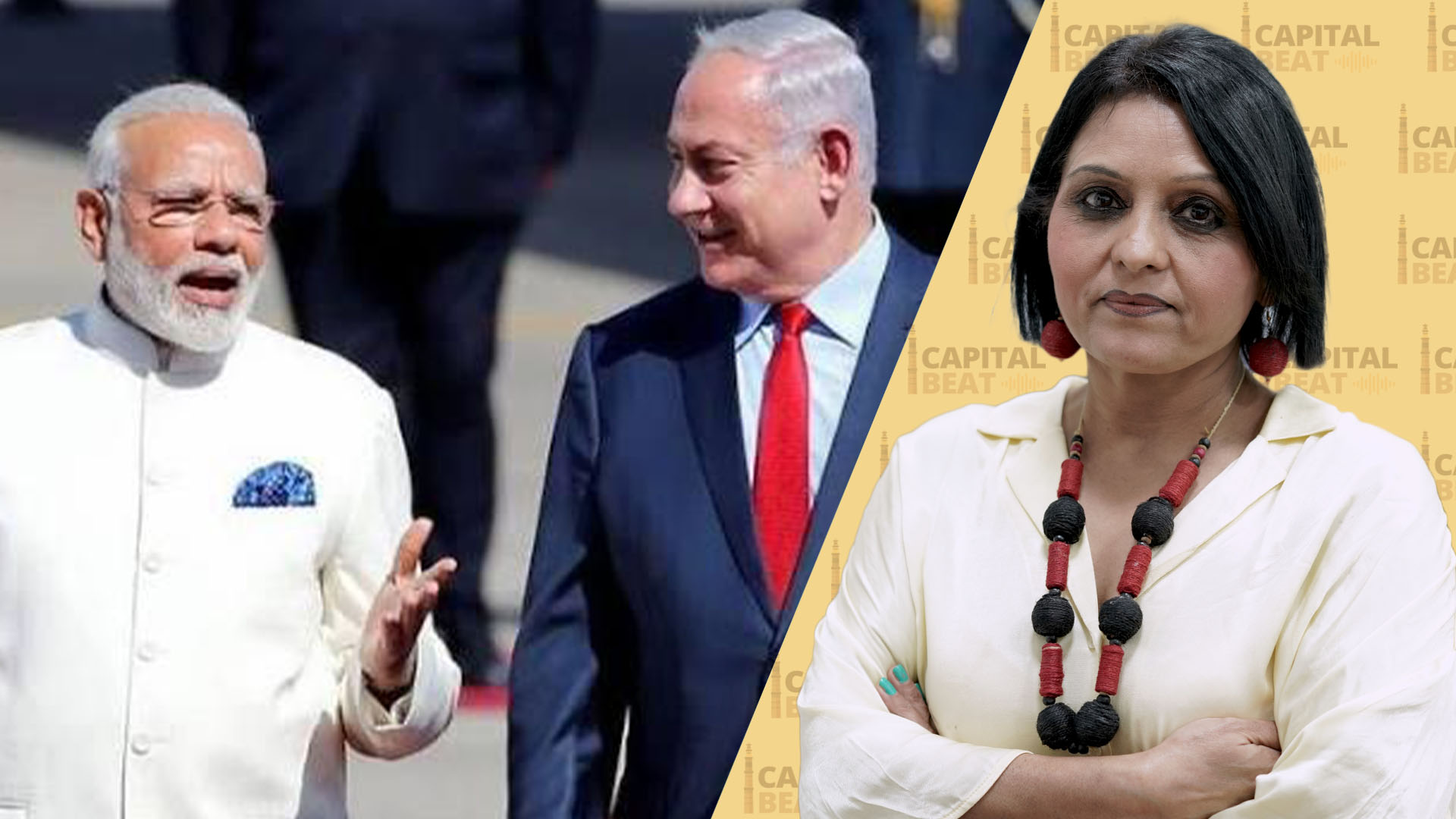

Former diplomat KP Fabian, senior journalist Kallol Bhattacharya, international relations expert Shubhda Chaudhary, author and political expert Pushparaj Deshpande, and independent security analyst General Ashok Mehta (retd) discussed Prime Minister Narendra Modi’s two-day visit to Israel in this episode of Capital Beatfocusing on the timing of the trip, the proposed “hexagonal alliance”, and the future of India-Israel strategic ties.
The visit included an address to the Knesset, making Modi the first Indian prime minister to do so. In his departure statement, Modi described India and Israel as sharing a “robust and multifaceted strategic partnership” and noted that ties had “significantly strengthened in the last few years”.
The panel examined whether the trip signals a strategic and ideological reset between India and Israel, particularly against the backdrop of tensions in West Asia and global discussions around a possible escalation involving Iran.
Departure statement and political reactions
In his statement before departure, Modi said he would hold talks with Israeli Prime Minister Benjamin Netanyahu and meet President Isaac Herzog. He described his address to the Knesset as “a tribute to the strong parliamentary and democratic ties that connect us”.
Modi also said he would interact with the Indian diaspora in Israel, acknowledging their contribution to strengthening bilateral ties. The visit comes amid heightened global attention on West Asia and discussions of regional alignments.
Also Read: PM Modi gets red carpet welcome as he begins his second visit to Israel in 9 years
The debate was further sharpened by a public message from Priyanka Gandhi, who expressed hope that Modi would raise the issue of “the genocide of thousands of innocent men, women, and children in Gaza” during his address to the Knesset and demand justice.
‘Inflammable region’
KP Fabian described the visit as “important for both India and Israel”, while cautioning against what he termed “a certain convolutedness” among commentators who “try to accelerate the importance of the visit”.
Referring to tensions involving Iran, Fabian posed a central question: “Is Prime Minister Modi going to tell his host that any idea of having a war, limited or otherwise, with Iran will be dangerous and irresponsible?”
Also Read: PM Modi on Israel visit: Confident my trip will consolidate ‘enduring bonds’
He added that if America were to attack Iran, retaliation could extend to Israel and Gulf Cooperation Council countries hosting American bases, setting “fire to an inflammable region”.
Fabian underlined India’s interest in peace in the region, noting that millions of Indians live there. Citing Modi’s earlier words that “this is not an era of war”, Fabian said it would be important to see what message India conveys during the visit.
‘Morally and legally wrong’
On Palestine, Fabian stated that Israel must respect its obligations under international law. He described the annexation move in the West Bank as “morally and legally wrong”.
He also referred to India’s evolving position at multilateral forums, noting that New Delhi eventually joined broader condemnation efforts after initially refraining.
“Let us see whether India will carry its message in a meaningful way,” he said.
Also Read: India, Israel begin first round of FTA talks ahead of PM Modi’s visit
On defence ties, Fabian said bilateral defence relations “will be deepened and broadened”, adding that both leaderships “want to get closer and closer for reasons to do with defence relationship”.
‘Hexagon of alliances’ proposal
The discussion turned to remarks made by Netanyahu on February 22 about a proposed “hexagon of alliances” across the Middle East and beyond. The concept includes India, Arab nations, African nations, Mediterranean countries such as Greece and Cyprus, and unspecified Asian countries.
Netanyahu described the aim as creating “an axis of nations that see eye to eye on the reality, challenges, and goals against the radical axis”, referring to both “the radical Shia axis” and “the emerging radical Sunni axis”.
Fabian said Israel is exploring alternative regional corridors and alignments, and questioned how far India would cooperate within such a framework.
Also Read: Can Modi maintain ‘balance’ in India’s ties with Arabs, Israel?
Shubhda Chaudhary described the “entire façade of the hexagonal alliance” as not new and questioned its domestic legitimacy within Israel and Arab countries. She referred to proceedings at the International Criminal Court and said Netanyahu “has arrest warrants against him”.
Chaudhary raised questions about diplomatic protocol, asking why the visit was first announced by Netanyahu and not by India. She also questioned why Netanyahu did not travel to India.
She cited reports of Indian workers facing difficulties in Israel and asked why the government had not taken cognisance.
“Why did no one take cognisance of the fact that the torture was done?” she asked, adding that India has a large diaspora in Israel, including health professionals and students.
Defense technology, Atmanirbhar Bharat
On defence cooperation, Chaudhary questioned the implications of reported transfers of the Iron Dome and Iron Beam systems. She asked, “What about our own legitimacy and sovereignty of Atmanirbhar Bharat?”
She said questions remain over source codes and upgrade mechanisms in defence deals.
“Why are we selling the entire sovereignty of our defence system?” she asked.
Chaudhary also questioned India’s response to regional developments following the October 7 attacks, and referred to differences between statements made by the Prime Minister and those issued later by the Ministry of External Affairs.
India’s non-alignment position
Pushparaj Deshpande said Greece and Cyprus, which are part of the proposed alliance, are members of the International Criminal Court. He asked whether such countries would endorse arrest warrants or reconsider their ICC commitments.
He also raised concerns about the timing of the visit amid a significant military build-up in the region. Referring to India’s historical position, he said the country has followed a “Nehruvian consensus around non-alignment” for 75 years.
Also Read: India signs UN statement condemning Israel’s West Bank actions
Deshpande said, “Either way, all of them mandate that you mediate and you call for peace.” He noted India’s long record of contributing peacekeepers to United Nations missions.
Incidents involving Indian workers in Israel
Deshpande said India must separate Israel as a state from the political leadership currently in power. He reiterated India’s support for a two-state solution and said this position should be raised during high-level meetings.
He questioned why alleged incidents involving Indian workers in Israel had not been addressed publicly with the same intensity as other overseas concerns.
“Why is this government not speaking for Indians?” he asked.
He also said Parliament should debate whether India has shifted from non-alignment and whether relations with countries such as Iran, Qatar, Turkey, Lebanon, and Syria could be affected.
Air defence systems
General Ashok Mehta said he had visited Israel multiple times and had previously admired its counter-terrorism doctrines. He described himself as “a transformed man now”, citing what he called a shift in Israel’s conduct of war.
Mehta questioned the timing of the visit, noting that advisories had been issued for Indians in the region even as the Prime Minister travelled there.
Also Read: India’s Israel embrace rooted in history, ideology, and arms deals, says S African author
On air defence systems, he clarified that “there is no such thing as Sudarshan Chakra” as a single system, describing it instead as an integration of layered air defence components, similar to Israel’s Arrow, Iron Dome, Iron Beam, and David’s Sling systems.
He said Israel is unlikely to provide “complete 100 per cent transfer of technology”, noting that earlier transfers such as Green Pine technology were exceptions.
Mehta also questioned how a system designed for a country the size of Israel could be scaled to India’s geography, and asked how this aligned with the policy of Atmanirbhar Bharat.
(The content above has been transcribed from video using a fine-tuned AI model. To ensure accuracy, quality, and editorial integrity, we employ a Human-In-The-Loop (HITL) process. While AI assists in creating the initial draft, our experienced editorial team carefully reviews, edits, and refines the content before publication. At The Federal, we combine the efficiency of AI with the expertise of human editors to deliver reliable and insightful journalism.)

Comments are closed.