
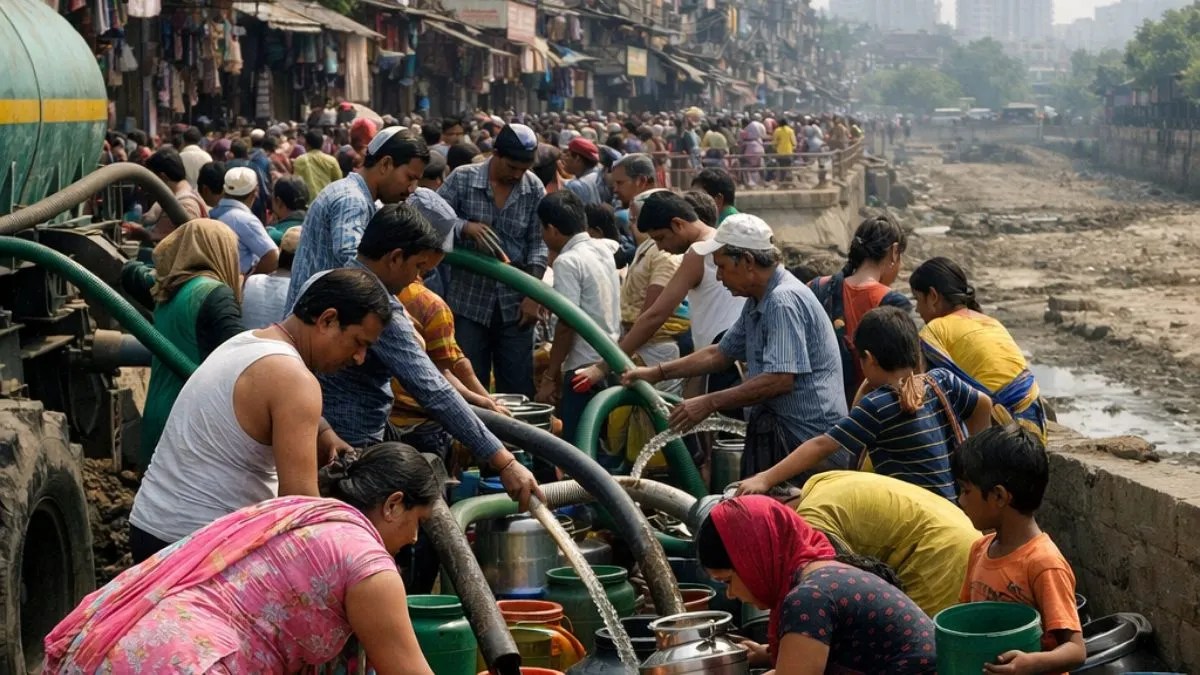
Water crisis begins to deepen in metropolitan cities, problems of more than 40 percent population will increase by 2030…Big revelation in the report

New Delhi: Behind the glamor of India’s big cities, there is a horrifying reality hidden – ‘water disaster’. The predictions made by the recent reports of NITI Aayog and Stanford University about India are no less than a nightmare. Researchers claim that if the situation does not improve, by the year 2030 India’s population will be almost 40 percent population Will yearn for every drop of clean drinking water. Metros like Delhi, Bengaluru and Chennai have now topped the list of most water-stressed areas in the world.
Pictures of Bengaluru and Chennai shocked, now the crisis is ‘permanent’
Some time ago, pictures of thousands of people waiting for tankers with empty vessels on the streets of Bengaluru had caught the attention of the whole world. Earlier in 2019, Chennai had also seen a ‘Day Zero’ like situation. Experts believe that now this problem is not limited to summer heat only, but permanent urban crisis It has been made. Uncontrolled groundwater extraction and rapidly disappearing ponds have dried up the sources that quench the thirst of cities.
Half the world will be thirsty by 2050, it will be a heavy burden on pockets
According to global projections, by the year 2050, half of the world’s urban population will be vulnerable to severe water shortages, with Indian cities likely to have the highest number. According to a study by Stanford University, in the coming times, low-income families will have to reduce their total income. 20 percent share You may have to spend only on purchasing water. That means ‘water’ is going to be more expensive than bread and clothes.
Pune Model: Will farmers quench the thirst of cities?
Amidst this dire crisis, Stanford researchers have presented a revolutionary solution in ‘Earth’s Future Journal’. Based on a study from Pune city, it has been suggested that if farmers are allowed to legally sell their excess irrigation water through the urban tanker network, the cost of water could be reduced significantly. The report says that with the right policies the total water supply could be reduced by only 1% increase Even after doing this, every urban person has to face daily 40 liters of water can be ensured.
Dilapidated infrastructure and borewells become a mess
Nature alone is not responsible for the urban water crisis. Our dilapidated pipelines, which waste crores of liters of water due to leakage, and indiscriminately dug borewells are the main villains of this problem. The water level has gone so deep that even borewells have started failing in many areas. In such a situation, rain water harvesting and effective water management is the only way left, otherwise the future war will be fought for ‘water’.

Comments are closed.