

The United States could be edging closer to a major military confrontation with Iran, with a sustained campaign potentially beginning soon, Axios reported on Wednesday, citing sources familiar with the matter.
Report flags possible week-long military campaign
According to the report, any US strike would likely resemble a prolonged, weeks-long military campaign rather than a short, targeted operation like the one conducted in Venezuela last month. Sources told Axios that Washington could pursue a joint US-Israeli operation, possibly broader in scope than the 12-day war last June.
Add Zee News as a Preferred Source
Nuclear talks amid rising tensions
The report comes amid heightened tensions following the second round of nuclear talks between the United States and Iran, which concluded in Geneva on Tuesday. US envoys Steve Witkoff and Jared Kushner, son-in-law to President Donald Trump, met Iranian Foreign Minister Abbas Araghchi for high-stakes negotiations. While both sides described the discussions as constructive, several sources told The Jerusalem Post that significant gaps remain.
A US official said progress had been made but acknowledged that key differences persist.
“Progress was made, but there are still a lot of details to discuss. The Iranians said they would come back in the next two weeks with detailed proposals to address some of the open gaps in our positions,” the official said.
Iran is expected to return within two weeks with more detailed proposals aimed at narrowing those differences.
US military build-up in the region
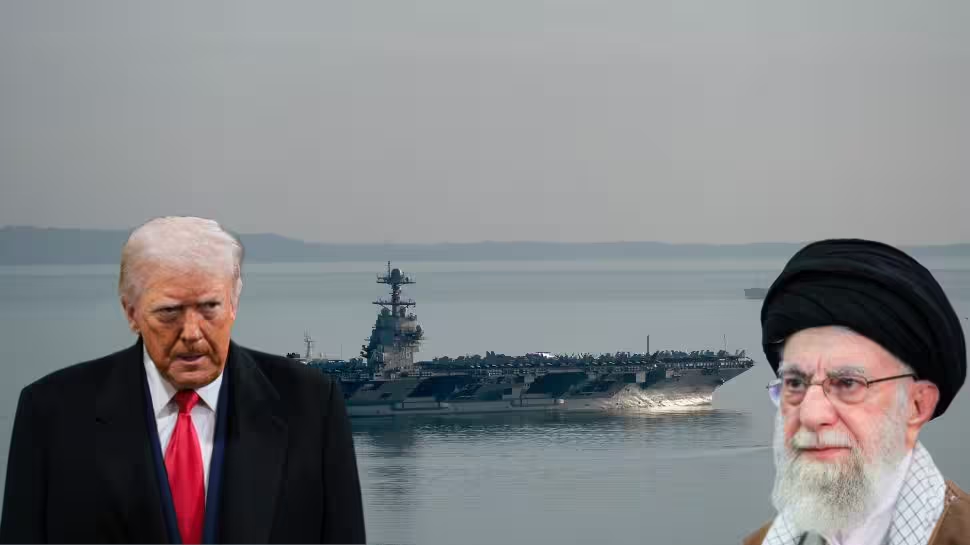
Even as diplomatic efforts continue, Washington has increased pressure on Tehran while steadily expanding its military footprint in the region. The buildup reportedly includes the deployment of two carrier strike groups to the Middle East, with the USS Abraham Lincoln already on station and the USS Gerald R. Ford en route. They are supported by more than a dozen warships operating in the Persian Gulf and Arabian Sea.
In addition, over 50 fighter jets, including F-22s, F-35s, and F-16s, have recently arrived, reinforcing the hundreds of aircraft already positioned at sea and at regional bases. Air defense assets such as THAAD and Patriot missile systems have also been deployed to strengthen protective capabilities.
Since late January, flight-tracking data indicates that more than 250 US cargo flights have transported weapons, equipment, and supplies into the region, underscoring the scale of the ongoing military buildup.
War of words between Trump and Khamenei
Ahead of the Geneva talks, both sides engaged in strong rhetoric. President Donald Trump warned of the “consequences of not making a deal” and urged Iran to be “reasonable” in the next round of negotiations, referencing the June 2025 B-2 bomber attack as a reminder of US military capability.
Iranian Supreme Leader Ayatollah Ali Khamenei responded with a sharp warning of his own, challenging Trump’s repeated claims of American military supremacy.
“The US President keeps saying that they have the strongest military force in the world. The strongest military force in the world may at times be struck so hard that it cannot get up again,” Khamenei said in a series of posts on
Referring to the increased US naval presence, Khamenei added:
“The Americans constantly say that they’ve sent a warship toward Iran. Of course, a warship is a dangerous piece of military hardware. However, more dangerous than that warship is the weapon that can send that warship to the bottom of the sea,” he noted.
Background: The 2015 nuclear deal collapse
The current tensions are rooted in the collapse of the 2015 Joint Comprehensive Plan of Action (JCPOA), signed between Iran and world powers, including the United States. Under the deal, Tehran capped uranium enrichment at 3.67 per cent and reduced its stockpile to 300 kilograms. The agreement unraveled in 2018 after Trump withdrew the US unilaterally, setting the stage for years of escalating friction between Washington and Tehran.

Comments are closed.