
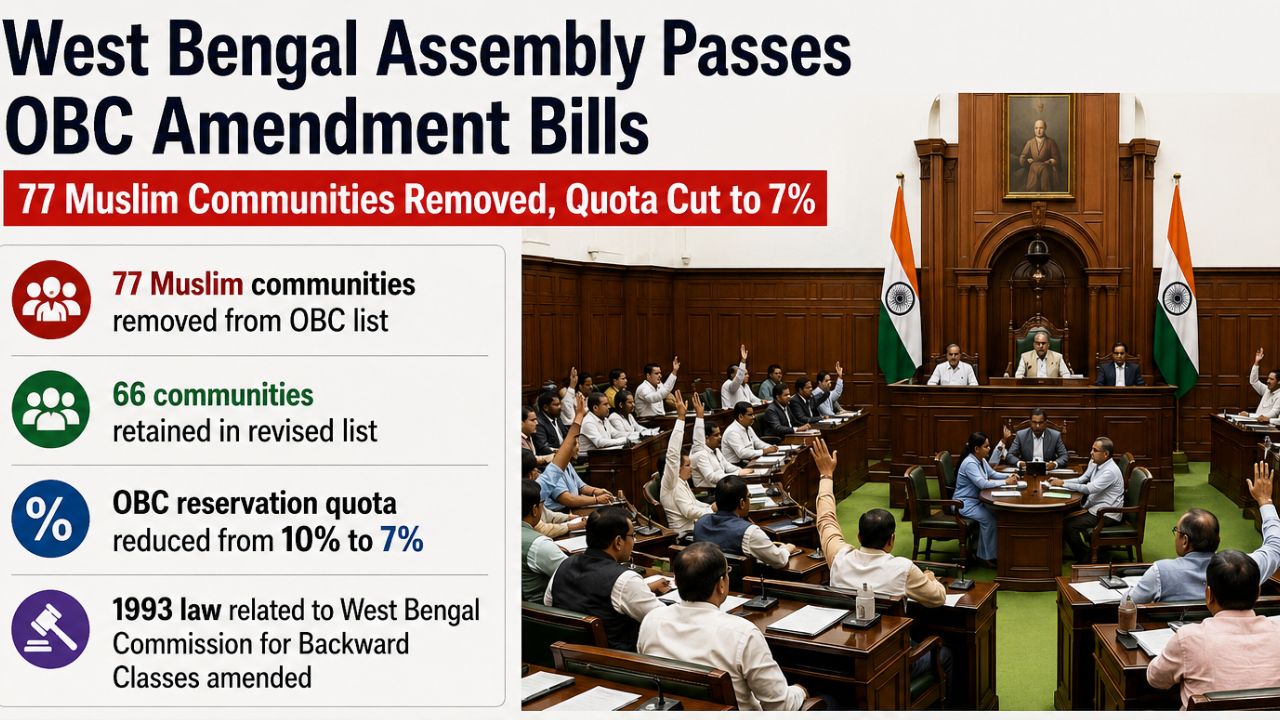
West Bengal Assembly passes OBC amendment bills, 77 Muslim communities out of reservation list

Kolkata: The West Bengal Legislative Assembly on Monday passed two amendment Bills revising the state’s Other Backward Classes (OBC) reservation framework, formally implementing changes following a 2024 Calcutta High Court order.
The amendments remove 77 Muslim communities from the OBC list, retain 66 approved communities and reduce the OBC reservation quota from 10 per cent to 7 per cent.
Assembly Approves OBC Law Amendments
The House passed the West Bengal Backward Classes (Other than Scheduled Castes and Scheduled Tribes) Reservation of Vacancies in Services and Posts (Amendment) Bill, 2026, and the West Bengal Commission for Backward Classes (Amendment) Bill, 2026.
The legislation was introduced by Backward Classes Development Minister Gourishankar Ghosh, who said the amendments were necessary to comply with the Calcutta High Court’s directions and ensure that future inclusion of communities in the OBC list is based on proper surveys conducted by the State Backward Classes Commission.
Reservation Quota Revised
Under the amended law, the OBC reservation quota has been reduced from 10 per cent to 7 per cent. The state government said only 66 communities that were identified following two surveys have been retained in the revised OBC list.
The amendments also seek to strengthen the role of the West Bengal Commission for Backward Classes in evaluating claims for reservation and preventing the issuance of ineligible OBC certificates.
Background of the Changes
The changes follow a May 2024 judgment of the Calcutta High Court, which set aside the inclusion of 77 Muslim communities in the OBC list, holding that the process had not followed the required legal procedure.
Following the court’s ruling, the state government issued a notification in May 2026 implementing the revised OBC list. The bills passed on Monday provide the legislative backing for those changes.
Political Debate Continues
During the Assembly debate, the government maintained that the amendments were intended to ensure transparency and compliance with judicial directions.
The legislation was passed with 186 MLAs voting in favor and 17 against. The move is expected to have a significant impact on the state’s reservation framework while remaining subject to future reviews by the Backward Classes Commission.

Comments are closed.