
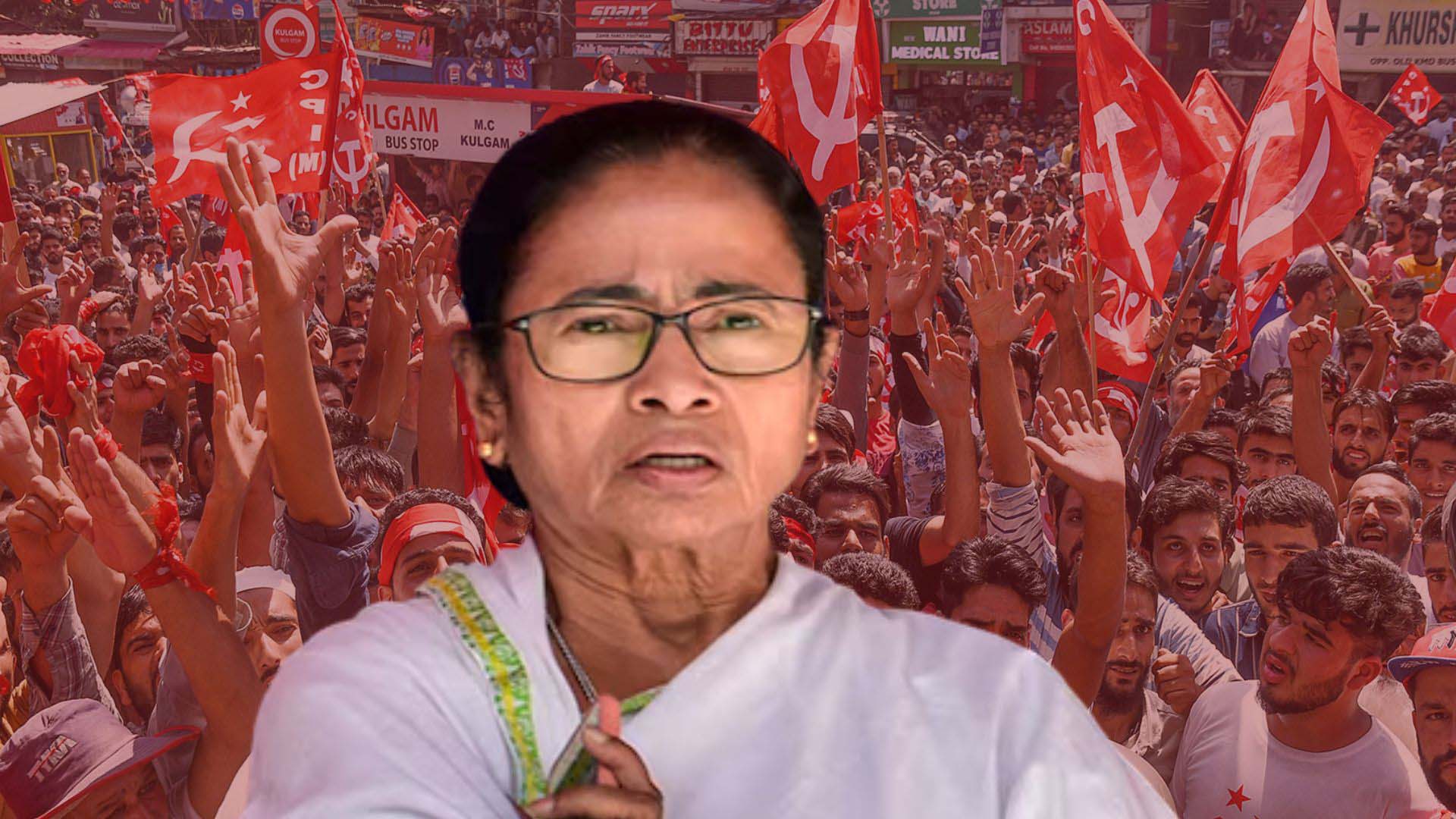

The Left Front, once a dominant political force in West Bengal for 34 uninterrupted years, has witnessed a steep decline since it was voted out of power in 2011. As another round of state elections approaches, the pressing question remains whether the Left, spearheaded by the Communist Party of India or CPI(M) can recover even a fraction of its lost influence.
Also read: Mamata’s ‘I am the candidate’ gambit returns for 2026 Bengal battle
Despite all the pre-election noise, the alliance faces an uphill task against formidable rivals—Bengal’s ruling Trinamool Congress (TMC) and the Bharatiya Janata Party (BJP), the current principal Opposition party in the state.
It’s easier said than done, as the Left struggles to match the scale and strength of its competitors.
There are quite a few reasons why the Left today is a pale shadow of what it was in its heyday.
Leadership crisis
The Left’s decline begins with its weakening leadership and organisational structure. Once known for its disciplined cadre and robust leadership, the current setup lacks the steam to take on any formidable opponent.
While towering leaders such as Jyoti Basu and Buddhadeb Bhattacharjee led Bengal’s Left government once, organisational stalwarts such as Pramode Dasgupta, Anil Biswas, Sailen Dasgupta, and Biman Bose, among others, formed its backbone. Subhash Chakraborty, a former minister, was as influential a vote-catcher.
Also read: From ‘Didi-o-Didi’ to welfare push, softer tone, cultural reset: BJP reworks Bengal playbook
With most of them dead and Biman ailing, the once-efficient party machinery has significantly weakened.
Voter shift
Equally damaging has been the steady erosion of the Left’s voter base. As the TMC consolidated power, many traditional Left supporters shifted allegiance to the BJP, viewing it as a stronger challenger to the rule of Chief Minister Mamata Banerjee.
Senior CPI(M) leader Ashok Bhattacharjee, a former state minister who has been the Left’s most prominent face from north Bengal, recently acknowledged this concern, warning against a repeat of such shifts in the upcoming elections, in the presence of the current state secretary of the CPI(M) in Bengal, Mohammed Salim.
To give some figures, in 2011, the year it lost power, the Left’s vote share was still more than 40 per cent. It fell to around 21 per cent in the 2016 state elections. In the 2021 state polls and 2024 Lok Sabha polls, it went down further to reach around five per cent. The BJP’s corresponding growth to around 40 per cent in the 2019 and 2024 Lok Sabha elections and the 2021 state polls proves how much the Opposition votes have shifted.
Alliance gap
The absence of a strong alliance has further constrained the Left’s prospects. Unlike in the 2016 and 2021 elections, there is no tie-up with the Congress this time.
Also read: Bengal Leftists shed atheist avatar to keep up with times, don religion on sleeve
Efforts to consolidate minority votes have also faltered, with no firm alliance with the Indian Secular Front. Meanwhile, new entrants like Humayun Kabir’s home-based Janata Unnayan Party and Asaduddin Owaisi’s All India Majlis-e-Ittehadul Muslimeen (AIMIM) are likely to fragment the vote base further.
Political style
The Left’s political messaging has also come under scrutiny. Its leaders often take a moralistic stance against both TMC and BJP, branding them as “Bijemool” while accusing one of corruption and the other of polarisation.
However, critics argue that rhetoric alone cannot win elections. Many middle-class voters still recall what they describe as economic stagnation and rigid governance during the Left’s 34-year rule.
Additionally, the party is often seen as retaining its “bhadralok elitism,” limiting its ability to cultivate grassroots leaders. While figures such as Meenakshi Mukherjee bring youthful energy, questions remain about their influence within a traditionally rigid structure.
Even attempts to project fresh faces have hit setbacks, with emerging leaders like Pratikur Rahman switching sides to the TMC.
The Left may be attempting a revival, but whether it can translate intent into electoral success remains a daunting challenge. We will know on May 4.
The content above has been transcribed from video using a fine-tuned AI model. To ensure accuracy, quality, and editorial integrity, we employ a Human-In-The-Loop (HITL) process. While AI assists in creating the initial draft, our experienced editorial team carefully reviews, edits, and refines the content before publication. At The Federal, we combine the efficiency of AI with the expertise of human editors to deliver reliable and insightful journalism.

Comments are closed.