
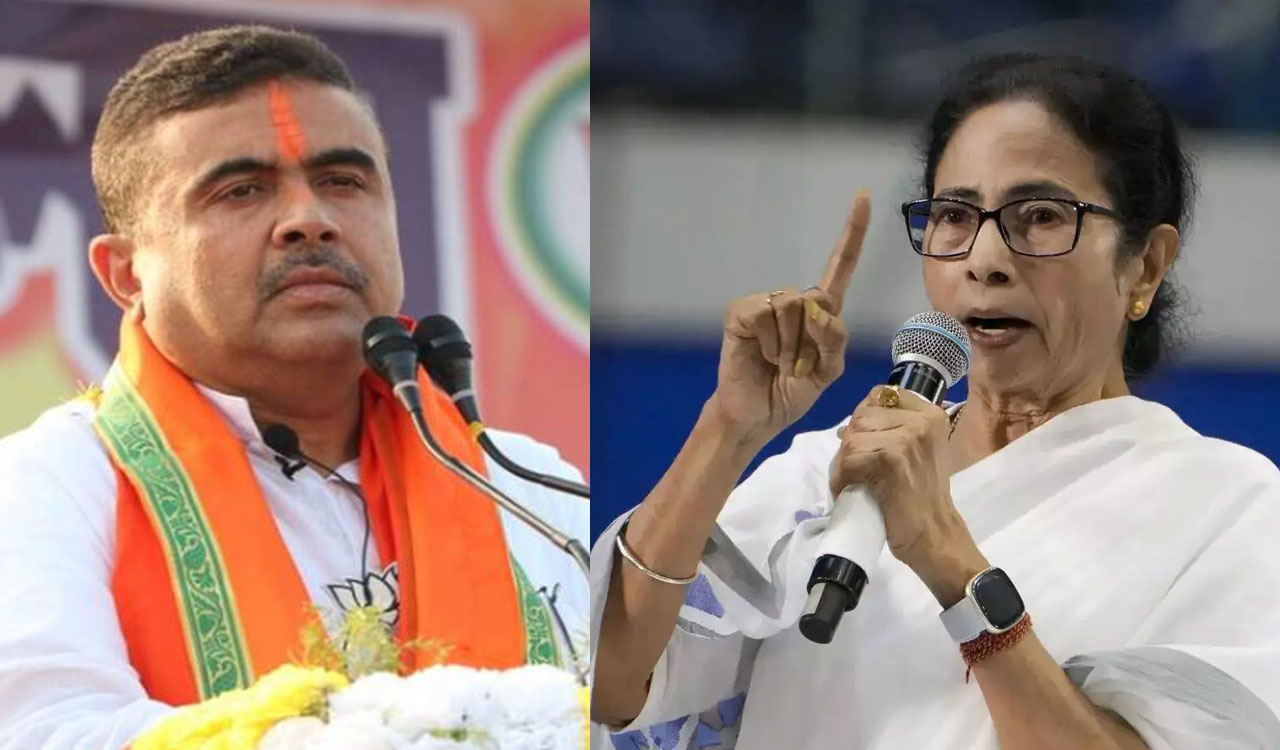

Mamata Banerjee will defend her seat even as the BJP has fielded the leader of opposition from the constituency
Published Date – 18 March 2026, 12:31 AM
Kolkata: Betting on calibrated generational change and organisational loyalty rather than star power, the ruling TMC on Tuesday unveiled candidates for 291 of the 294 West Bengal assembly seats, signalling a strategy of controlled churn as it seeks a fourth straight term in office.
The Mamata Banerjee-Suvendu Adhikari rivalry is set to acquire a fresh electoral theatre in Bhabanipur, where the chief minister will defend her seat even as the BJP has fielded the leader of opposition from the constituency. The stage is set for a direct face-off between the two rivals who first clashed in Nandigram in the 2021 assembly polls, when Adhikari defeated his former mentor by a narrow margin despite the TMC’s sweeping victory across the state.
Announcing the list from her Kalighat residence, Chief Minister and TMC supremo Mamata Banerjee said the party would leave the three Darjeeling hills seats to ally Bharatiya Gorkha Prajatantrik Morcha (BGPM) led by Anit Thapa and expressed confidence of crossing the 226-seat mark in the 294-member assembly.
“We will contest 291 seats and win more than 226,” Banerjee asserted, flanked by party national general secretary Abhishek Banerjee and state president Subrata Bakshi.
The candidate list reflects a carefully balanced electoral recalibration by the ruling party ahead of the high-stakes contest in which it faces anti-incumbency after nearly 15 years in power while simultaneously attempting to blunt the BJP’s aggressive campaign.
Of the 291 candidates, the TMC has retained 135 sitting MLAs, dropped around 75 legislators and shifted another 15 to different constituencies, indicating what party insiders described as a “targeted anti-incumbency management exercise”.
The churn comes even though the TMC had secured a commanding mandate in 2021 with 215 seats and later increased its tally to 225 through defections and bypoll victories.
Political observers say the scale of candidate replacement suggests that the party leadership has attempted to refresh its electoral face while preserving its core organisational structure.
A Kolkata-based political analyst said the list indicates a “controlled generational transition” within the party.
“The TMC is trying to signal renewal without destabilising its grassroots machinery. Dropping some incumbents helps address local anti-incumbency, while retaining over a hundred MLAs preserves the booth-level network that remains its biggest electoral asset,” he said.
Banerjee herself will once again contest from Bhabanipur against BJP’s Suvendu Adhikari, while several senior ministers, including Firhad Hakim, Javed Ahmed Khan, Arup Biswas, Indranil Sen and Chandrima Bhattacharya, have been renominated from their existing constituencies.
The list also features a mix of professionals, sportspersons and cultural personalities, though the overall emphasis remains on organisational faces rather than celebrity candidates, a marked shift from earlier elections where “star value” was occasionally deployed to generate momentum.
Olympian and Asian Games gold medallist Swapna Barman has been fielded from Rajganj, while former cricketer Shib Shankar Pal has been nominated from Tufanganj.
Actor-politician Soham Chakraborty has been shifted to Tehatta, and party spokesperson Kunal Ghosh has been fielded from Beliaghata in what will be his first assembly election.
Among the prominent exclusions are Barasat MLA Chiranjeet Chakraborty, Behala West MLA Partha Chatterjee and Beliaghata legislator Paresh Pal.
The party has also introduced several younger faces, including Shreya Pandey in Maniktala and Sirsan Banerjee, son of TMC MP Kalyan Banerjee, from Uttarpara.
According to party data, the list includes 52 women, 95 SC/ST candidates and 47 minority nominees, a social coalition that has traditionally underpinned the TMC’s electoral success in the state.
Age demographics indicate a calibrated generational push as well, with four candidates below 31 years of age and 38 between 31 and 40 years, while nearly a third fall in the 41-50 years age bracket.
A senior TMC leader said the party leadership had prioritised “ground connect and organisational credibility” over celebrity appeal.
“The leadership consciously avoided excessive star power. The emphasis was on candidates who can manage booths, mobilise voters and maintain local networks,” he said.
The list also reflects the party’s attempt to consolidate local social equations in several politically sensitive constituencies.
In Nandigram, where Banerjee lost narrowly to Adhikari in 2021, the TMC has fielded Pabitra Kar, a former BJP-linked panchayat leader who recently returned to the party.
The move is seen as an attempt to consolidate local organisational networks in the high-profile seat that remains symbolically significant in West Bengal’s political narrative.
Elsewhere, the party has retained strong district-level figures in key electoral battlegrounds such as Birbhum, North 24 Parganas and south Bengal’s rural belt, which together form the backbone of the TMC’s electoral machinery.
The candidate list comes amid an intense political debate over the Special Intensive Revision (SIR) of electoral rolls, which has led to large-scale deletions of voters in several districts.

Comments are closed.