
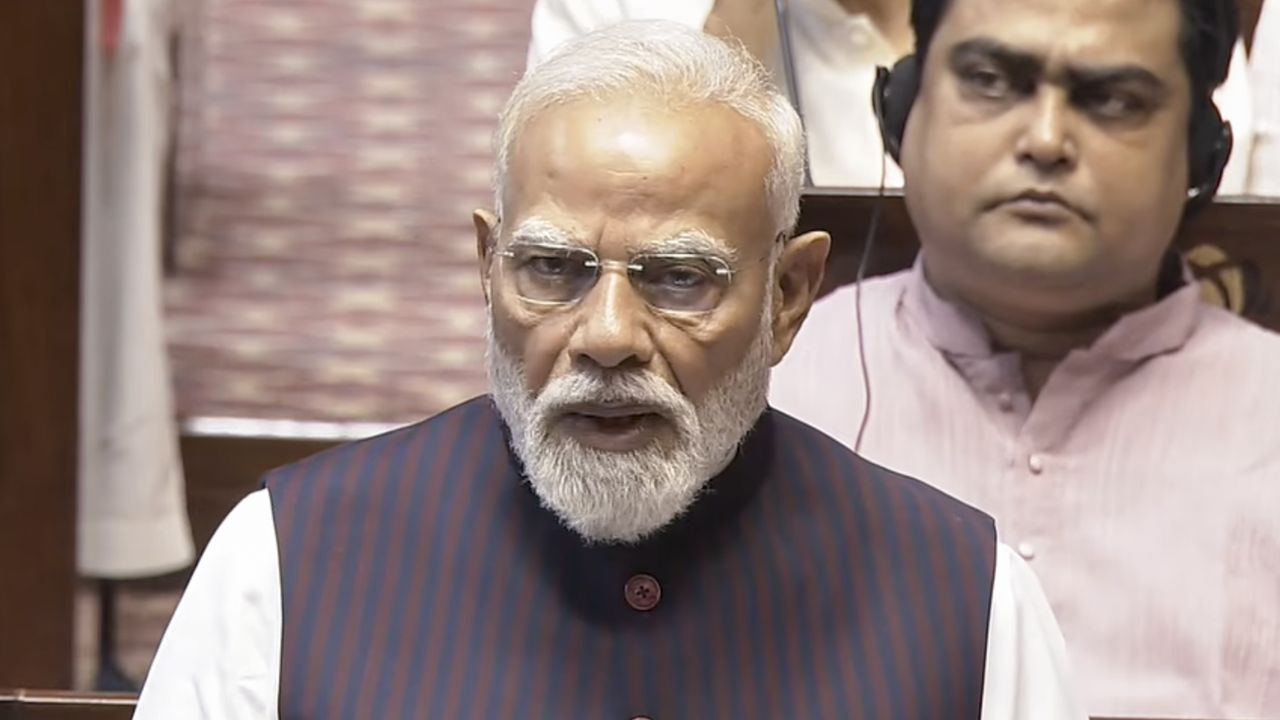

Prime Minister Narendra Modi gave an important warning during his address in the Rajya Sabha on March 24. If the ongoing wars at the global level drag on for a long time, then the world as well as India will have to face serious challenges. This statement is not just a general political comment, but an indication of the changing global order.
In today’s time, wars are not limited to borders only; They have profound effects on energy markets, food supplies, global trade, currency markets, and social stability. The Iran-Israel war and ongoing tensions in West Asia have made it clear that even a regional conflict can shake the entire world economy. India, being an emerging economy and deeply linked to global supply chains, becomes one of the most vulnerable countries in such a situation.
Also read: Is PM Narendra Modi’s image being harmed? From Operation Sindoor to American Deal
In such a situation, this statement of the Prime Minister is actually a warning that the coming time may not only be of opportunities but also of difficult tests. In this article we will discuss that if this crisis continues, then what crises or challenges may have to be faced in the future?
1. Energy crisis
India is largely dependent on imports for its energy needs. Prices of LPG cylinder and diesel-petrol are examples of this. If war increases instability in oil-producing regions, especially West Asia, crude oil prices could rise sharply. This will increase not only the cost of petrol and diesel but also the cost of power generation and transportation.
2. Inflation will increase
When energy or diesel-petrol becomes expensive then everything becomes expensive. Transport is expensive, production is expensive and finally consumer goods are expensive. This creates ‘cost-push inflation’. The purchasing power of the poor and middle class decreases, leading to lower consumption and slower economic growth.
3. Supply chain breakdown
The modern economy is based on ‘global supply chain’. The COVID-19 pandemic and the Russia-Ukraine war showed how a regional crisis can affect production and distribution around the world. The availability of chips, medicines, fertilizers may be affected.
4. Food safety threat
Sulfur is imported in large quantities from Middle East countries which plays an important role in making fertilizers. In such a situation, if this crisis continues for a long time, there will be a shortage of fertilizers due to which production will decrease and there may be a food crisis in the future.
5. Impact on exports
When the global economy weakens, demand decreases. This will have a direct impact on India’s exports. Sectors like IT, textile, auto components are affected due to this. This reduces foreign exchange and may increase trade deficit.
6. Rupee will weaken
When global uncertainty increases, investors flee to safer markets. Due to this, capital starts flowing out of emerging markets like India and the rupee weakens. A weak rupee makes imports more expensive, which further increases inflation.
7. Increase in defense spending
The environment of long war forces countries to strengthen their security. India may also have to spend more on its borders and military capability. This will increase pressure on the government budget and may reduce resources for development projects.
8. Challenge of diplomatic balance
India’s foreign policy has been based on ‘strategic autonomy’. But when global powers are at loggerheads, like NATO and Russia, it becomes difficult to maintain balance. In such a situation, every decision has economic and political impact. Obviously India will face similar challenges in the Iran-Israel-America war also.
9. Fear of increasing unemployment
When investment decreases and business slows down, employment opportunities also decrease. Pressure increases on startups, manufacturing and service sectors. This may increase unemployment and social dissatisfaction.
10. Law and order problem
If the environment of inflation, unemployment and uncertainty increases, a situation of dissatisfaction arises in the society. In such a situation, it is a challenge for the government to maintain social stability along with keeping the economy strong.
Also read: ‘Will not tolerate disaster, will live by changing’, PM Modi’s taunt on Kejriwal
In such a situation, PM Modi has tried to convey symbolically that if the war does not stop, what kind of problems may have to be faced?

Comments are closed.