
What Is Chenab–Beas Tunnel? Cost, Location, Pakistan’s Concerns And Its Big Impact On North India

India’s newly proposed Chenab-Beas tunnel has led to yet another diplomatic conflict between India and Pakistan, as reports have indicated that the construction work will commence from August 1, 2026. While Pakistan claims that the project poses “dangerous implications for Pakistan’s economy” and violates the terms of Indus Water Treaty, India has been aggressively going ahead with its plans for the full utilization of its river water share. This comes months after India’s declaration that Indus Water Treaty will be put “in abeyance” after the Pahalgam terrorist attack. In this regard, Prime Minister Narendra Modi stated that “blood and water cannot flow”. Apart from the politics, Chenab-Beas tunnel is also an infrastructural project that can revolutionize water management, hydro power generation, and connectivity in one of the most vital Himalayan regions.
As per reports, this project, formally called Chenab-Beas Link Tunnel Project or Link-3 project, will be constructed in Himachal Pradesh and is estimated to cost Rs 2,532 crore. The execution of the project is done by National Hydroelectric Power Corporation (NHPC), and the government aims to complete the project by July 31, 2029.
Chenab-Beas tunnel project aims to divert water and strengthen Himalayan infrastructure
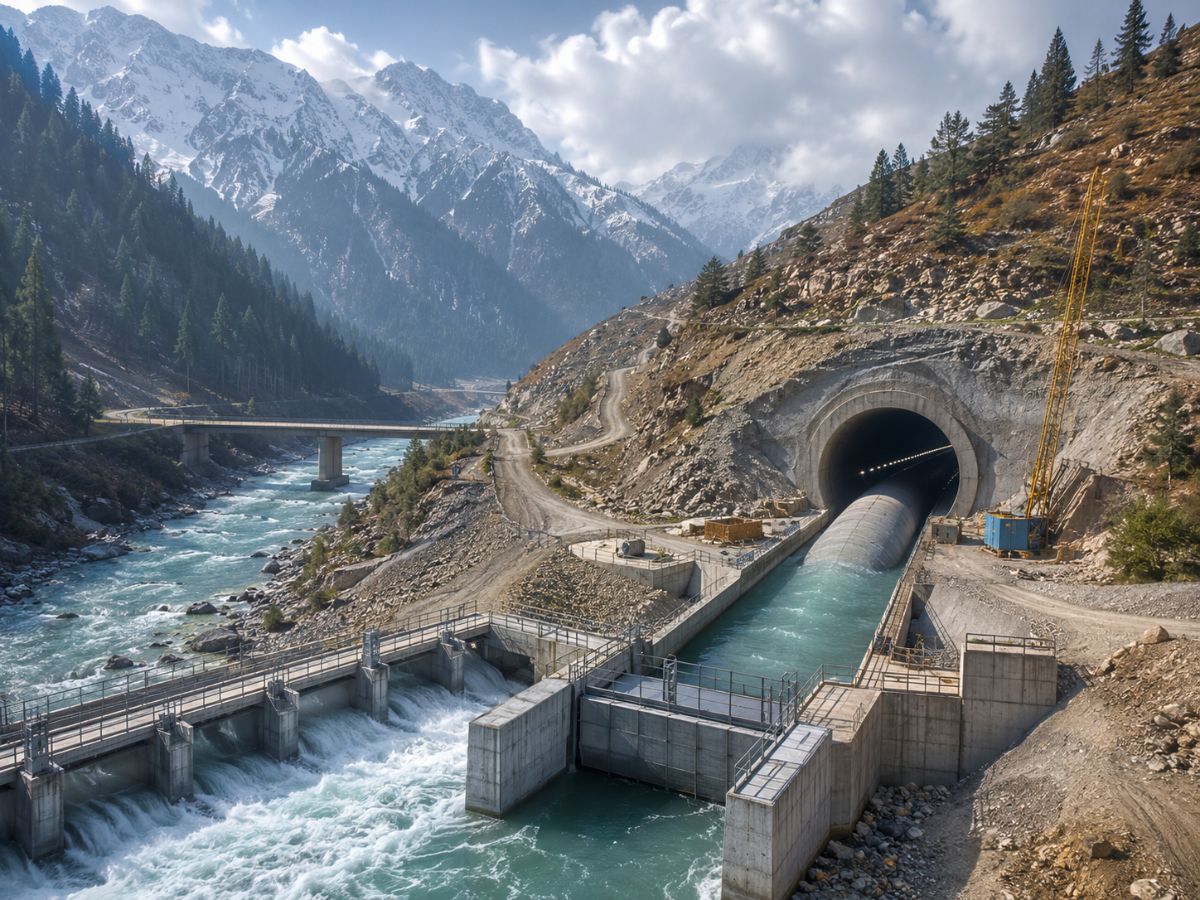
The Chenab–Beas tunnel is designed to transfer surplus water from the Chenab basin to the Beas River through an 8.7-kilometre-long tunnel. Both rivers are part of the larger Indus river system, which includes the Chenab, Jhelum, Ravi, Beas and Sutlej.
The first phase also includes a 19-metre-high concrete barrage on the Chandra River near Koksar village in Himachal Pradesh’s Lahaul Valley. The structure will be built at an elevation of nearly 10,300 feet. According to the South Asia Network on Dams, Rivers and People (SANDRP), the barrage and stilling basin will sit on a deep upstream plastic concrete cut-off trench and include reinforced bank-side power intake structures.
The Chenab-Beas tunnel itself will pass through the Pir Panjal Range and will be supported during construction by horizontal access adits. Once the work is completed, these access tunnels will be permanently sealed with concrete plugs. The water tunnel will be located close to the Atal Tunnel near Rohtang Pass.
Apart from improving water diversion, the project is expected to generate around 4,000 MW of additional hydropower in Himachal Pradesh. While its primary purpose is water management and power generation, the large-scale tunnelling and supporting infrastructure are also expected to improve access in this mountainous region, strengthening North India’s connectivity by creating better infrastructure in one of the country’s toughest terrains.
Why the Chenab-Beas tunnel has alarmed Pakistan
Pakistan has strongly objected to the project, saying India has neither informed Islamabad nor issued any formal notice before moving ahead.
“India has neither officially communicated nor shared any notice about these projects. These projects confirm that India seeks to weaponise water; this carries dangerous implications for Pakistan’s economy…,” Pakistan’s Foreign Ministry said, as per reports.
Islamabad has specifically raised objections over the proposed transfer of nearly 1.9 million acre-feet of water from the Chenab basin to the Beas basin.
“We have seen this media report and the public tender document issued by the Government of India for the Chenab–Beas link project with the intention of transferring 1.9 million acre-feet of water from the Chenab River to the Beas. Such an inter-basin project constitutes a grave violation of the Indus Waters Treaty,” Pakistan’s Foreign Ministry said.
Pakistan has also criticised another Indian project linked to the Chenab River. It described the proposed sediment management tunnel at the Salal Dam in Jammu and Kashmir as a “deeply concerning development.”
The Rs 268-crore Salal project, also to be carried out by NHPC, aims to tackle decades-old siltation in the reservoir. Engineers say the Chenab carries massive amounts of Himalayan sediment, reducing storage capacity, lowering turbine efficiency and making water-flow management more difficult. The new tunnel will allow water diversion when required and remove accumulated sediment through a bypass system.
How the Chenab-Beas tunnel fits into the Indus Waters Treaty debate
The concerns raised by Pakistan stem from the Indus Waters Treaty signed by India and Pakistan on September 19, 1960. Under the agreement, the eastern rivers: Ravi, Beas and Sutlej, were allocated to India, while Pakistan received the western rivers, Indus, Jhelum and Chenab.
The arrangement gave India control over nearly 20 per cent of the Indus basin waters, while Pakistan received around 80 per cent. Even on the western rivers, India retained limited rights for non-consumptive uses such as irrigation, hydropower generation and navigation.
Pakistan has repeatedly objected to Indian dams and hydropower projects on the western rivers over concerns that they could affect downstream water availability. The issue has gained fresh attention after India suspended the treaty following the Pahalgam terror attack. Since then, New Delhi has signalled that it intends to fully utilise the water resources available within its territory.
Environmental concerns surrounding the Chenab-Beas tunnel
Even as the Chenab-Beas tunnel promises benefits in water management, hydropower and regional infrastructure, environmental experts have urged caution because of where the project is being built.
Reportedly, according to SANDRP, the Himalayan region has witnessed a series of climate-related disasters in recent years, including landslides, flash floods, cloudbursts, earthquakes, glacial lake outburst floods (GLOFs) and rapidly changing river flows linked to climate change.
The group cited scientists who warned that a glacial lake outburst flood “is an emerging threat in the Chandra basin”. In November 2025, the Lahaul-Spiti Deputy Commissioner had also warned, “We are sitting on a GLOF.”
SANDRP further cautioned that “this might be one of the most disaster-prone regions in the Indian Himalayas for such a project. It witnesses multiple risks which do not sit side by side, but routinely mix with each other, magnifying the impact of the disaster.”
The organisation also warned that “the safety of thousands of Indians and the future of the Indian Himalayan region” is at stake.
As work on the Chenab-Beas tunnel prepares to begin, the project now stands at the centre of three major debates: India’s push to maximise its river resources, Pakistan’s objections under the Indus Waters Treaty, and the challenge of executing a massive engineering project in one of the Himalayas’ most fragile landscapes.
Also Read: Why Does US Want Lawrence Bishnoi, Can India Refuse To Send Him?
Khalid Qasid is a media enthusiast with a strong interest in documentary filmmaking. He holds a Master’s degree in Convergent Journalism from AJK MCRC. He has also written extensively on esports at Sportsdunia. Currently, he covers world and general news at NewsX Digital.
The post What Is Chenab–Beas Tunnel? Cost, Location, Pakistan’s Concerns And Its Big Impact On North India appeared first on NewsX.

Comments are closed.