
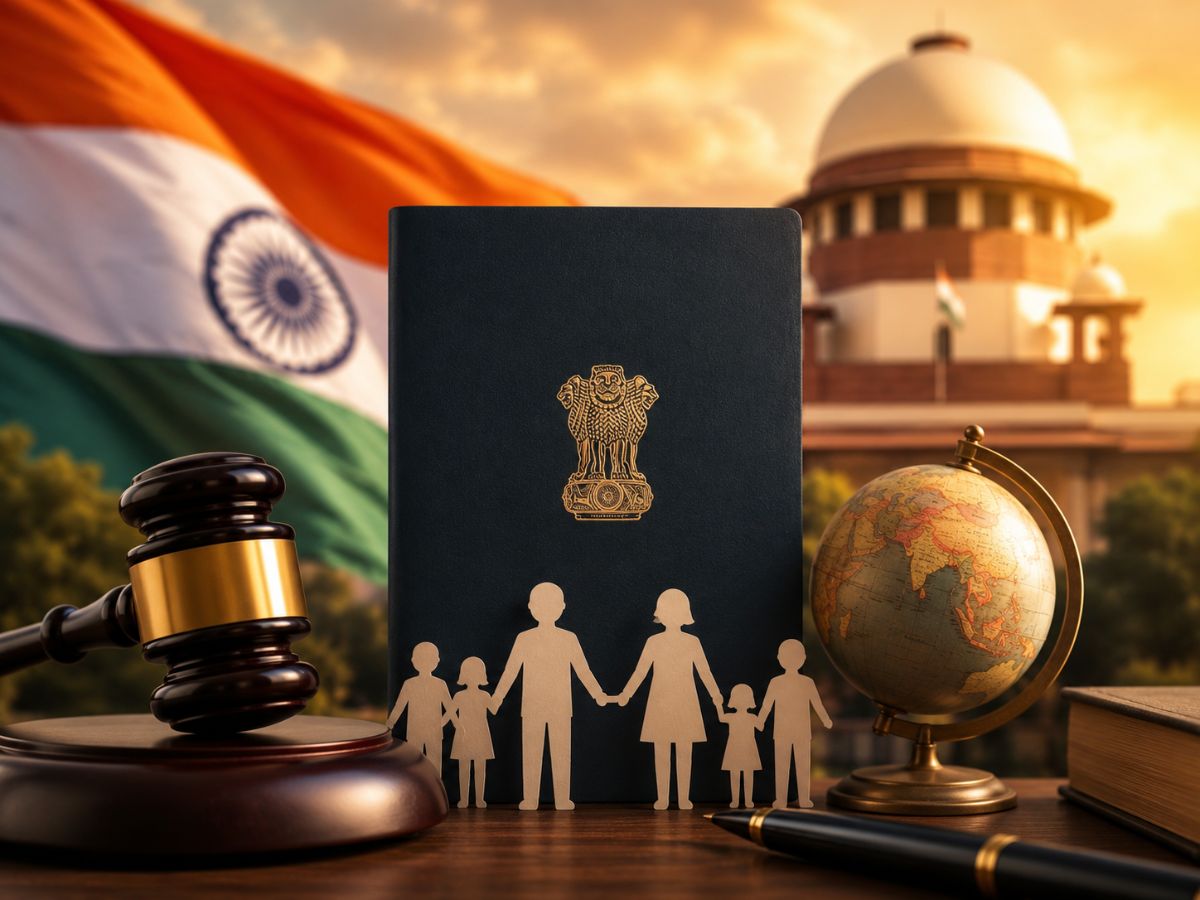
What Is ‘One Nation, One Citizenship’? Why India Still Doesn’t Have A Single Citizenship Certificate

India adheres to the principle of “One Nation, One Citizenship” of Indian citizenship unlike other nations like the US where a person has citizenship of the state he belongs to as well as citizenship of the country itself. Every Indian citizen is considered a citizen of the Republic of India without regard for the particular state he lives in. However, a new debate has sprung up about a separate issue: if there is just one citizenship of India, then why there is no one document proving its existence? This issue has risen to prominence following the government’s statement that an Indian passport is not conclusive proof of Indian citizenship.
The discussion has now shifted beyond passports. Constitutional experts argue that the real gap is not in India’s citizenship law, but in the documents used to prove Indian citizenship. They say India has one citizenship system, but no universally recognised Citizenship Certificate that conclusively establishes a person’s legal status.
Constitution recognises Indian citizenship but leaves proof to different laws
The Constitution deals with citizenship through Articles 5 to 11, which empowered Parliament to enact the Citizenship Act, 1955. That law lays down how Indian citizenship can be acquired through birth, descent, registration, naturalisation or incorporation of territory and also explains how it may be renounced, terminated or taken away.
However, the Constitution and the Citizenship Act stop short of naming any one document as conclusive proof of citizenship. Legal experts point out that citizenship is a constitutional and statutory status, while documents merely serve as evidence of that status.
The same principle applies to passports. Although passports are issued only after detailed document checks and police verification, the Passport Act, 1967 allows the Central Government, under Section 20, to issue travel documents to non-citizens in exceptional circumstances and in public interest. That is why experts argue a passport carries strong evidentiary value but cannot legally be treated as infallible proof of Indian citizenship.
Why Aadhaar, PAN, Voter ID and passports cannot settle the citizenship debate
The current documentation system assigns different purposes to different identity documents. Aadhaar is designed to establish identity for government services. PAN is meant for taxation. A driving licence certifies a person’s ability to drive, while a voter identity card confirms electoral registration, subject to corrections under the law.
Because every document serves a specific statutory purpose, none has been designed to function as a universal declaration of Indian citizenship. According to legal experts, this fragmented framework creates uncertainty whenever questions arise over illegal migration, electoral integrity, border management or public administration.
They argue that this uncertainty has become more visible during the ongoing Special Intensive Revision (SIR), one of the country’s largest electoral verification exercises, in which millions of records are being scrutinised, corrected and authenticated under constitutional supervision.
Proposal seeks a single Indian citizenship certificate after verification
Supporters of reform argue that once the verification exercise is completed, the government should consider creating a National Citizenship Register and issuing a Citizenship Certificate to every individual whose citizenship has been verified under law.
They stress that such a certificate would not replace Aadhaar, passports, voter identity cards or PAN. Those documents would continue serving their existing legal purposes. Instead, the proposed Citizenship Certificate would perform an entirely different constitutional function by becoming the single authoritative document certifying Indian citizenship.
According to the proposal, such a reform would permanently settle recurring disputes over proof of citizenship, strengthen national security and border governance by clearly distinguishing Indian citizens from foreign nationals and other lawful residents, improve governance through reliable citizenship data, reduce duplication across government databases and reinforce constitutional certainty. It also notes that citizenship is often described as the “right to have rights,” making documentary certainty especially important.
Supporters say the goal is certainty, not exclusion
The proposal argues that the idea should not be confused with the National Register of Citizens (NRC). It states, “The objective is not exclusion. The objective is certainty.” It also says any reform should not operate retrospectively or unsettle settled rights, but instead be guided by constitutional values, transparent procedures, judicial review and accessible grievance mechanisms.
Supporters further argue that technology now makes such a reform more practical than ever. A digitally secured Citizenship Certificate backed by physical documentation, biometric authentication and QR-based verification could fit into India’s expanding digital governance system while protecting privacy. They say India has spent decades issuing passports, Aadhaar cards, PAN cards and voter IDs, but still lacks one document that conclusively certifies Indian citizenship. In their view, introducing a Citizenship Certificate would complete a long-missing part of India’s constitutional architecture by giving every verified citizen a single, legally recognised proof of citizenship.
Also Read: Why Is Govt Asking Shipping Companies To Avoid Deploying Indians In Strait of Hormuz?
Khalid Qasid is a media enthusiast with a strong interest in documentary filmmaking. He holds a Master’s degree in Convergent Journalism from AJK MCRC. He has also written extensively on esports at Sportsdunia. Currently, he covers world and general news at NewsX Digital.
The post What Is ‘One Nation, One Citizenship’? Why India Still Doesn’t Have A Single Citizenship Certificate appeared first on NewsX.

Comments are closed.