
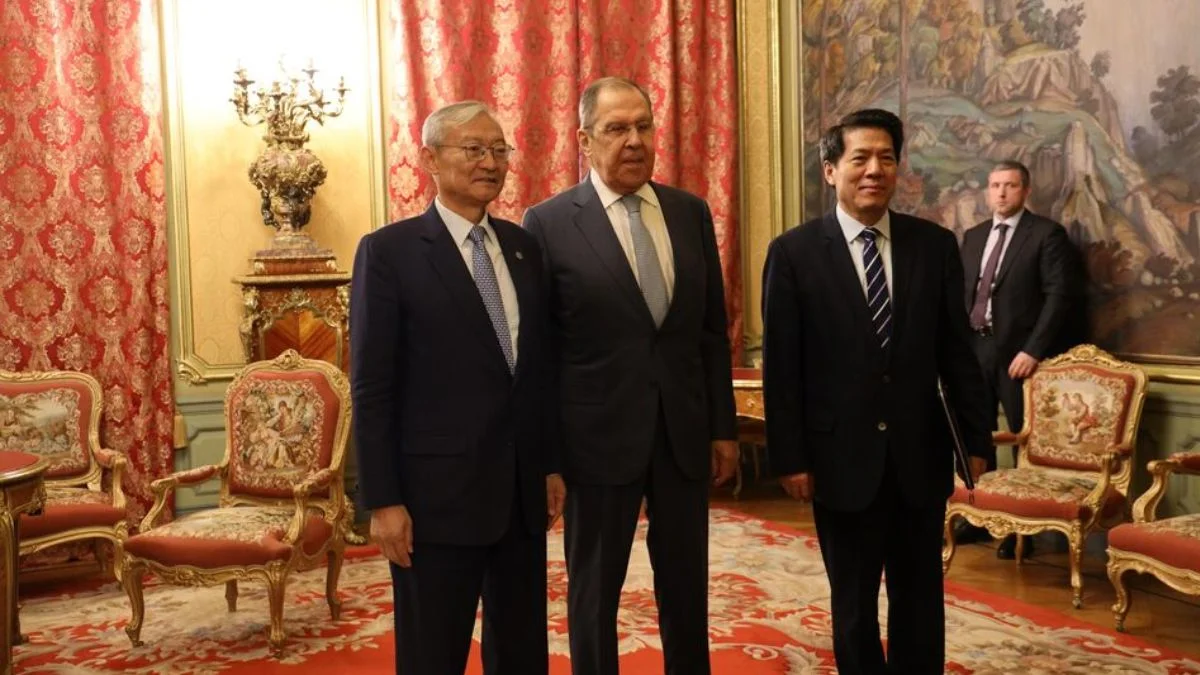

Russian Foreign Minister Sergey Lavrov hosted Nurlan Yermekbayev, Secretary General of the Shanghai Cooperation Organization (SCO), in Moscow on April 3, 2026, for a working meeting aimed at reviewing the bloc’s activities and sharpening its role in Eurasian security and development. Statements from the Russian Ministry of Foreign Affairs, as summarised in open‑government‑linked channels, describe the encounter as a “working visit” focused on exchanging views about the SCO’s performance in the current geopolitical environment.
Coordination in a shifting regional landscape
The discussions are framed as part of Russia’s broader effort to reinforce the SCO as a key pillar of a multipolar international order, especially as Moscow deepens strategic ties with China, India and Central Asian states. Russian‑government‑linked summaries note that Lavrov and Yermekbayev are expected to review the outcomes of recent SCO summits, including the Tianjin‑hosted Heads‑of‑State meetings, and assess how well member states are implementing earlier decisions on security, economic integration, and connectivity.
Officials emphasise that particular attention will be devoted to strengthening the SCO’s “overall potential” in support of “reliable security and sustainable development” across Eurasia. Open‑source policy‑and‑diplomacy‑watch briefs interpret this as a signal that Russia wants the bloc to expand beyond its traditional counter‑terrorism and border‑cooperation mandate into broader economic, energy and infrastructure‑coordination roles, especially as Western‑imposed sanctions continue to shape Moscow’s external‑relations pattern.
Focus on security, connectivity and multilateralism
The SCO is widely seen in open‑source strategic‑affairs literature as one of Russia’s main institutional vehicles for cultivating a Russia–China Central Asia axis insulated from Western‑led security and economic structures. In that context, the Lavrovn Yermekbayev meeting is expected to touch on ways to intensify joint counter‑terrorism and border‑security coordination, as well as to streamline mechanisms for information‑sharing and crisis‑management procedures among member‑state security services.
Analysts reviewing earlier SCO‑linked meetings also point to the bloc’s growing interest in transport‑corridor projects, digital‑infrastructure cooperation, and the creation of regional‑financial‑support channels. In Moscow, Lavrov and Yermekbayev are likely to discuss how the SCO’s economic‑cooperation agenda can be aligned with national programmes such as Russia’s Asia‑oriented infrastructure and energy‑export initiatives, as well as China’s Belt‑and‑Road‑linked schemes that already overlap with several SCO‑member corridors.
Preparing for the Tianjin‑era agenda
The 2026 meeting in Moscow also comes amid preparations for the SCO’s upcoming summit cycle under the presidency of the Kyrgyz Republic, with a full‑scale Heads‑of‑State gathering expected later in the year in Tianjin, China. Open‑source SCO‑secretariat‑style summaries indicate that the organisation is already working through a list of priority areas under the 2025–2026 chairmanship, including cross‑border digital‑governance standards, regional‑sports‑and‑youth‑cooperation platforms, and the formalisation of new working groups on energy and connectivity.
In that context, Lavrov’s meeting with Yermekbayev serves both as a bilateral Russian–SCO stock‑taking and as a soft coordination point ahead of larger‑format ministerial and leaders‑level meetings. Russian‑linked diplomatic‑commentary portals suggest that Moscow is keen to use the SCO forum to consolidate political backing for its Eurasian‑integration and de‑dollarisation strategies, while also balancing internal‑members tensions such as India‑related disputes and Central‑Asian sensitivities through consensus‑based mechanisms rather than unilateral pressure.
As of April 3, 2026, the Lavrov Yermekbayev talks represent one of several high‑level diplomatic engagements aimed at re‑calibrating the SCO’s institutional weight in the emerging global order. For Russia, the meeting underscores that the organisation remains a central platform for advancing Moscow’s vision of a security‑and‑development‑anchored Eurasian bloc, even as the wider international system remains under strain from overlapping conflicts and shifting alliances.

Comments are closed.