
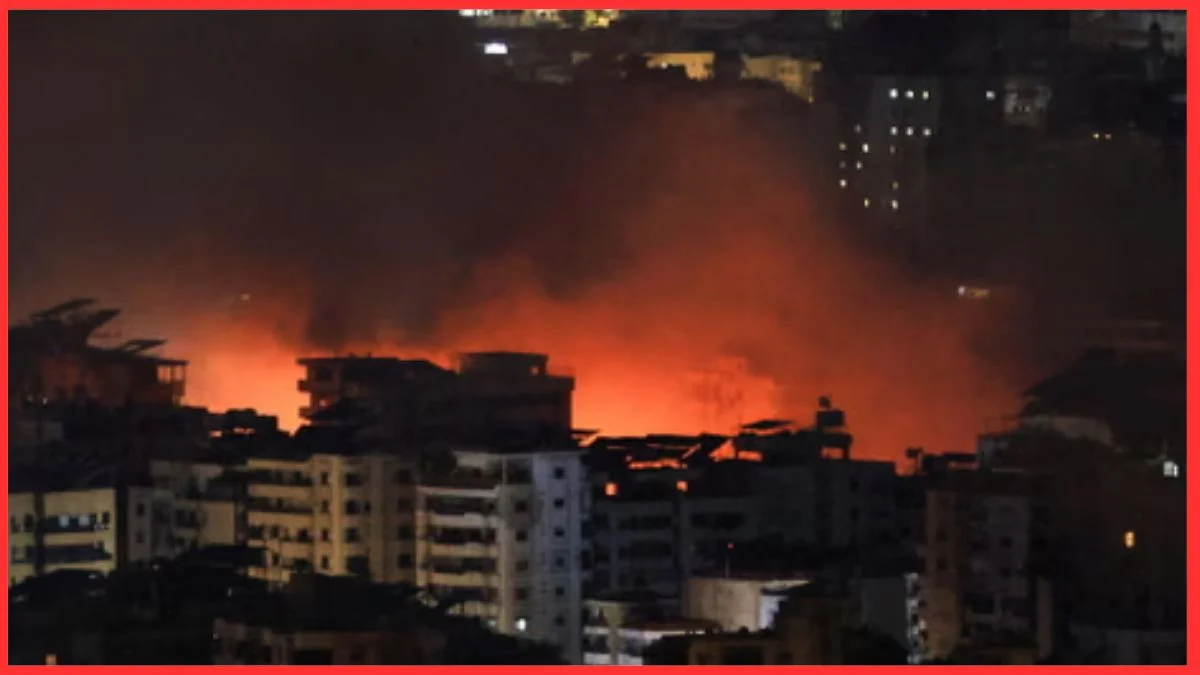

The rapidly intensifying confrontation involving Hezbollah, Israel, Iran and the United States has entered a profoundly volatile phase that analysts increasingly describe as a de facto regional war rather than a contained confrontation. The latest developments illustrate a battlefield that is expanding across multiple fronts, involving missile launches, drone attacks, and retaliatory strikes that risk transforming the already fragile Middle Eastern security landscape into a prolonged and destructive conflict.
The Lebanese armed group Hezbollah announced that it had launched a drone attack targeting an Israeli military installation located west of the Sea of Galilee. According to the organisation’s statement, the drones were directed at what it described as the Samson base, also known as Camp Shimshon. Hezbollah framed the operation as part of its broader military engagement against Israel and as a response within the expanding theatre of hostilities linked to the wider confrontation involving Iran.
While Hezbollah’s announcement signals the activation of the northern front against Israel, the Israeli military simultaneously reported a more alarming development. According to the Israel Defense Forcesmissiles had been launched from Iranian territory toward Israel. Israeli authorities confirmed that national air defence systems were immediately activated in order to intercept the incoming threat. The statement indicated that interception systems were actively working to neutralise the missiles before they could reach Israeli territory.
This exchange marks a significant escalation in the confrontation between Israel and Iran, two states that have long engaged in indirect conflict through proxies but rarely crossed the threshold into direct missile exchanges. The involvement of Hezbollah through drone warfare and the confirmation of Iranian missile launches suggest that the conflict is no longer confined to proxy engagements but is increasingly evolving into direct military confrontation.
At the same time, reports from inside Iran describe a country that is bracing for a sustained confrontation. Iranian officials have rejected the framing emerging from Washington that the conflict’s duration will be determined by external actors. Instead, Tehran is asserting that it will decide how long the war lasts. Such statements reflect a strategic posture designed to signal endurance rather than rapid escalation followed by de escalation. In essence, Iran appears to be preparing the international community for a long confrontation rather than a short crisis.
Iranian messaging has been particularly explicit regarding its willingness to endure a prolonged military struggle. Officials have stated that the Iranian armed forces are prepared for a war of attrition. Such language carries considerable strategic weight in military doctrine. A war of attrition implies that the objective is not immediate battlefield victory but the gradual exhaustion of the adversary through sustained pressure, resource depletion, and continuous military engagement.
Meanwhile, the situation inside Iran has grown increasingly tense following continued strikes attributed to joint United States and Israeli military operations across several locations in the country. Witnesses in central areas have reported hearing air defence systems activating in response to incoming attacks. These defensive responses underscore the reality that Iranian territory is now part of the operational theatre of the conflict, rather than merely serving as a strategic rear base.
The Iranian military establishment, particularly the Islamic Revolutionary Guard Corpshas publicly declared its intention to continue retaliatory operations. Officials associated with the force have stated that Iran is employing increasingly advanced weaponry in its responses. Although the specific systems referenced have not been publicly confirmed, the messaging is clearly designed to convey technological escalation and to signal that Iran retains significant strategic capabilities.
The convergence of these developments illustrates a deeply unstable strategic equation. Israel now faces simultaneous threats from direct Iranian missile launches and drone attacks launched from Lebanese territory by Hezbollah. For Israel’s defence planners this represents the classic nightmare scenario of multi front warfare, in which northern and distant theatres of conflict intersect with direct strategic strikes.
From an international relations perspective, the entry of the United States into active strike operations alongside Israel fundamentally alters the geopolitical dimension of the conflict. American involvement introduces the full weight of a global military power into what had previously been a regional confrontation. For Iran, this creates both a strategic challenge and an opportunity to frame the war as resistance against foreign intervention, a narrative that Tehran has historically used to consolidate domestic support and regional alliances.
The risk facing the Middle East now is not merely escalation but entrenchment. If Iran truly intends to pursue a long war of attrition while Israel continues military operations and Hezbollah sustains its drone campaign, the conflict could evolve into a drawn out regional struggle involving repeated missile exchanges, air strikes and proxy engagements across several borders.
In practical terms the battlefield geography is already widening. Lebanon’s southern frontier, Israeli strategic infrastructure, and Iranian urban centres are all emerging as interconnected theatres of operation. Each new strike deepens the cycle of retaliation and increases the likelihood of further regional actors being pulled into the confrontation.
The strategic reality therefore confronting policymakers is stark. What began as a series of retaliatory actions is rapidly hardening into a structured war dynamic between Israel and Iran with Hezbollah acting as a northern combat arm and the United States providing military support to Israel. Such a configuration carries the potential to reshape the security architecture of the Middle East for years to come.
At this moment the conflict stands at a dangerous crossroads. The continuation of missile launches, drone warfare, and retaliatory air strikes indicates that neither side is preparing for immediate de escalation. Instead the rhetoric emerging from Tehran and the operational tempo observed across the region suggest that the war is entering a phase defined not by sudden climax but by sustained confrontation.
For a region already burdened by decades of conflict, the implications are severe. The present escalation is not simply another Middle Eastern crisis. It is the emergence of a direct strategic clash between Israel and Iran with the United States engaged and Hezbollah actively fighting. If the trajectory continues unchanged, the Middle East may be witnessing the opening stages of one of the most consequential regional wars of the modern era.

Comments are closed.