


Market demand is shifting toward designers who can apply visual language to address business challenges and support brand development at both national and international levels.
Tough shake-out in the digital market
The rapid advancement of digital technology is reshaping the graphic design industry. According to a report by 360 Research Reports, global demand is increasingly concentrated on digital products such as websites, mobile applications, and social media platforms. More than 33% of current demand is linked to brand building and positioning.
In Vietnam, this trend is becoming more pronounced alongside the expansion of the digital economy and e-commerce. Companies are increasing investment in brand identity systems, UI/UX (user interface and user experience design), digital content, and packaging to strengthen their competitiveness in online markets.
A report by Next Move Strategy Consulting notes that while the supply of design graduates is relatively large, many lack practical experience, systems thinking, and the ability to address real-world branding challenges. As a result, businesses often need to allocate additional resources for training. At the same time, competition from international firms has intensified pressure on local companies to retain talent and expand their operations.
Industry demand is gradually shifting toward designers with adaptable mindsets, cross-functional skills, and stronger capabilities in analysis, concept development, and brand storytelling. As more companies establish in-house creative teams, designers are increasingly expected to contribute not only to execution but also to brand and communication strategy.
A shift in mindset for graphic design students
As artificial intelligence (AI) becomes more integrated into creative industries, questions have emerged about the evolving role of human designers.
Speaking at the conference Communication and Creative Industries in Contemporary Asia (ICCCI 2025), Professor Rick Bennett, Deputy Vice-Chancellor and Vice President of British University Vietnam (BUV), said higher education institutions need to focus on developing depth of thinking and strong theoretical foundations, rather than concentrating solely on technical skills.
At the same event, Dr. Nick Zhang from Hong Kong Baptist University observed that technological advances, including AI, are driving structural changes across the creative sector. Rather than reducing human involvement, these changes are increasing demand for professionals who can integrate creative thinking, analytical skills, and technological understanding to generate new forms of value.
Students join a discussion. Photo courtesy of BUV |
In response to these developments, BUV has introduced a dual bachelor’s degree programme in graphic design with Manchester Metropolitan University. Its School of Art is the second-oldest art education institution in the U.K. and was ranked among the world’s top 51-100 in the QS World University Rankings 2025. Currently, BUV has also been ranked among the world’s top 200 universities for Art and Design, and is currently the only international university in Vietnam to be ranked in this subject.
The graphic design programme is designed not only to teach visual aesthetics but also to develop structured thinking and strategic capabilities in future designers.
The programme emphasises a “concept-first, not tool-first” approach, in which critical thinking forms the foundation and software tools serve as supporting instruments.
Students are required to analyse problems, understand client needs, develop core concepts, and structure messages before moving to execution. This method aims to reduce over-reliance on technology while encouraging independent thinking and creative identity.
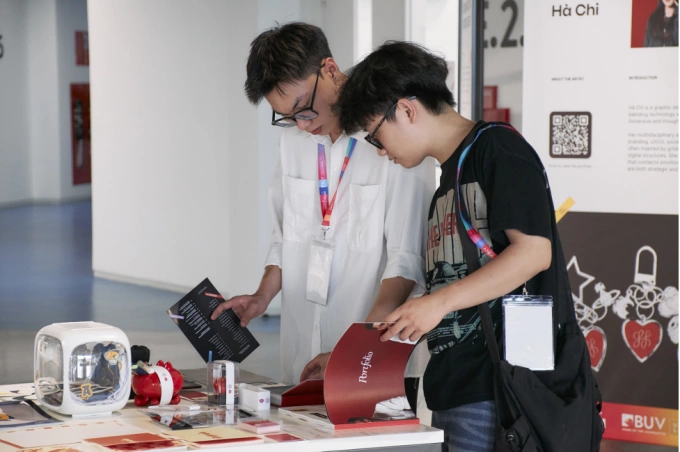 |
Students checking portfolio. Photo courtesy of BUV |
Learning at BUV is structured around a studio-based model that reflects professional practice, minimising the separation between classroom learning and workplace expectations. Students work on real projects and receive feedback from international faculty members and industry practitioners.
This approach exposes students early to professional workflows, performance standards, and the need to articulate and defend design ideas. Assessment is based on portfolios and accumulated project work rather than traditional examinations, providing a clearer indication of students’ problem-solving and conceptual abilities.
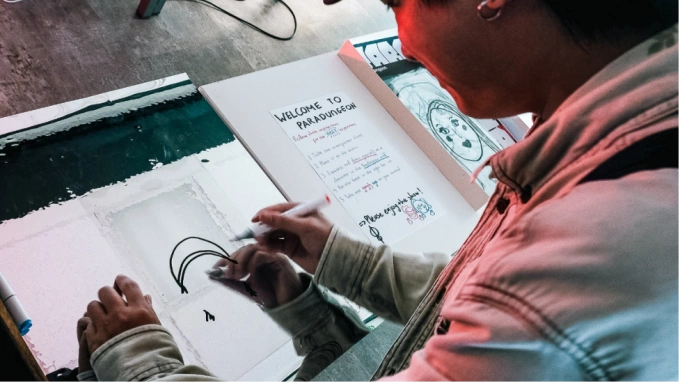 |
A student working on a project. Photo courtesy of BUV |
The curriculum also seeks to balance traditional foundations with digital competencies. Students begin with hand drawing, spatial awareness, and visual language to establish a grounding in form and composition before progressing to digital tools and technology-based design. This structure is intended to help students understand design principles at a fundamental level rather than focusing exclusively on software-driven output.
Interdisciplinary learning is another component of the programme, encouraging students to draw on perspectives from communication, technology, and business when addressing design challenges.
With a fully internationally qualified teaching staff, BUV supports students in developing strengths across different areas, including UI/UX design, brand identity, and brand positioning. The dual-degree model allows students to access U.K. academic standards in Vietnam at a lower cost than studying overseas.
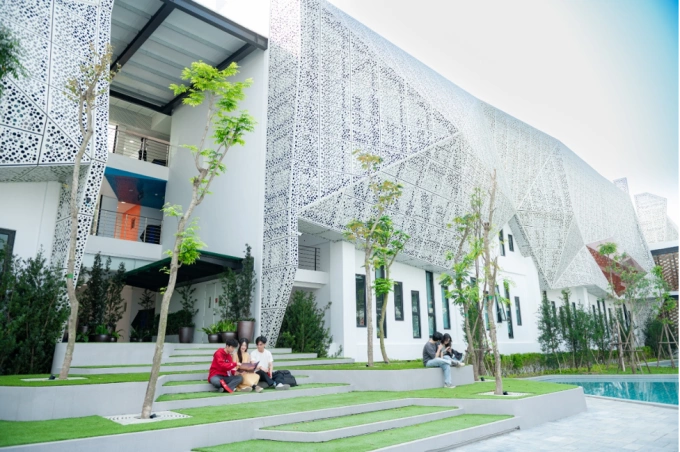 |
BUV campus. Photo courtesy of BUV |
BUV and Manchester Metropolitan University also jointly fund a scholarship scheme with limited slots, reflecting an effort to support talent development for the creative industries by improving access to international-standard education.
British University Vietnam is Vietnam’s first QS 5-star university and the first in Vietnam and ASEAN accredited by QAA, the UK’s higher education quality assurance agency. Its programmes are designed to align with industry developments, combining academic study and practical application, with graduates typically pursuing employment or further study shortly after graduation.
Learn more about BUV’s Graphic Design programme here.
Comments are closed.