
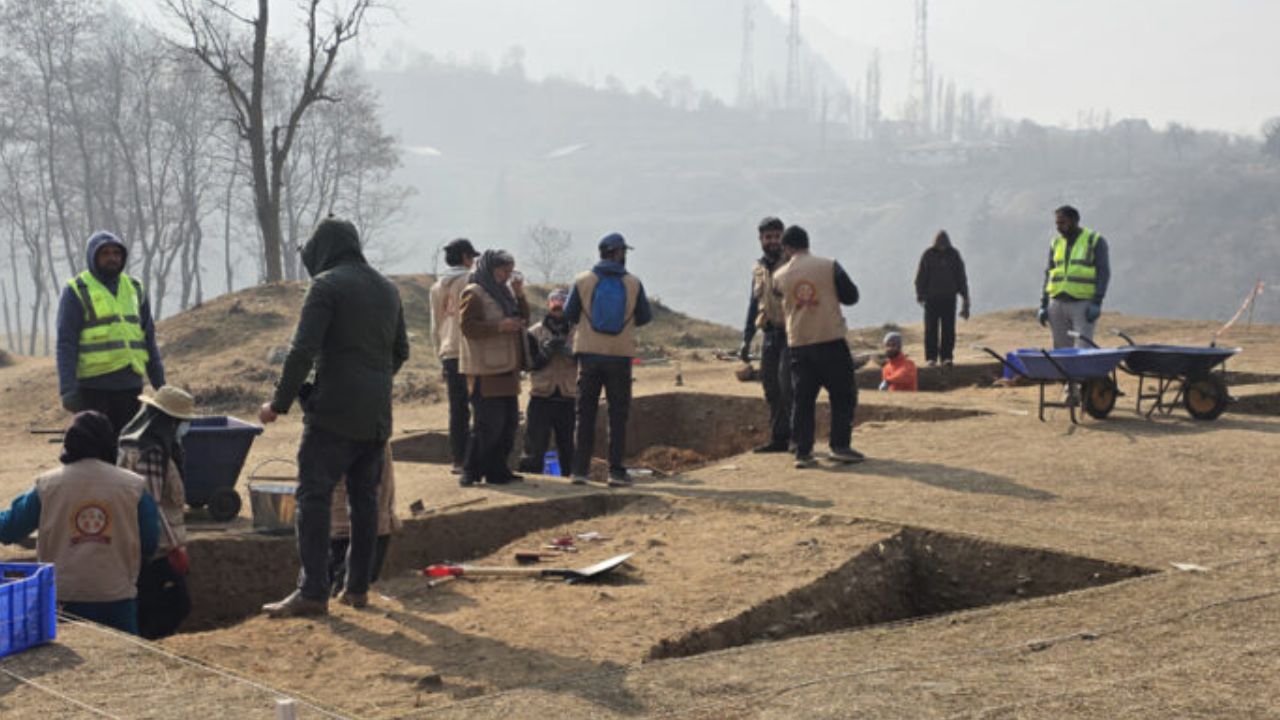

Prime Minister Narendra Modi has mentioned the Buddhist stupas of Jehanpora in Baramulla, Jammu and Kashmir in the Mann Ki Baat program. Prime Minister Modi has said that what people thought was a common hill here, was a Buddhist stupa, in which many traces of the past are buried. He said that these dunes were not created by nature, they were created by humans, about which people were unaware. Due to a coincidence, the Buddhist stupas of Jehanpora were revealed to the world.
Prime Minister Modi said, ‘In Baramulla, Jammu and Kashmir, there is a place named Jehanpora. People had been seeing some high mounds there for years. Ordinary mounds, no one knew what these were? Scientific study of these mounds was started. And then some surprising things started coming to light. It turned out that these mounds are not natural. These are the remains of some big building made by man.
Also read: From curbs to opposition’s offer, the whole story of the ruckus over Brahmin MLAs in UP
Prime Minister Narendra Modi:-
Thousands of kilometers away from Kashmir, an old, faded photograph was found in the archives of a museum in France. Three Buddhist stupas were visible in that picture of Baramulla. From here the times changed and a glorious past of Kashmir came before us.
What is there in Jehanpora?
Archaeologists have unearthed a large Buddhist settlement of the Kushan period in Jehanpora village of Baramulla district of Kashmir. The Archeology Department is gathering more information about this place in Kashmir Valley. This can give new understanding to the ancient history of the area. Here, along with the Archeology Department, students of Jammu and Kashmir and some departments of Kashmir University are working together. The Center of Central Asian Studies Archives and the Department of Archeology and Museums are also involved in this study.
Also read:How influential are Brahmins in UP? Know everything from figures and numbers
The five-month-long excavation has yielded three stupas, walls, pottery, copper items and an apsidal stupa, which are approximately 2000 years old. The site has been identified from old texts such as Rajatarangini, travelogues and ground penetrating radar. Drone survey and mapping also confirmed that large mounds containing remains of ancient stupas have been found. There is still more to be discovered here.

Comments are closed.