
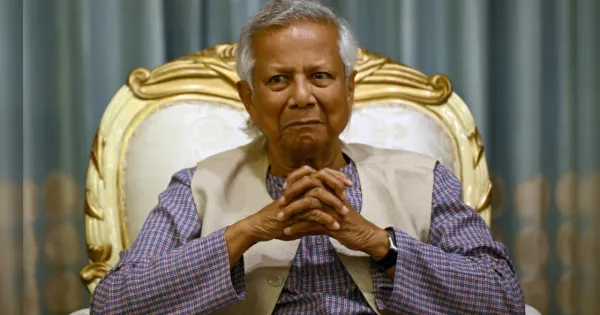
While leaving, Mohammad Yunus showed India the greed of ‘Seven Sisters’! Big questions raised in farewell speech

Dhaka: Bangladesh’s interim chief Mohammad Yunus, in his final address to the nation, claimed achievements during his 18-month tenure and talked about major changes in the country’s foreign policy. He stressed that Bangladesh no longer follows the dictates of any other country, but adopts a completely self-confident, independent and dignified stance.
Yunus raised questions by mentioning ‘Seven Sisters’
In his televised address, Yunus described Bangladesh’s coastline as a strong medium to connect with the global economy. Linking Nepal, Bhutan and the ‘Seven Sisters’ (seven states of North-Eastern India) together, he said that there is immense economic potential in this region. He cited efforts to make Bangladesh’s ports internationally efficient and claimed that with better connectivity the region could become a global manufacturing hub.
Although he did not name India explicitly, he used the term ‘Seven Sisters’ to present the north-eastern states as an equal economic unit with independent countries like Nepal-Bhutan. Experts believe that this is a well-thought-out strategy, which shows an attempt to present the geographical and economic identity of the region from a different perspective.
Challenges of North Eastern States and Role of Bangladesh
India’s seven northeastern states—Arunachal Pradesh, Assam, Manipur, Meghalaya, Mizoram, Nagaland, and Tripura—are far from the sea and are connected to the mainland through the Siliguri Corridor (Chicken Neck). Taking advantage of their landlocked situation, Yunus described Bangladesh as the main means of maritime access for them, so that they can better connect with global trade.
Bangladesh no longer ‘submissive’: Yunus claims
Yunus described his tenure as a turning point for Bangladesh’s foreign policy. “We have strengthened sovereignty, national interest and dignity. Today’s Bangladesh is full of self-confidence, capable and responsible in protecting its independent interests,” he said. Taking an indirect aim at the foreign policy of the era of former Prime Minister Sheikh Hasina, he termed it ‘dependent’ and ‘based on instructions’.
Impact on India-Bangladesh relations
During Yunus’ tenure, tensions between Dhaka and New Delhi increased, particularly over attacks on minorities (especially Hindus) and political issues. It also had a negative impact on business relationships. It is clear from Yunus’s last address that he wanted to present Bangladesh as a strong, independent player, but the mention of ‘Seven Sisters’ remains a matter of concern for India.

Comments are closed.