
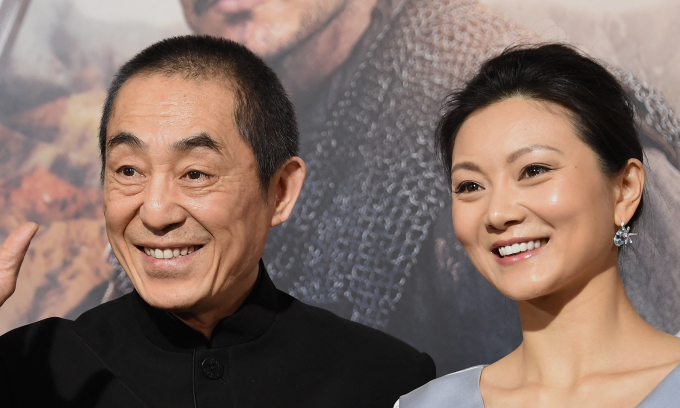

Chinese director Zhang Yimou (L) and his wife Chen Ting attend the premiere of Universal Pictures’ “The Great Wall,” Feb. 15, 2017, at the TCL Chinese Theatre in Hollywood, California, the U.S. Photo by AFP |
The South China Morning Post reported that Chen, now 45, drew attention after appearing at the Beijing premiere of 76-year-old Zhang’s latest film “Scare Out” in mid-February.
Photos of her casual appearance quickly circulated on Chinese social media, where many users praised her youthful look and slim figure despite being a mother of three.
Born in Wuxi in eastern Jiangsu Province, Chen studied dance from a young age and began living independently at a boarding school at 13.
She first met Zhang in 1999, when she was 18, during a casting event for one of his films while studying at the Beijing Film Academy. Although she was not selected for the role, Zhang was reportedly drawn to her “pure and refined” temperament and asked for her contact information after the audition.
The two soon began dating. Chen later decided to leave university and devote herself fully to the relationship. Between 2001 and 2006, she gave birth to their three children: sons Yinan and Yiding, and daughter Yijiao.
The couple did not officially register their marriage until 2011, a step required for their children’s household registration and school enrollment in China.
Their relationship remained largely unknown to the public until 2013, when authorities investigated Zhang for violating the country’s former one-child policy, following accusations from a Chinese actress. Zhang later admitted the violation and paid a fine of 7.49 million yuan (US$1 million).
In a 2018 interview with a Beijing-based fashion magazine, described by the South China Morning Post as the only interview she has granted, Chen spoke about her decision to start a family.
“When Zhang asked me whether I could marry him and have children with him, I agreed without hesitation,” she said. “I am willing to deliver children for him. Also, I think a single child is lonely. So I hope to have more than one child.”
Zhang once told the media that he decided to marry Chen partly due to pressure from his mother, who hoped he would have multiple children, especially sons.
In 1978, Zhang married Chinese writer Xiao Hua, with whom he has a daughter. The couple divorced a decade later.
Following the investigation into the one-child policy violation, Chen has occasionally shared glimpses of her family life online, though she generally continues to keep a low profile. She rarely accompanies Zhang to film premieres or red-carpet events.
In 2022, she announced that she had asked a Chinese social media platform to remove identity verification labeling her as “Zhang Yimou’s wife,” explaining that the designation had been added without her request.
“Everyone has their own life plan. So stop speculating without any evidence,” she wrote.
Over the years, Chen has received increasing praise online for raising their children while Zhang continues to maintain a highly productive filmmaking career, often releasing at least one major film each year.
Their eldest son Yinan, who graduated from the New York Film Academy, has already worked in film as an actor, assistant director, and screenwriter. Their younger son Yiding studies at Yale University, while daughter Yijiao attends the Central Academy of Drama in Beijing.
In her spare time, Chen practices yoga and has obtained a coaching certificate in the discipline. She also continues to perform ballet and occasionally appears on stage with her daughter.
Zhang is widely regarded as one of China’s most influential filmmakers and a key figure in the country’s “Fifth Generation” of directors, according to the official website of the Cannes Film Festival. He began his career as a cinematographer before making his directorial debut in 1987.
He became the first Chinese filmmaker to receive recognition from the Academy of Motion Picture Arts and Sciences, earning Academy Award nominations for Best Foreign Language Film for “Ju Dou” in 1990, “Raise the Red Lantern” in 1992, and “Hero” in 2003.
His films have also won major international honors, including the Silver Lion at the Venice International Film Festival for “Raise the Red Lantern” in 1991, the Golden Lion at Venice for “The Story of Qiu Ju” in 1992 and “Not One Less” in 1999, the Grand Jury Prize at the Cannes Film Festival for “To Live” in 1994, and the Silver Bear at the Berlin International Film Festival for “The Road Home” in 1999.
He also served as chief director of the opening and closing ceremonies of the 2008 Beijing Olympics.

Comments are closed.