
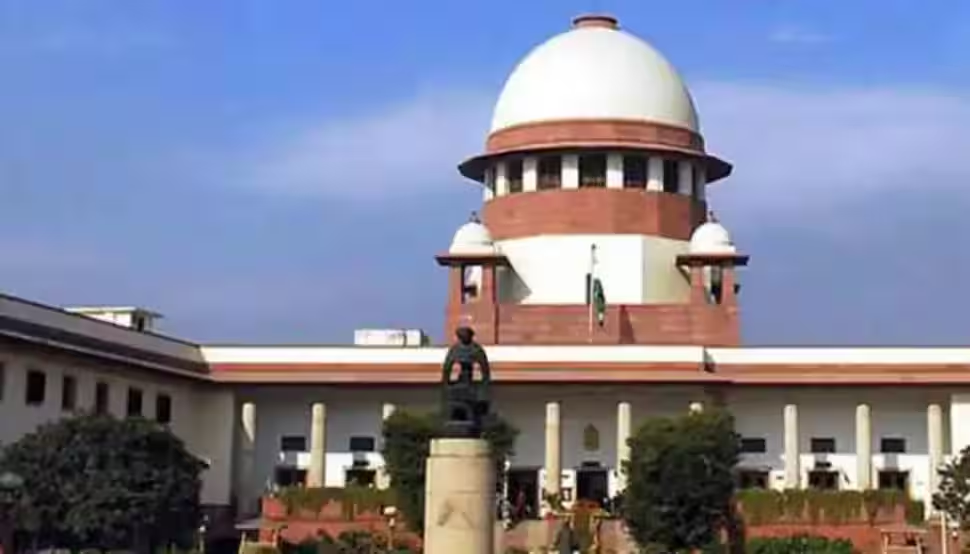

The Supreme Court on Thursday (January 15) reserved its verdict on a petition seeking withdrawal of life support for 31-year-old Harish Rana, who has remained in an irreversible permanent vegetative state since 2013 after falling from a building, Bar and Bench reported. Two medical boards set up by the apex court have observed that Rana has no chance of recovery.
An irreversible permanent vegetative state (PVS) is a severe, long-term condition following brain damage in which a person appears awake (eyes open, sleep-wake cycles) but shows no awareness of self or surroundings, with recovery considered extremely unlikely.
A bench comprising Justice JB Pardiwala and Justice KV Viswanathan was hearing a miscellaneous application filed by Rana’s father requesting the withdrawal of all life-sustaining treatment for his son.
Add Zee News as a Preferred Source
“These are very delicate issues. We decide matters every day, but who are we to decide about someone’s life? We are mortals,” the court said.
If the court approves the request, it will mark the first instance in which the judicial directives of Common Cause are implemented.
What happened to Harish Rana?
Harish Rana, now 31, suffered a severe brain injury in August 2013 after falling from the fourth floor of his paying guest accommodation in Chandigarh while pursuing his B. Tech degree. Since then, he has remained in a permanent vegetative state.
His parents had earlier approached the Delhi High Court seeking the constitution of a medical board to assess whether life-sustaining treatment could be withdrawn under the Supreme Court’s Common Cause v. Union of India guidelines. However, the High Court denied relief, noting that Rana was not on mechanical life support, could sustain himself without external aid, and was not terminally ill, making passive euthanasia inapplicable.
The parents challenged this order in the Supreme Court in 2024, requesting the constitution of a primary medical board. Although initially declined, the court allowed them to reapply if further directions were needed.
As Rana’s condition remained irreversible, his father filed a fresh petition seeking withdrawal of life-sustaining treatment.
Advocate Rashmi Nandakumar, representing the family, stated that Rana has been in a permanent vegetative state with 100% disability for 13 years and that continued clinically assisted nutrition and hydration merely sustain biological life. She argued that Supreme Court precedents, including Gian Kaur, Aruna Shanbaug, and Common Cause, recognize that the right to life under Article 21 also encompasses the right to die with dignity.

Comments are closed.