
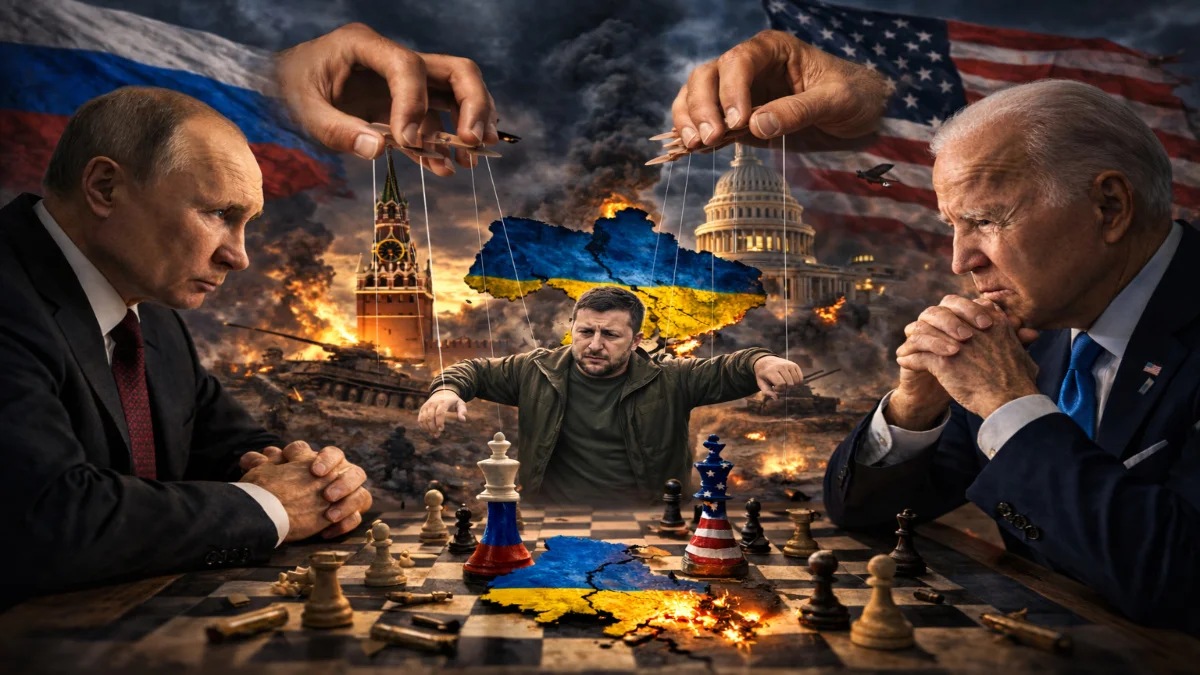

The Ukrainian war has become one of the defining geopolitical crises of the 21 st century that begs a very foundational question that is persistent in debate in the world of diplomatic, academic and journalistic circles: is it a war between Ukraine and Russia, or does it represent a wider strategic struggle between the powers of the world, with Ukraine being the main battlefield of competing interests? Although the sovereignty and agency of Ukraine are the key points of the war, the magnitude and scope of international intervention, especially United States intervention indicates that the conflict cannot be viewed through the prism of a bilateral conflict. Rather, it seems to be part of a broader trend of great-power competition, the grievances of the past, a sense of security, and geopolitical struggles overlap.
The US has become the strongest external ally in Ukraine since the outbreak of hostilities in 2022. Under Washington, there has been very wide military, financial and intelligence support which has helped Kyiv to continue fighting against the Russian troops. This assistance has covered the sophisticated weapons, battlefield intelligence, the coordination of logistics and training programs carried out in Ukraine and other allied nations. Financial aid packages have also been used to stabilize the economy of Ukraine and keep the government of Ukraine running in the stress of wartime conditions. In the light of Washington, this support is seen as the need to protect the rules-based international order as well as the need to help a sovereign nation to deal with aggression. Simultaneously, it coincides with the larger U.S. strategic goals that are targeted to avoid the growth of Russian influence in Europe.
The richness of this involvement has inevitably spawned an argument on the broader forces that influence the conflict. Opponents of the Western military assistance claim that the long-term aid will fuel the duration of the war by removing the motivation to compromise and negotiate. The advocates respond that this kind of aid is necessary so that Ukraine can be able to protect itself and negotiate in a strong position. No matter these varying interpretations, the magnitude of the involvement shows that the war has become integrated into the larger geopolitical arguments that go far beyond the borders of Ukraine.
To explain these dynamics, one needs to look at the history of tensions between the United States and Russia, which date back to the time of the existing conflict. Since the Cold War had ended, the relations between Washington and Moscow have been characterized by the periods of cooperation and conflict. The expansion of the North Atlantic Treaty Organization towards the east is one of the most controversial issues. To Russia, the expansion of NATO to its borders is a direct threat to its security environment and depth. Russian leaders have raised this argument numerous times stating that this expansion would qualify to nullify the previous promise made by the transitioning period following the Cold War though the Western governments deny that any promises were ever made formally.
These fears were enhanced by the fact that Ukraine was slowly edging near western political and economic institutions. To a high number of policymakers in Moscow, the likelihood of Ukraine becoming a member of NATO or becoming a full member of the western systems of security was considered an unacceptable change in the regional balance of power. Russian officials have always put their actions into the context of avoiding the strategic encirclement and maintaining national security interests. Western governments on the contrary believe that sovereign states are entitled to make their own choice of alliances and no outside pressure can determine security arrangements.
The split between Russia and the West has been enhanced through economic actions. Ever since the onset of the conflict, the United States and its allies have imposed blanket sanctions on major parts of Russian economy, such as finance, energy, technology, and defence. Such sanctions are expected to limit the ability of Russia to continue its military activities and to inflict economic burdens that could be successful in changing the policy. Nevertheless, they have also enhanced the geopolitical realignments as Russia has been interested in furthering economic partnership with nations beyond the Western sector, such as its partners in Asia, Middle East, and Global South.
It is in this larger context that some of the analysts can see the war as having those features that are traditionally connected with proxy wars. In the modern history, the contention between the rival powers was a common situation where opposing sides in the conflict at the local level were backed by the larger power, pitting them in the conflict on the bigger stage. The Cold War era saw many wars, such as Korea and Vietnam, Afghanistan, etc. being directed by the same dynamics. Those who use this framework to analyze Ukraine note the widespread military and financial support that the western nations have been giving Ukraine as a pointer that the war has taken a more geopolitical context.
But other people warn of diminishing the role of Ukraine to that of a passive proxy. The leaders and citizens of Ukraine have repeatedly stressed that their fight is all about the defense of the national sovereignty, territorial integrity, and political independence. The attitude of people in Ukraine to the fight against Russian forces is very strong and represents the national mobilization process that cannot be justified by some outside forces. This point of view highlights the significance of viewing Ukraine as an independent actor influencing the direction of the war instead of a platform on which other larger powers are fighting.
This difference between the interpretations indicates the intricacy of the conflict. On the one hand, the war is obviously due to local reasons, such as historical issues between Russia and Ukraine, national accounts, and disputes of territories and political orientation. Conversely, the intervention of foreign powers has clearly increased the scope of the conflict and made it a frontline in the changing order of the geopolitical world.
The war has far reaching strategic implications that are far wider than Eastern Europe. To NATO members and other western allies, they feel that it is necessary to protect Ukraine because it would maintain stability in Europe and prevent future aggression. To Russia, the war is frequently being marketed back home as the struggle to defend against the alleged Western intrusion to it. In the meantime, the war is perceived by many nations not directly engaged in the conflict via the prism of changing the balance of power across the world, economic shocks, and energy security issues.
These opposing views have rendered the diplomatic solution to be unbelievably hard. A number of negotiation efforts such as initial negotiations that were made soon after the outbreak of hostilities did not lead to a permanent resolution. Both parties hold terms that the other considers to be unsatisfactory and the further stream of military assets into the war has only made the lines more difficult instead of making them softer. Consequently, the war has plunged into a long-term and devastating stalemate, at the cost of many human and economic lives.
In spite of these factors, the conflict will be ultimately resolved, probably, through the new wave of diplomatic interests of all key stakeholders. The realization of sustainable peace would necessitate focusing on the direct aspect of the problem of territory and security but also on the general strategic concerns that have defined the clash between Russia and the West. Devoid of such a dialogue, there is a danger that the war will keep playing the role of a center of great-power rivalry extending the instability in Europe and beyond.
In conclusion, the war in Ukraine is a demonstration of how intensively challenging it is to separate local conflicts with international politics of power within an ever-globalized world. Although the struggle of Ukraine to obtain sovereignty has become the core of the conflict, the involvement of external powers on a great scale has turned the war into a great geopolitical game with a much greater impact than the region. It is possible that by appreciating this complex reality the future attempt at shifting confrontation into negotiation and ultimately achieving a lasting peace can be done.

Comments are closed.