
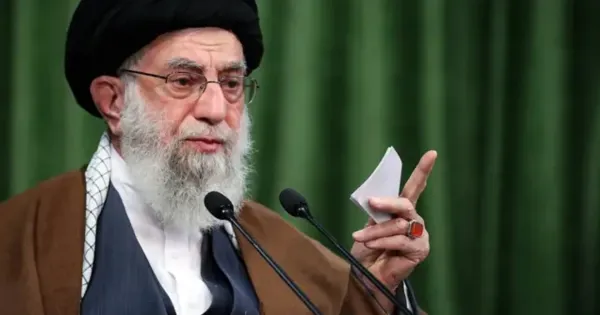

New Delhi. The thinking of America and Israel behind the assassination of Iran’s supreme religious leader Ayatollah Ali Khamenei was that his sudden death would pose a serious threat to Iran’s current governance system and the country would plunge into anarchy. After this, the anti-Iran elements present in the country will take advantage of this situation and start an anti-government mass movement, which will lead to the formation of a new government in Iran.
This calculation may have been inspired by the cases of Muammar al-Gaddafi and Bashar al-Assad in Libya and Syria respectively. However, the difference between Iran and those countries is that there the future of the state was linked to a single person, whereas in Iran the situation is completely different. In very few governments in the world will a single position wield as much power as Iran’s Supreme Leader. Religious legitimacy, command of the armed forces and final political decisions are all included in this one verse. Soon after Mr Khamenei’s death, top regime officials appointed a three-member ‘Leadership Council’. It includes President Massoud Pezeshkian, Chief Justice Ghulam Hussein Mohseni AJE and ‘Guardian Council’ member Alireza Arafi. The Guardian Council is a powerful body with 12 members that keeps an eye on political candidates and can veto laws passed by Parliament. This ‘Leadership Council’ will perform the roles of the Supreme Leader until the next Supreme Leader is elected.
After this, Iran’s ‘Assembly of Experts’ (a group of 88 elected clerics) will work to choose the next supreme leader. It is noteworthy that in 2024, the Guardian Council had barred former Iranian President Hassan Rouhani from contesting elections for the Assembly of Experts. Rouhani is considered a moderate leader whose administration signed the nuclear deal in 2015. Additionally, the key to electing the next supreme leader will also be held by the clerics of ‘Qom’ city. This historical city in central Iran is considered one of the most important religious centers of Iran. The city of Qom, its madrassas and religious institutions play a key role in the ideological framework of Iran. Qom is home to one of the world’s largest Shia madrassas, ‘Hauza Ilmiya Qom’. It trains thousands of clerics and scholars. The city is also famous for the shrine of ‘Fatima the Innocent’ and serves as the ‘brain’ for the theocratic state of Iran.
Since the Islamic Revolution (1979), clerics trained in Qom have shaped Iran’s ideology and guided its system of governance. Many political figures of Iran have spent important years of their training or teaching in the madrassas of Qom. This includes Ayatollah Ruhollah Khomeini to Ayatollah Ali Khamenei. The title of Ayatollah (Sign of God) is not chosen by public voting. It is a scholarly honor bestowed through recognition by peers and religious authorities and is often held within the seminaries of Qom. The Maulvi selected for this must have exceptional mastery of Islamic law, ethics and jurisprudence. The importance of the Supreme Leader under Iran’s political system is that he has ultimate authority over all branches of the government, including the military, the judiciary, and the state media. The President and parliamentary bodies also work under their protection and within the limits set by them.
The Supreme Leader derives this authority from the principle of ‘Velayat-e Faqih’ (Protection of the Islamic Jurist), which was propounded by Ayatollah Ruhollah Khomeini and which places the Supreme Leader at the apex of both religious and state authority. The word Ayatollah, originating from the Arabic and Persian languages, signifies a sign from God or a symbol of religious authority. This title is given to high-ranking clerics in Shia Islam to demonstrate their advanced theological knowledge and moral authority in the community. The title emerged in the late 19th century and became more prominent in Iran due to the Safavid dynasty, which made Shia Islam the state religion. Ayatollah Khomeini gained immense influence in the 1970s, particularly during the Iranian Revolution of 1979, which led to the establishment of a theocratic government in the country. This title is generally awarded to those who have completed extensive studies in Islamic jurisprudence and theology.
Ayatollahs serve as spiritual leaders who provide guidance on both moral and religious dilemmas. Earning this degree typically requires years of education. In modern times, the title is still widely used in Shia communities of Iraq, Iran, and Lebanon, where ayatollahs continue to shape Shia identity and political dynamics in the Middle East. The names of Ayatollah Khamenei’s successors include Mojtaba Khamenei, Alireza Arafi, Mohammad Mehdi Mirbagheri, Ghulam-Hussein Mohseni-Ezei, Hassan Khomeini, etc.
Mojtaba Khamenei is the second son of Ayatollah Khamenei and is known to hold significant influence among administrators and the IRGC. Alireza Arafi is a 67-year-old cleric who is considered an influential figure in Iran’s religious establishment but is not widely accepted as a politician. Mohammad Mehdi Mirbagheri is a member of the Assembly of Experts and is widely known for his criticism of the West. Gholam-Hossein Mohseni-Ezei is a senior Iranian cleric who currently heads the country’s judiciary. Hassan Khomeini is one of the most talked about names in succession discussions. He is the grandson of Ayatollah Ruhollah Khomeini and is also the custodian of his grandfather’s mausoleum in Tehran.

Comments are closed.