
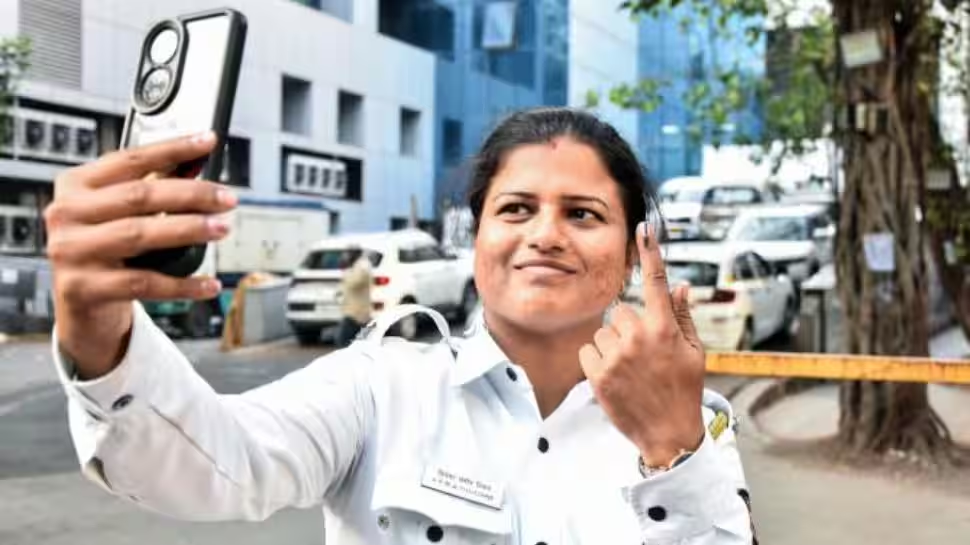

BMC Election Results 2026: The Brihanmumbai Municipal Corporation (BMC) elections have drawn attention across the country as one of India’s most important local polls. With 227 seats up for grabs, the results will not only decide the future of Mumbai’s governance but also influence politics at the state and national level. After nearly four years without an elected civic body in Asia’s richest municipal corporation, voters finally headed to the polls on January 15, 2026.
BMC’s importance goes beyond local administration. It manages one of India’s richest and most strategically important cities, where resources, infrastructure decisions and administration affect millions of urban lives and economic flows. It influences how the city develops.
The BMC’s budget runs into tens of thousands of crores, making the civic body a powerful institution whose leadership guides development, public services and even political narratives. In addition, this election was held at a time when Maharashtra’s politics was divided, with the Shiv Sena splitting, the Maha Vikas Aghadi (MVA) breaking apart and the Congress choosing to run alone in many areas.
Add Zee News as a Preferred Source
Across the city, more people voted compared to 2017 and there were changes in the number of candidates. These patterns show how political strategies and the city’s politics are developing.
Emerging patterns from exit polls, political realignments and Opposition strategies point to three scenarios that will influence Mumbai’s next civic administration and could also change political fortunes beyond Maharashtra. Let’s examine what the outcome could mean under different winning scenarios.
A Victory For The BJP And Its Allies
Exit polls have predicted a strong performance for the BJP-led Mahayuti alliance, which includes the Bharatiya Janata Party, the Eknath Shinde faction of the Shiv Sena and allied supporters. Multiple pollsters estimate that the BJP-Shinde combination could win between 131 and 151 of the 227 seats. This would put them well above the majority mark of 114.
This result follows recent trends in Maharashtra, where the Mahayuti bloc has gained support, especially in middle-class and suburban areas. The BJP itself contested a high number of seats, while its allies coordinated closely across many wards.
If the BJP and its allies win a clear majority, Mumbai’s governance and policies are likely to see smoother functioning. Political alignment across the BMC, the state government and the central government would reduce administrative hurdles and allow faster execution of infrastructure projects, budgets and reforms.
From coastal upgrades to public safety and service improvements, existing or planned schemes could continue without delays, as the alliance focuses on large-scale civic development, drainage solutions and modernizing the city.
A united BMC would also be better positioned to secure financial support from the state and central governments, bringing more funding for stormwater management, transport upgrades and tech-based urban planning.
Ultimately, a decisive win would give the alliance political stability, letting it concentrate on long-term civic planning rather than internal negotiations or compromises.
A Mahayuti majority in the BMC would have political benefits beyond running the city. Winning in Mumbai, India’s financial capital, would strengthen the BJP’s image as an effective party in governance, service delivery and urban development. It could also weaken regional rivals by showing that traditional voter support is moving toward the alliance, especially in suburban areas.
Success in the BMC would give the party experience and political momentum that could be used in upcoming state assembly and national elections, helping with candidate choices, campaign planning and organization building.
While these political gains are important, there would still be challenges and internal dynamics to manage. Even with a majority, the alliance would need to carefully handle the distribution of power, particularly between the BJP and its regional allies. Decisions like the mayor’s position, committee allocations and ward-level resource distribution would require careful political balancing.
Victory For The Thackeray Brothers
The 2026 BMC elections have drawn attention because of the attempted political reunion of the Thackeray cousins, Uddhav Thackeray and Raj Thackeray, whose traditional strongholds have influenced Mumbai’s politics for decades. Ahead of polls, they jointly released a manifesto under the banner of ‘Shiv Shakti Vachan Nama’, appealing to Marathi identity and welfare of local residents.
Although exit polls suggest the Thackeray alliance, combining Uddhav Thackeray’s Shiv Sena (UBT), Raj Thackeray’s Maharashtra Navnirman Sena (MNS) and allied partners, trails behind the Mahayuti bloc, they are still competitive, with multiple surveys projecting around 58-68 seats.
For the Thackeray alliance to win, several factors would be important. Lower voter turnout or dissatisfaction in suburban areas, where the BJP is stronger, could change results in island city wards that traditionally support regional parties.
The cousins’ test would be whether they managed to work together effectively and split BJP votes in key wards, especially in areas where multiple parties contested and anti-BJP votes could be divided.
Finally, while their manifesto focuses on Marathi pride and resident welfare, they would also need to address everyday city issues like flooding, sanitation and local infrastructure to gain support from all communities, including non-Marathi populations.
A Thackeray-led BMC majority would represent a strong political comeback and reinforce the importance of regional leadership in urban Maharashtra. It would also show that national parties do not have a monopoly over civic governance, especially in traditional Shiv Sena areas.
A loss for the BJP in Mumbai could also force the party to rethink its urban strategy and messaging ahead of future elections.
Under the Thackeray alliance, the focus of policies might move toward local issues, with more attention to heritage areas, working-class neighborhoods and community-focused governance.
However, running the BMC would come with challenges. Bringing together different regional groups with varying priorities could slow decision-making and require extensive negotiation. Securing funding from the state or central governments, especially if controlled by rival parties, could also require careful political and financial management.
Congress and Allies – Key Role And Gains
The Indian National Congress, which is contesting independently or in loose alliances, has positioned itself as a major alternative to both the Mahayuti and regional coalitions. The party campaigned on governance, civic services and inclusive development themes.
While exit polls predict the Congress-aligned bloc may secure a smaller share of seats, around 12-24 seats, according to various projections, this outcome does not necessarily diminish the party’s strategic value on Mumbai’s political map.
In a multi-party scenario, even a modest number of seats can give Congress an important role in Mumbai’s civic administration. If no single bloc wins a clear majority or if disagreements arise within alliances, the grand-old party could use its seat share to influence committee decisions, civic appointments and policy-making.
Performing better than expected would also help the party rebuild its presence in the city and strengthen its reputation for handling local governance. With representation in important wards, Congress members could focus on important civic issues such as water supply, public health and sanitation, which affect a wide range of communities.
A stronger Congress presence in the BMC could attract urban voters who are unhappy with both the major national alliances and regional parties, as they may prefer Congress’s focus on practical governance. The party could also form strategic alliances with smaller groups and independent candidates who were elected for local reasons, working together on specific policy issues.
A good performance in the BMC elections would help the Congress rebuild its organization in the city and create momentum for future state assembly elections.
What Each Scenario Could Mean For The City
The 2026 BMC elections could change how Mumbai is governed, no matter which party or alliance comes out on top. Voters have shown that they care more about basic services like drainage, sanitation and drinking water than party or identity politics and these priorities are likely to influence governance.
Higher voter registration suggests people are more engaged in civic issues, even as the number of candidates has gone down, showing that parties are focusing on fewer and more strategic choices. With three main blocs (the Mahayuti, the Thackeray alliance and the Congress or other smaller parties), the elections are highly competitive and every ward matters for the overall balance of power.
The importance goes beyond simply electing councillors. These elections are a test for parties trying to strengthen their influence in Maharashtra’s most important urban area. A Mahayuti win, a Thackeray comeback or a strong showing by the Congress would each influence Mumbai’s governance, policy focus and future political alignments in different ways. Ultimately, Mumbai’s voters have voted not only who represents them, but also the city’s priorities, the direction of its policies and the balance of power in one of India’s most politically active states.

Comments are closed.