
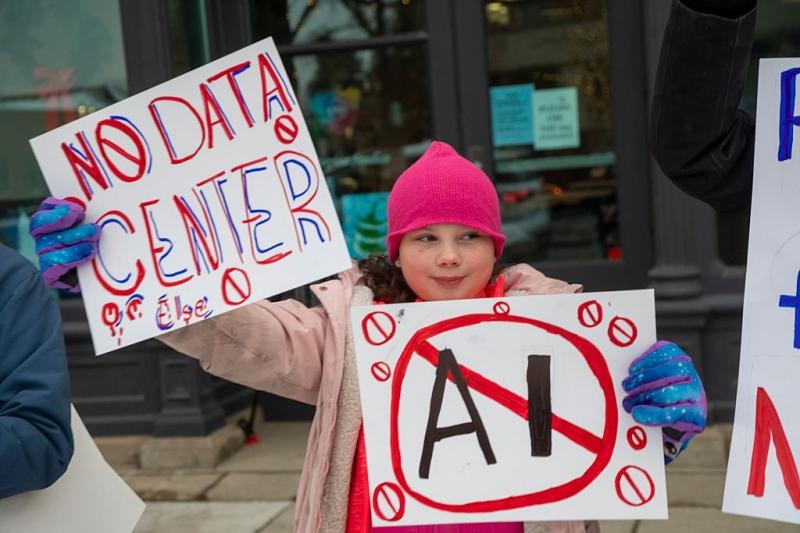

The hype surrounding artificial intelligence continues to resonate in the halls of corporate suites and financial circles. Many business leaders and investors believe AI holds the promise of reducing costs and increasing profits. However, outside these circles, the narrative does not resonate. In fact, new polling indicates Americans increasingly view AI as a risk, not an opportunity.
The most compelling result of this new polling is how Americans believe the government should address the challenges of AI. Americans were asked to choose between supporting workers displaced by AI or incentivizing tech companies to continue innovating. The majority chose supporting workers.
This is significant. For years, the notion that everyone else would benefit from the success of the wealthy and powerful drove much of the debate. However, this new polling indicates this notion no longer holds. Americans are no longer willing to accept the loss of jobs today with the promise of benefiting tomorrow.
Public Anxiety Over Corporate Accountability and Economic Fairness
There is also a strong consensus in favor of making companies answerable. The respondents are more than willing to share the burden of the loss of their jobs due to the application of AI technology.
The respondents are in favor of making tech companies answerable and are willing to share the burden of the loss of their jobs due to the application of AI technology. The respondents are not in favor of the free market principle, where the company can gain as much as it wants from the application of AI technology.
The respondents are experiencing a sense of strain in their lives, as they feel that their lives have become less affordable in the last year. The respondents are not confident about their financial future, as only a small percentage are confident about the same.
The respondents are of the opinion that the system is designed in a way that the elites are favored, and the big companies are charging higher prices in an unfair manner. The respondents are of the opinion that AI is just one more factor that may further widen the gap.
AI is also rising as a public issue. It still ranks lower than top concerns, but it is climbing fast. It now ranks ahead of several long-standing topics. That shift signals growing awareness and concern. People are paying attention to how AI may shape jobs, wages, and the wider economy.
Why AI Success Requires a New Social Contract?
One reason for that concern is a lack of trust in government action. Many people say they do not see a clear plan to deal with job losses from AI. They worry about young workers entering a tougher job market. They also fear that whole industries could shrink or vanish before new roles appear. These are not abstract risks. They connect to real fears about income and stability.
Public trust in common pro-AI messages is also weak. Claims that AI will boost growth for everyone do not convince most people. Even fewer believe that AI will not lead to large job losses. These views show a gap between how leaders talk about AI and how the public hears it.
This gap has clear political stakes. Messages that focus only on innovation or global competition may not resonate. Voters seem more focused on protection, fairness, and accountability. They want to know how change will affect their work and pay, not just how it will help the economy in the long run.
If policymakers want to build trust, they may need to shift their approach. That could include stronger safety nets, clear plans for retraining, and rules that tie company gains to worker outcomes. It may also mean clearer communication about risks and trade-offs.
That AI will continue to advance is beyond dispute. The question is how the benefits and drawbacks will be apportioned. The current perception is that the burden will fall on the worker. Until that is resolved, the public is unlikely to wholeheartedly embrace the promise of AI.

Comments are closed.