

Store owners in Johor Bahru have reported an unusually quiet year-end period, which was typically marked by an influx of Singaporean visitors.
Robin Jian, who owns a café frequented by visitors from the city-state, said the last two months of the year are often the busiest for local businesses.
“But that does not seem to be the case this time,” he told Malaysian newspaper The Star earlier this month.
“The crowd from Singapore is missing, even on weekends. This is probably the worst year-end crowd we have seen since the Covid-19 pandemic,” he noted, estimating the drop at 30-40%.
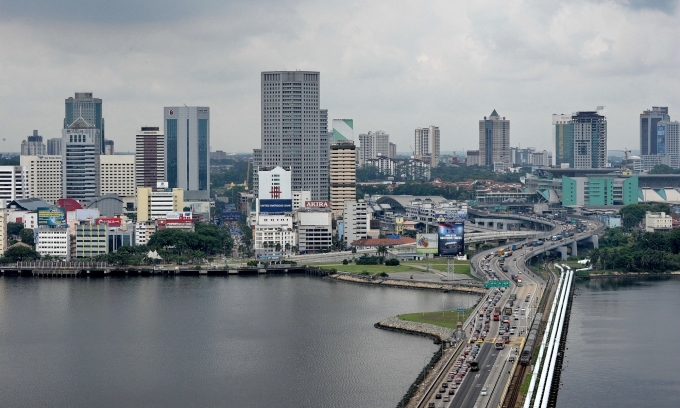
This photo taken on Nov. 26, 2013, shows a view from Singapore of the border crossing into the Malaysian southern city of Johor Bahru. Photo by AFP |
Johor Bahru, the capital of Malaysia’s southernmost state of Johor, sits just across the border from Singapore and is linked to the city-state by the Johor-Singapore Causeway.
The crossing is heavily used each day by Malaysians commuting to work and Singaporeans drawn by lower prices for goods and services, especially during the year-end school holidays.
Last year, Singapore’s Immigration and Checkpoints Authority said more than 3.4 million travelers crossed the land checkpoints between Nov. 15 and 21, the first week of the holiday. Crossings peaked on Dec. 20, 2024, when about 562,000 travelers passed through the Causeway, a record at the time, as reported by The Straits Times.
This year, the school holidays run from Nov. 22 to Dec. 31 and local businesses had expected a similarly busy season.
But like Jian’s café, stores across the city with mostly Singaporean clientele, ranging from hair salons to massage parlors, have also reported declines of 10-30% in business. Those that saw comparable foot traffic, meanwhile, said spending has dropped from a year ago, according to Mothership.
Food and beverage was the outlier though, as many outlets have reported stable or even increasing traffic.
The slowdown has been felt not just by stores but also locals. Raj, who frequently travels from Malaysia’s Selangor state to Johor, said he was struck by the smaller number of Singapore-registered vehicles on the roads and in shopping mall car parks early this month.
“Usually, the weekends are full of Singaporeans coming over to shop and eat out. It would be so difficult to get a parking lot and the shelves at the supermarkets are also almost emptied out,” he said.
Jian and many other store owners have attributed the fall in the number of Singaporean customers largely to the stronger ringgit.
The Malaysian currency has rallied sharply this year, making it Asia’s best-performing currency. Singaporeans traveling north are now looking at around RM3.17 (US$0.78) to the Singapore dollar. It was RM3.36 in April and above RM3.5 early last year, per Bloomberg.
However, Tey Tian Hwang, chairman of the Johor Baru Small Businesses Association, believes the key reason is the rainy and gloomy weather.
“While the stronger ringgit may have some effect, I believe the weather plays a more significant and decisive role,” he said.
Concurring, 52-year-old businessman S. Sures said the city has seen heavier and more unpredictable rainfall this year-end.
He added that multiple upgrading projects, particularly in the town area, have worsened the already heavy traffic and difficult-to-find parking, which may have also contributed to the slowdown.
“I think all of these factors, along with the ringgit’s stronger position against the Singapore dollar, have created the perfect storm,” he said.
Some Singaporeans have said they prefer to visit Johor Bahru closer to Chinese New Year for festive shopping and have therefore delayed their trips until January 2026, as the holiday will fall later in February compared with this year, according to AsiaOne.
Nonetheless, businesses are optimistic that conditions will turn around soon. Tey said an uptick in visitors from Singapore is expected as early as this weekend, adding that currency strength is unlikely to be a major deterrent given that prices for goods and services in Johor Bahru remain lower than in the city-state.
“Regardless of the weather or currency exchange, we are likely to still see more crowds from Singapore soon as they are used to shopping and holidaying here, especially at this time of the year,” he noted.
Fuad Rahmat, president of the Johor Baru Bazaar Karat Development and Welfare Association, said the city is also set to benefit from improved connectivity following the recent launch of the electric train service linking it to Kuala Lumpur.
“The rainy spell has dampened business here but once it clears up, we should be able to see large crowds,” he said.

Comments are closed.