
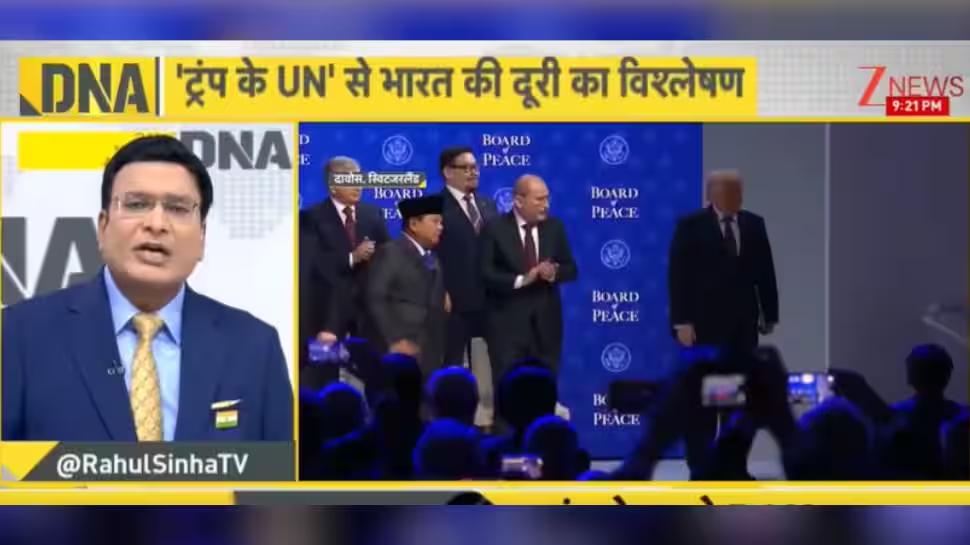

US President Donald Trump’s foreign policy initiatives are increasingly being seen as isolating the United States from major global stakeholders, with India emerging as a key country maintaining a strategic distance. One such instance was India’s decision to stay away from the Trump-proposed Gaza Peace Board meeting held on January 22 in Davos, Switzerland.
The meeting, attended by several Arab nations and Pakistan, was also extended an invitation to India. However, New Delhi chose not to send any representative. The move is being viewed as a deliberate diplomatic signal reflecting India’s disagreement with Trump’s approach to global conflict resolution.
One of the primary reasons behind India’s absence was Trump’s decision to sideline the United Nations. Traditionally, ceasefires and post-conflict rehabilitation processes are overseen by the UN and its agencies. However, Trump kept the UN out of the Gaza ceasefire framework and instead promoted a parallel structure involving private entities. India, which has consistently upheld the primacy of multilateral global institutions, viewed this as undermining the UN’s authority.
Add Zee News as a Preferred Source
Analysis of the ‘hanging war’ between Trump and Caliphate
PAK bowed before Trump…India will not bow
Muslims will hoist the tricolor on the mosque…fanatics will stop them!See #DNA LIVE with Rahul Sinha#DNAFriends #ZeeLive #ZeeNews #DNAWithRahulSinha@RahulSinhaTV
https://t.co/bCUN3H98Zd— Zee News (@ZeeNews) January 23, 2026
Secondly, Trump’s inclusion of Pakistan in the Gaza Peace Board raised serious concerns in New Delhi. India considers Pakistan a state sponsor of terrorism, and its presence in a so-called peace initiative was seen as diluting the credibility of the process. This further reinforced India’s decision to distance itself from the initiative.
Another major factor was the perceived bias within the Peace Board. While Israel was included, no senior representative from Gaza or the Palestinian Authority was given a seat at the table. Even rules and frameworks for the board were reportedly discussed only with Israel, sidelining Palestinian voices, an approach India does not endorse. India has long maintained that Gaza is a bilateral issue between Israel and Palestine, and any resolution must involve both parties equally.
Meanwhile, global resistance to Trump’s assertive diplomacy appears to be coalescing around India. European Commission President Ursula von der Leyen is scheduled to visit India on January 26, followed by Brazil’s President Lula da Silva. Leaders from Russia and Germany have also engaged closely with New Delhi, indicating a broader alignment against unilateralism.
India’s refusal to join the Gaza Peace Board thus reflects not isolationism, but a principled stand, one that reinforces its commitment to multilateralism, balanced diplomacy, and global equity.

Comments are closed.