
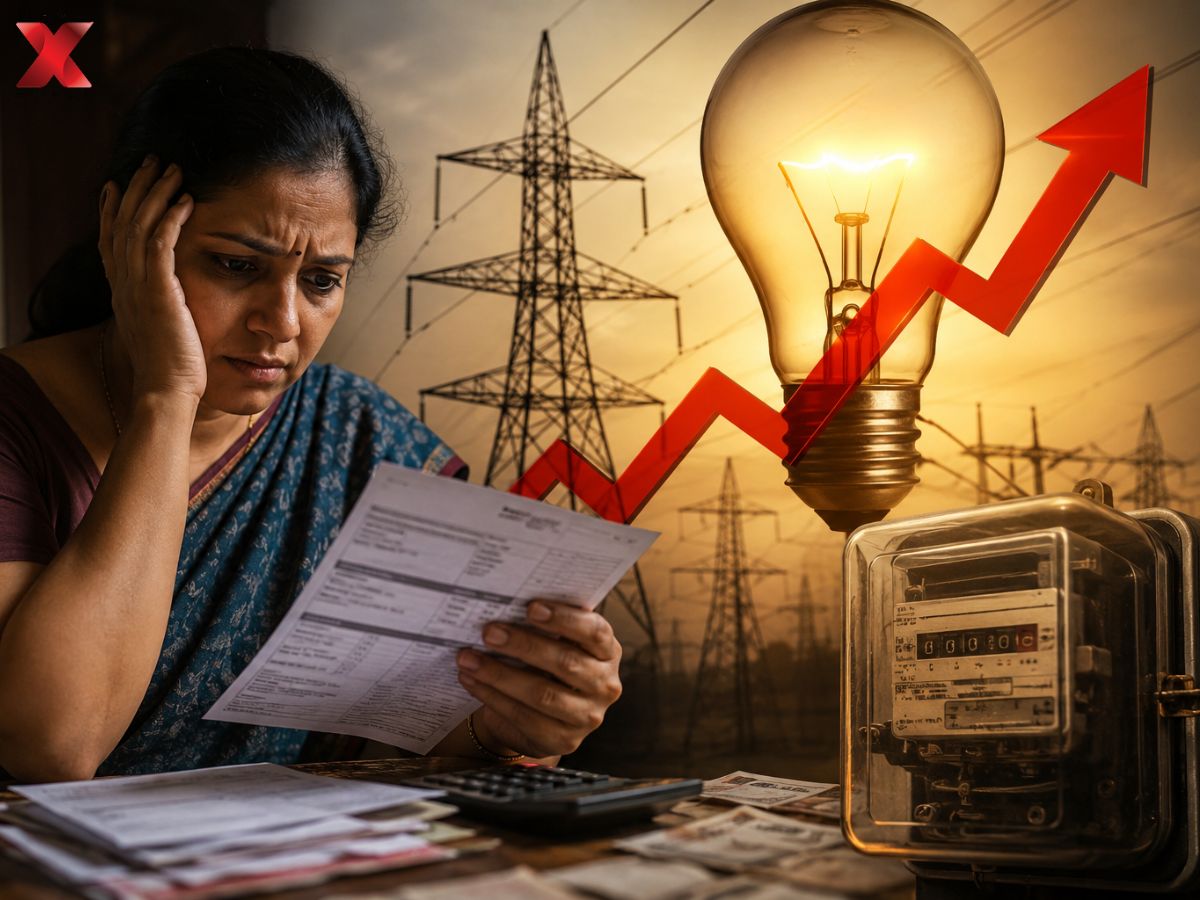

UP electricity bills are set to get costlier from June as UPPCL imposes a 10% fuel surcharge. The additional charge will be added to power bills to help distribution companies recover higher fuel and power purchase costs. But why are consumers being asked to pay more now? Uttar Pradesh Power Corporation Limited (UPPCL) has decided to levy 10% of Fuel and Power Purchase Adjustment Surcharge (FPPAS) on power bills, implying that the people of Uttar Pradesh will have to shell out more for electricity from June. The enhanced tariff would be levied on all types of consumers, that is, domestic and commercial as well as industrial ones. The move comes as energy demand has surged across the state amid intense summer heat and rising fuel costs around the world.
This is an additional charge that will be included in the electricity bills issued in June and is expected to increase the monthly expenditure of millions of consumers. The extra levy was required to recover the increased fuel and power procurement cost incurred by the distribution companies, the UPPCL said.
Why is the Uttar Pradesh electricity bill going up?
UPPCL charges the surcharge under the Fuel and Power Purchase Adjustment Surcharge (FPPAS) mechanism, which allows power distribution companies to pass on the extra cost of fuel and power purchases to consumers.
The utility mentioned that the surcharge reflects the March 2026 price, which the UPERC notification states will be recovered after three months.
The letter issued by Pankaj Saxena, Chief Engineer, Regulatory Affairs Unit (RAU), stated, “Fuel and Power Purchase Adjustment Surcharge (FPPAS) calculated for the month of March, 2026 as per regulation is to be charged in the month of June, 2026. FPPAS chargeable is 10% for the month of March, 2026 to be charged in the month of June, 2026. I have been directed to request you to implement the same for all categories of consumers as per provision of the regulation,” as reported by ANI.
The operation of the new FPPAS mechanism
The extra charge has been imposed under the Multi-Year Tariff (MYT) Regulations, 2025, of UPERC. Power distribution companies can pass on any additional expenses incurred in the purchase and transmission of electricity to consumers after a lag of three months.
Explaining the process, Saxena said, “As per the regulation, any extra power purchase and transmission costs incurred in a given month are recovered after a delay of three months. This means the additional cost incurred in March 2026 will be recovered from consumers in June 2026.”
He added that the surcharge for March 2026 has been worked out at 10% in terms of Clause 16(4) of the MYT Regulations, 2025. The 10% FPPAS shall be charged on the June 2026 bills and shall be applicable to all consumer categories.
The cap on fuel and power purchase adjustment surcharges has also been provided in the MYT Regulations, 2025. The Fuel and Power Purchase Adjustment surcharge shall not exceed 10% in any one billing cycle; any excess shall be carried forward for recovery in subsequent cycles, as per the MYT Regulations, 2025. This will help the distribution companies to recover the genuine cost without steeply impacting the customer electricity bill.
It also makes it mandatory for the distribution companies to charge the surcharge uniformly and publish the detailed calculation sheet on their websites for transparency purposes.
Rising power demand behind the decision
This jump has been observed as power consumption in Uttar Pradesh rises during the summer. After an increase in the temperature, consumption of the air-cooling appliances rises. and because of this, Uttar Pradesh has become the second-largest power-consuming state after Maharashtra.
The recorded data reveals the peak power demand for this year was 30,339 MW for Uttar Pradesh. Banda and other cities were battling record high temperatures and record high power consumption.
The state government has also directed utilities to ensure there is no disruption of power supply in urban and rural areas, which has led distribution companies to buy more power from the market, often at much higher prices.
High fuel prices and tension in West Asia exert pressure
This latest hike has come amid soaring global energy prices due to recent geopolitical instability in the West Asia region.
Uttar Pradesh minister Narendra Kashyap defended the hike, saying, “Under Yogi Ji’s leadership, no taxes or bills have been increased in Uttar Pradesh over the last nine years. But everyone knows about the war crisis in West Asia. In such conditions, if the government has to raise electricity bills, I believe the people should take it positively,” as reported by ANI.
The conflict has already impacted fuel markets around the world. India has raised petrol and diesel prices four times in less than two weeks, with the petrol rate in Delhi crossing the Rs 102 per litre mark and the diesel rate crossing the Rs 95 per litre mark after the latest round of price revisions.
This is not the first fuel surcharge of the year 2026
This is not the first time that electricity consumers in the U.P. have been asked to pay extra fuel charges. Earlier this year, UPPCL had imposed a similar 10% fuel surcharge on February bills. In previous billing periods, there was also a separate surcharge of 1.24%.
The successive tweaks highlight the increasing pressure on power distribution companies as they fight volatile fuel costs, rising electricity demand, and higher procurement costs.
Also Read: UP Electricity Price Hike 2026: Calculate How Much More You Will Pay on Your Power Bill After New Tariff Increase
What does that mean for consumers?
The effect will depend on monthly electricity consumption, but for most households, the bills will start going up in June. With the electricity bills rising, commercial establishments, small businesses and industrial units will also have to shell out higher operating costs.
The latest surcharge piles on the financial pressures consumers are already facing coping with high living costs, with fuel and transport costs moving higher as well as utility bills.
Could other states also raise their electricity bills?
This is not merely an issue of Uttar Pradesh FPPAS. Many states in India have similar fuel adjustment mechanisms that allow power distribution companies to pass on higher fuel and power purchase costs to consumers.
Where state electricity regulators allow power utilities to pass on costs to consumers, they usually do so through periodic surcharges. These costs may include electricity that costs more than anticipated or higher transmission and fuel costs. The exact methodology varies from state to state, but the principle is the same.
Power demand has hit record levels in many parts of the country this summer, and with global geopolitical tensions still high, fuel prices are also remaining high. Experts believe power distribution companies in other states could also seek such adjustments if procurement costs remain high.
Any increase would be subject to the financial position of individual state utilities, regulatory approvals and local tariff regulations. No other big states have announced a similar surcharge so far.
Also Read: Bank Holidays In June 2026: Banks To Remain Closed For 11 Days; Check Full RBI Holiday List
Priyanka Roshan is a business writer and assistant editor at the NewsX website who tracks everything from stock market swings and corporate earnings to personal finance trends and policy shifts. Known for turning fast-moving business developments into sharp, reader-friendly stories, she combines speed, accuracy, and a data-driven approach to break down complex financial news for everyday audiences.
With over 9.5 years of newsroom experience, Priyanka has worked with leading media organisations, including Bussiness, Times Now, and Ping Digital, covering diverse beats such as business, politics, technology, auto, travel, sports, and the world. From live breaking news desks to SEO-led digital storytelling, she specialises in creating engaging content that keeps readers informed without overwhelming them.
The post Why Is UP Increasing Electricity Bills And Will Other States Follow Suit? appeared first on NewsX.

Comments are closed.