
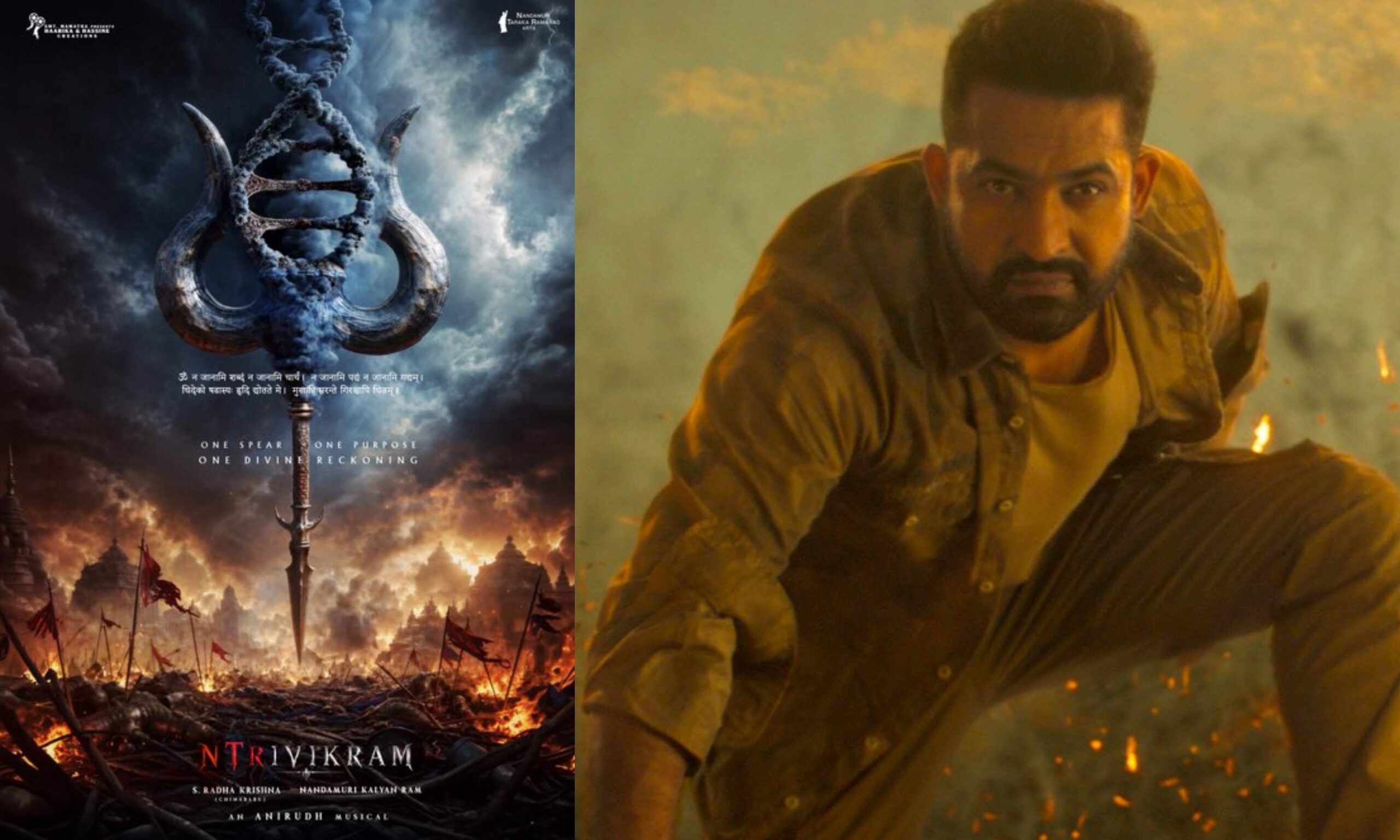

Jr NTR and director Trivikram Srinivas, who last worked together on Aravinda Sametha Veera Raghava in 2018, have reunited for a new mythological action film believed to be centred on Lord Murugan, also known as Kartikeya or Subramanya.
The film, tentatively titled #NTRxTrivikram, will have music composed by Anirudh Ravichander, and is expected to go on floors only in early 2027.
The teaser poster shows a burning battlefield encircled by a tridentwith the trident’s middle prong morphing into a strand of DNA.
NTR captioned his post, “The Son of Shiva. The Pride of Parvathi. The Eternal Commander.”
It was producer Naga Vamsi’s separate caption, however, that triggered the row: “Born in the North. Forged in the Heartland. Worshipped in the South. Now… a tale destined to belong to the universe.”
Why it stung
For many Tamil social media users, the phrase “born in the North” struck a nerve. Murugan, in Tamil tradition, is revered as Tamil Kadavul — the Tamil god — and is considered an indigenous deity rather than one imported from northern Hindu cosmology. Several users pointed out that, mythologically, Murugan is described as born from the divine sparks of Lord Shiva’s third eye at the celestial Saravana Poigai, a detail they felt the caption ignored or contradicted by anchoring his origin in the north.
Also Read: Bengal eggs row: Is BJP imposing vegetarianism on children? | AI With Sanket
Reactions ranged from measured objection to outright anger. Some users accused the makers of distorting history and asked why a film built around a Tamil deity was being made without Tamil involvement. Others used sharper language, accusing the team of bowing to “Aryan” framing and erasing Tamil ownership of the god. A few comments escalated into warnings, including threats to ban the film’s release in Tamil Nadu if the framing wasn’t corrected. Some also flagged that the poster’s accompanying verse was in Sanskrit rather than Tamil, compounding the sense of cultural sidelining.
The historical debate
The disagreement over Murugan’s origins is not new. Tamil scholars, including the historian Tho Paramasivam, have long argued that Murugan was originally a Sangam-era Tamil deity, associated with hills, war, youth and valour, who was later absorbed into the wider Hindu pantheon and reframed as Kartikeya, son of Shiva and Parvati, brother of Ganesha. Tamil Sangam literature, particularly texts like the Tirumurugarrupadaicelebrates Murugan as a deeply localised deity tied to Tamil geography and the six sacred abodes (Arupadaiveedu) located across present-day Tamil Nadu.
Also Read: VHP says Ram Temple Trust sought SIT probe into donation embezzlement
In the pan-India Hindu tradition, by contrast, the dominant origin myth holds that Murugan was born from sparks emanating from Shiva’s third eye, nurtured by six celestial mothers (the Krittikas) before being united into a single form by Parvati, a narrative geographically rooted in northern and central Indian cosmology, often linked to Mount Kailash. This dual identity, a Sanskritic warrior-god of the north and an indigenous Tamil deity of the south, has made Murugan a recurring flashpoint whenever popular culture attempts to retell his story, since any single framing risks being read as favouring one tradition over the other.
Online fallout
Within hours of Naga Vamsi’s post, Tamil users flooded the replies. One user, addressing the producer directly, wrote that spreading what they called “lies” would hurt their religious sentiments and could result in the film being shunned in Tamil Nadu. Another user accused the makers of being “full-time simps to the Aryans” for sidelining Tamil ownership of the deity. Others were more direct, warning the producer to “mind his words” and cautioning that the backlash could affect the film’s prospects. Several posts simply demanded that a Tamil god’s story not be told “without Tamil,” tagging NTR, Trivikram and the film’s official handles.

Comments are closed.