
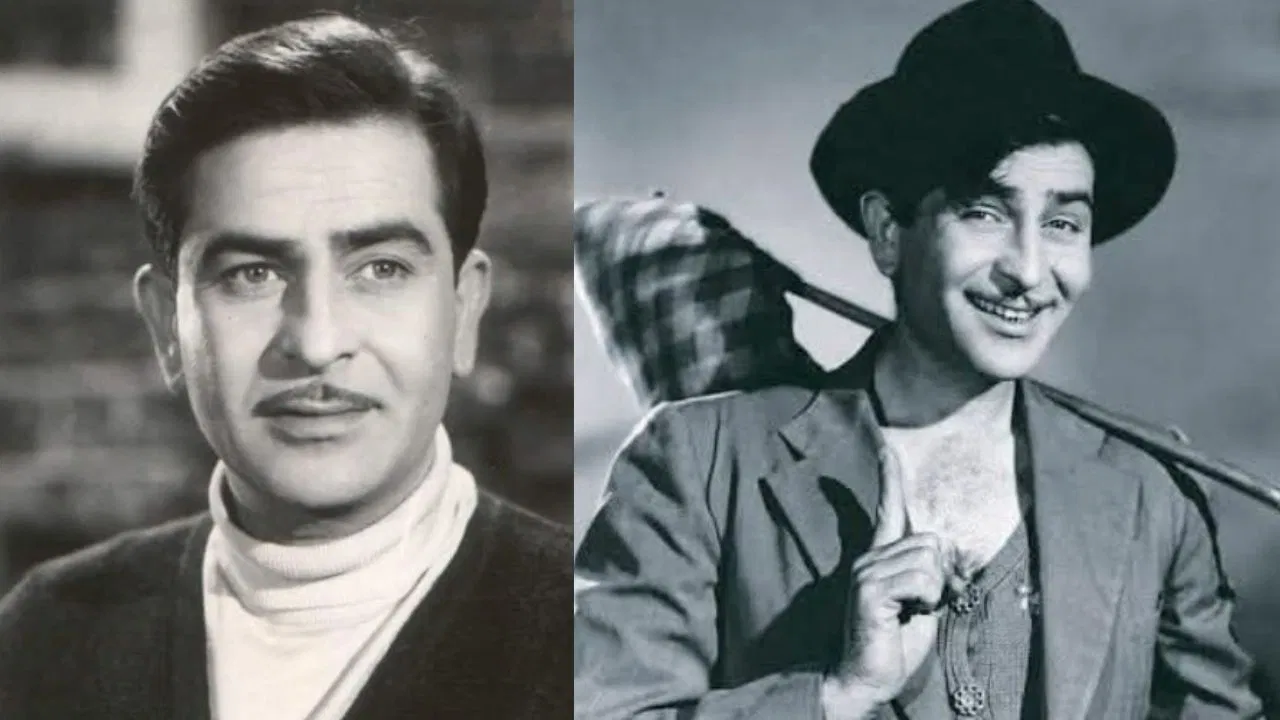

Mumbai: It made me sad for a long time, because greatness in this little world is always sad.
Greatness coming to an end—and that too an unhappy end—is almost unendurable.
That is what I felt when Raj Kapoor, the greatest showman the Indian film industry has ever known, inhaled life to its fullest, celebrated it with reckless generosity, and then came to a close in full public view—frail, broken, unable to hold up the very body that had once danced with the dreams of a nation.
In 1988, when Raj Kapoor was called to receive the Dadasaheb Phalke Award for his lifetime contribution to Indian cinema, the country gathered to honour him. But the man who arrived was no longer the indefatigable showman, no longer the tramp who could turn sorrow into song. He was ill. He was weak. He could barely walk.
As his name was announced, Raj Kapoor tried to rise—but his legs failed him. The moment froze. And then something quietly monumental happened. The President of India stepped down from the dais and walked towards him, to bestow the honour where he sat. Power descending to meet art. Authority bowing before imagination.
Raj Kapoor accepted the award, overwhelmed, his voice trembling as he tried to speak. What emerged was not a speech, but a farewell disguised as gratitude. A man who had given everything to cinema was asking for forgiveness—from his audience, from his colleagues, perhaps even from life itself.
A few weeks later, he was gone.
“I was just six years old, and we were in Delhi,” Ranbir Kapoor—my son-in-law—once said, recalling that moment. Too young to understand its full meaning, yet old enough to sense that something immense had ended. Almost screaming to the world through his silence: the show must go on. Don’t ask me why.
As I sit down to write this on Raj Kapoor’s birthday, the lines of Mera Naam Joker—that bruised, misunderstood masterpiece that cost him dearly and was rejected in its time—begin to echo in my mind:
Will we be in the game tomorrow?
There will always be stars in the garden.
Bhoolenge tum, bhoolenge woh,
We will always be there for you.
Tomorrow, we may not be there in the play.
The stars will continue their restless orbit.
You may forget. The world may forget.
But something of us will remain with you—always.
That was Raj Kapoor speaking to time itself. Not pleading for immortality, not demanding remembrance, but gently reminding us that the clown exits, the lights dim, the applause fades—and yet, somewhere beyond the curtain, the music goes on.
I understood the truth of that long before his passing.
In the summer of 1985, during the Moscow International Film Festival, Indian cinema was being taken seriously, even celebrated. Saaransh had found an echo there. India’s presence was formal, cultural, political. A high-powered delegation had arrived, led by Amitabh Bachchan, then a Member of Parliament and part of the Rajiv Gandhi government. At the Indian Embassy, I found myself brushing past giants—Pandit Ravi Shankar, Ustad Allarakha Sahib—each one a reminder that art was carrying the weight of a nation.
But my most profound insight into Raj Kapoor did not come from any official gathering.
It came from a taxi.
As we drove through the wide, grey streets of Moscow, the driver turned to me and asked, softly, “You’re from India?”
“Yes,” I said.
A pause. Then: “How is Raj Kapoor? I’m told he’s not keeping good health these days.”
That single question dissolved every award, every statistic, every claim to greatness. Here was an ordinary man, far removed from Bombay, from Hindi, from cinema’s machinery—yet carrying concern for an Indian actor as if he were his own. Raj Kapoor’s films had crossed borders without passports, ideologies without permission. His suffering was not news. It was felt.
The world did not merely watch Raj Kapoor’s films.
It absorbed them.
And when the Showman began to fade, the world noticed—not as spectators, but as family.
And for me, on his birthday, Raj Kapoor does not feel absent.
Life, in its mysterious generosity, wrote a screenplay I could never have imagined—one where his presence did not remain in memory alone, but arrived, laughing, stumbling, alive.
On days when Alia and Ranbir are both shooting, my granddaughter Raha Kapoor comes home to spend time with us. Soni and I play with her—this bubbling stream of life flowing quietly through generations: from Raj Kapoor, through Rishi Kapoor, through Ranbir Kapoor, and now into our home, into my daughter’s arms.
Sometimes, as I gaze into Raha’s eyes, I feel it—his presence. Unmistakable. Tender. Complete.
People often say to me, “Doesn’t she have Raj Kapoor’s eyes?”
Yes. She does.
He lives.
He lives in my memory.
He lives in my home.
He lives in the laughter of a child who does not yet know the weight of the name she carries.
And he lives in the hearts of millions across the world who may never meet him, yet feel they already have.
That is not nostalgia.
That is immortality.
And on his birthday, that is reason enough to bow—once more—to the greatest showman of them all.

Comments are closed.