

Speed has quietly become the most expensive variable in modern logistics.
For large platforms, shaving five minutes off delivery time is a matter of algorithm tuning and warehouse density. For small businesses and early-stage startups, however, speed is existential. If you cannot move fast, you lose customers—often permanently.
This is the reality behind what many founders now call the micro-logistics problem: how do you deliver urgently, reliably, and profitably in cities that are increasingly congested?
The answer, for a growing number of small operators, is not bigger vehicles or more drivers. It is radically different mobility.
The Micro-Logistics Challenge
For small businesses—cloud kitchens, independent pharmacies, legal firms, repair services—delivery is no longer a “nice to have.” It is part of the product itself.
Customers do not compare you only to competitors in your category; they compare you to the last best delivery experience they had, whether that came from a global platform or a neighborhood store.
The challenge is structural:
- Vans are slow in cities. Congestion, parking, and last-mile walking time kill efficiency.
- Cars are expensive. Fuel, insurance, maintenance, and idle time crush margins.
- Standard e-bikes are capped. At ~20 mph, they are excellent for food delivery—but insufficient for urgent, time-critical tasks.
When delivery windows shrink to 30 minutes or less, average speed matters more than capacity. This is where traditional logistics models begin to fail small operators.
Agility Is the New Currency
In dense urban environments, speed is not about top velocity—it is about path optionality. The most efficient delivery vehicle is not the one that is fastest on paper, but the one that can:
- Take narrow streets and alleys.
- Bypass gridlock.
- Park instantly.
- Maintain momentum across poor road surfaces.
This is why many startups are now evaluating the electric dirt bike not as a recreational product, but as an urban logistics tool.
Unlike fragile commuter bikes, this category is designed for abuse: potholes, curbs, uneven pavement, shortcuts through construction zones. It is built to move when the city says “stop.” For a small business, that agility directly converts into higher delivery reliability—and more completed jobs per hour.
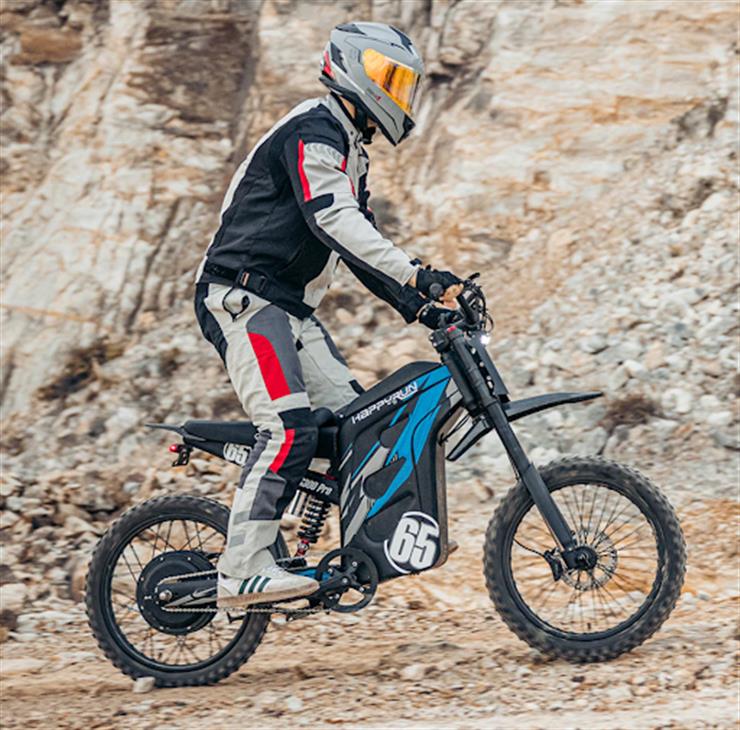
Hardware Spotlight: The HappyRun G300 Pro
When logistics speed becomes a strategic advantage, hardware choices stop being cosmetic. You need equipment that performs under load, repeatedly, across an entire workday.
This is where the HappyRun G300 Pro fits into the discussion—not as a lifestyle vehicle, but as an operational asset. Three specifications matter for commercial use:
- 6500W Peak Power Urgent deliveries are rarely weightless. Documents, equipment, medical samples, or spare parts add mass, and mass kills acceleration on weak platforms.
A 6500W peak motor provides the torque necessary to accelerate decisively even when loaded, climb bridges or flyovers without stalling, and re-enter traffic safely. For delivery riders, this is not about thrill—it is about predictability.
- 50 MPH Top Speed Urban delivery is not confined to back streets. Main roads and arterial routes are often unavoidable.
A system capable of maintaining 50 MPH allows riders to flow with traffic rather than become obstacles. In practice, this reduces risk and expands routing options—critical when minutes matter.
- 72V 30Ah Battery (70+ Miles) Downtime is invisible in spreadsheets, but devastating in operations.
A long-range electric platform allows a rider to complete a full shift without mid-day charging interruptions. For businesses paid per job, uninterrupted range translates directly into uninterrupted revenue.
For founders searching for the fastest electric bike that still makes economic sense for daily operations, this balance of performance and endurance is what turns hardware into leverage.
The Economics of Speed (ROI Analysis)
Logistics decisions ultimately come down to numbers. Let’s compare three common options for small delivery operations:
Gas Motorcycle
- Fuel cost: volatile and rising
- Maintenance: oil changes, filters, engine wear
- Downtime: frequent servicing
- Noise and emissions: increasingly restricted in cities
Standard Electric Bicycle
- Low operating cost
- Limited speed
- Reduced orders per hour
- Not suitable for urgent or long-distance runs
High-Performance Electric Platform (e.g., G300 Pro)
- Electricity cost: negligible per mile
- Maintenance: minimal moving parts
- Higher average speed
- Greater delivery radius
The key metric is Orders Per Hour (OPH).
If a rider on a slow platform completes 2 deliveries per hour, and a faster, more capable platform enables 3–4, the revenue delta compounds quickly. Over a week, month, or quarter, hardware efficiency becomes margin expansion. Speed is not a cost—it is a multiplier.
Real-World Use Cases Beyond Food
The fastest-growing adopters of high-performance electric delivery platforms are not restaurants. They are businesses where time sensitivity defines value:
- Legal and corporate document delivery: Contracts, filings, and notarized paperwork where deadlines are absolute.
- Medical courier services: Transporting samples, prescriptions, or equipment between clinics and labs.
- Automotive and industrial parts: Moving critical components that keep repair shops or factories operational.
In these scenarios, reliability and speed are worth far more than cargo volume. Two wheels outperform four, not by size, but by decisiveness.
Strategic Implications for Startups
Most startups obsess over software optimization. Fewer think deeply about physical execution. Yet logistics remains stubbornly physical. Code cannot outrun traffic.
Founders who treat mobility as infrastructure—not as an afterthought—unlock advantages that competitors cannot easily replicate. Hardware, once deployed, becomes a moat.
The transition to high-performance electric delivery is not about trends. It is about aligning operational reality with customer expectations.
Conclusion: Delivering the Future
The future of logistics is not larger vans or denser warehouses. It is faster, smarter movement at human scale.
For small businesses and startups, adopting agile electric platforms is less about sustainability branding and more about survival. When minutes decide outcomes, speed becomes strategy. Two wheels, properly engineered, are no longer a compromise. They are the sharpest tool in the box.

Comments are closed.