
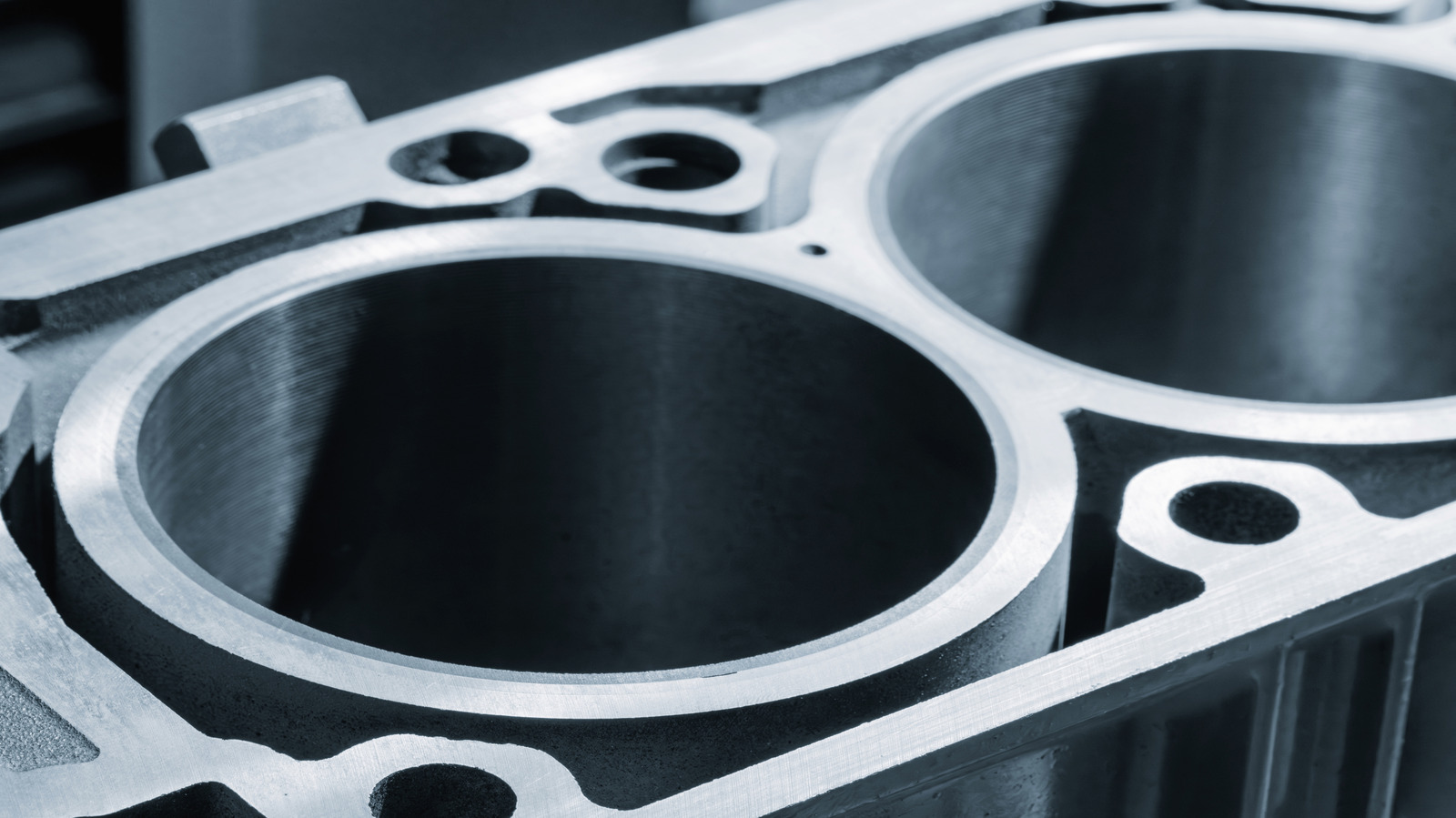

The whole point of an engine is to produce a series of controlled explosions, and unless you’re running a Wankel rotary or some other strange engine design, your vehicle likely has pistons moving up and down in a set of cylinders, generally containing a cylinder sleeve. That sleeve, also called a cylinder liner, is a replaceable metal insert fitted into an engine block that makes up the walls of the combustion chamber and cylinder. It’s a hardened hollow metal rod that works with the piston rings to provide a smooth, consistent seal and endure the heat of the combustion process. Cylinder sleeves come in two primary flavors: dry and wet.
Wet sleeves are surrounded by engine coolant or water when installed. This means the sleeve itself bears the compressive force of the engine working. The upside is that the water allows higher-compression engines, like large diesels, to dissipate heat more efficiently and avoid potentially warping the engine block. Only a few older gasoline cars have wet sleeves, such as the Lotus Elise, and most have dry sleeves instead.
Dry sleeves are the opposite; they don’t come into contact with engine coolant at all. They’re usually quite thin, effectively acting more as a sealant and temperature controller than a pressure-bearing vessel. They’re designed to press-fit into an engine block, and so the block itself is what contains the cylinder pressure. Both configurations have pros and cons, but why are wet sleeves in particular so ideal for large diesel engines? Let’s discuss.
Advantages of wet cylinder sleeves
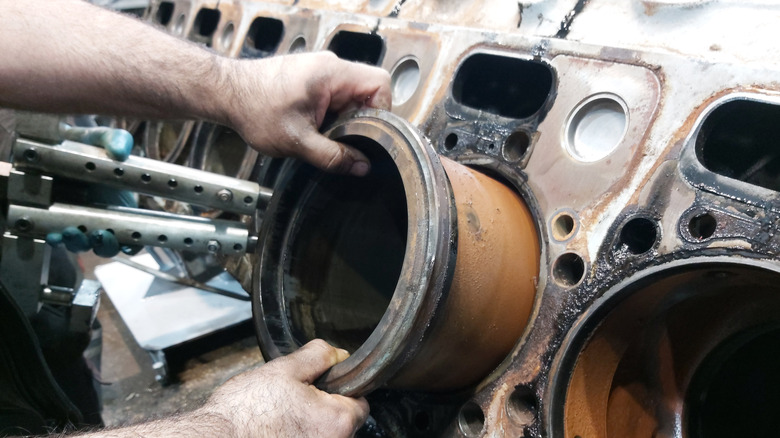
The main advantage of a wet cylinder sleeve lies in cooling efficiency. To demonstrate this more practically, think about the difference between an air-cooled and a liquid-cooled PC. What you’re doing is using water to dissipate the heat by carrying heated water through a closed-loop system. The water flows through a radiator and back to the critical components, continuously cooling them. The same principle is why water-cooled machine guns could fire for such prolonged periods of time despite having relatively thin barrels.
This thermal management is why wet cylinder sleeves are favored in high-stress engines, such as agricultural and heavy-duty marine diesels. Diesel engines have extremely high compression ratios compared to gasoline cars because of the way diesel works. It requires higher (therefore hotter) compression to ignite, meaning it generates more heat. More heat requires more efficient dissipation and consistent management, hence the wet sleeve.
Moreover, because of the way the sleeve is constructed, it’s more readily serviceable than a press-fit sleeve, which would require tremendous pressure to insert into a large diesel. This reduces maintenance costs and simplifies the engine rebuild process, particularly useful in industrial applications or wherever one can expect frequent engine teardowns. The main catch here, however, is that a diesel engine’s cylinder requires a relatively thick cylinder sleeve if it’s going to be liquid-cooled. Wet sleeves need to withstand compression during the combustion process, meaning the wall itself is thicker and made out of special materials, typically high-strength steels or irons, along with specialized alloys.
Why many engines use dry sleeves instead
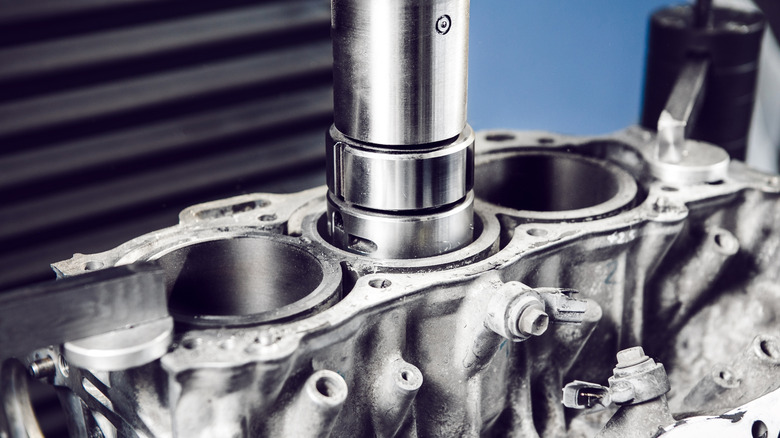
If you have a passenger car with a sleeved engine, chances are it’ll have dry sleeves. Unlike wet sleeves, dry sleeves don’t come into contact with the engine’s coolant unless you have a blown head gasket or other mechanical failure. In general, these are far simpler to understand than wet sleeves; all a dry sleeve does is slot into a cylinder, providing a wall of controlled material for the piston to ride on. It’s typically thinner than a wet sleeve and lacks the coolant surround, making it ideal for compact applications in regular vehicles.
Engine sleeves in general are designed for optimal thermal efficiency, dry sleeves included. They improve heat transfer to the engine block and its cooling system, allowing the engine to run cooler than one without sleeves. This also improves combustion efficiency and, by extension, fuel economy. The main difference between the two types is that dry sleeves reinforce the engine block itself; the block surrounds the sleeve, therefore it uses the block’s material for support. Provided the sleeve doesn’t have any cracks, this helps dissipate energy more evenly throughout the combustion process, which is particularly useful in high-performance engines.
Ultimately, manufacturers choose which sleeve type based on their specific needs. Wet sleeves offer improved cooling efficiency and easy replacement, whereas dry sleeves offer structural rigidity and are suited for high-pressure applications, such as forced induction or bored-out cylinders.

Comments are closed.