

“Ten years ago I would always ask for the price before taking a taxi or eating at a restaurant, and I do that until now,” Thu Ha, a Hanoi resident says while talking about her recent trip to the central coast during the four-day Reunification Day-Labor Day (April 30-May 3) holidays.
Concerns about being ripped off make her holiday travels increasingly stressful, she says.
“With small roadside restaurants, I usually ask for prices first or only go there if I have no other option.”
Before every major holiday, local authorities intensify inspections at tourist sites, restaurants, and service providers to ensure proper price listing and prevent overcharging.
But instances of price gouging continue to emerge, especially by small-scale operators.
This year, authorities in major tourist destinations such as Hanoi, Nha Trang, and Phu Yen have found numerous cases involving unclear pricing and exploitation of tourists, resulting in fines and administrative sanctions.
During the 2026 Spring Festival in Hanoi, the Huong Pagoda management received complaints about boat operators demanding above regulated rates and providing substandard service.
In a case on Feb. 24, an American tourist was allegedly charged VND1 million (US$38) by a motorbike taxi driver for a short ride in Hoan Kiem Ward, more than 10 times the normal fare.
During the late-April holiday in Nha Trang, a Thai visitor reported being charged VND100,000 for a single ice cream cone sold on the beach. Authorities later questioned the street vendor and seized their vehicle for further investigation.
In Dak Lak Province, home to Phu Yen beach town, a hotel was fined after visitors complained about unusually high service fees and unclear pricing policies.
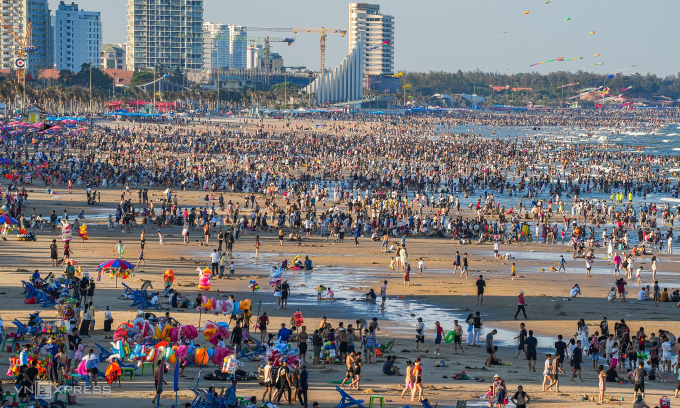
Tourists flood Bai Sau beach in Vung Tau during the April 30 holiday in 2026. Photo by VnExpress/Dang Khoa |
A 2025 report by the Mastercard Economics Institute found that tourism-related fraud is most common in sectors with flexible pricing and limited real-time oversight, including taxis, informal transport services, street food stalls, and small accommodation businesses.
Tran Tuong Huy, deputy director of the Institute for Tourism and Social Research, said the seasonal nature of tourism encourages some vendors to prioritize short-term gains, while many travelers reluctantly accept inflated prices due to overcrowding and limited options during holidays.
Holiday periods in Vietnam usually suffer from severe overcrowding at popular destinations.
According to tourism sector data, domestic travel demand during major holidays typically rises by 30-50% compared to regular periods, creating conditions for opportunistic businesses to make a quick buck.
Experts also point to weak enforcement and the absence of a professional service culture.
At many places, price displays are not strictly mandated, and local authorities often lack the manpower and effective penalties needed to deter violations.
Slow adoption of digital feedback systems further limits tourists’ ability to report abuses and protect their rights.
Huy said addressing the problem would require better distribution of tourist flows as well as stricter codes of conduct for tourism businesses.
Nguyen Tien Dat, general director of Hanoi-based AZA Travel, said the key distinction between legitimate price increases and price gouging lies in transparency.
He said holiday surcharges caused by higher labor and operating costs could only increase prices by 12-20%, and anything beyond that could be profiteering.
“Customers should be clearly informed about prices and service quality before making a purchase.”
Dat also highlighted overlapping official responsibilities as another major issue.
Hotels and restaurants are overseen by tourism management boards and their prices by market management agencies affiliated with departments of industry and trade. Transportation services such as taxis and motorbike taxis are overseen by construction or transport authorities.
Dat said this fragmented system creates loopholes in enforcement and accountability.
To improve the oversight, he suggested the government should study models used in countries such as Thailand, where dedicated Tourist Police units are empowered to quickly handle complaints related to pricing, fraud, and tourist safety at major destinations.
To tackle the long-standing problem, Dat proposed stricter penalties, including fines several times the illicit profits people earn, temporary business suspensions ranging from one to six months, and even revocation of licenses to create a stronger deterrent.
He also suggested placing hotline signs in various languages in highly visible locations to better support international visitors.
According to data from the World Tourism Organization, only around 10% of tourists who encounter problems report them through hotlines because complaint procedures are often too complicated.
Dat pointed out that simplifying online reporting systems would help authorities respond more effectively.
Local governments should develop regularly updated lists of “trusted destinations” on official websites to help visitors make informed choices, he added.
Huy warned that a mismatch between prices and service quality could badly dent a destination’s reputation.
Tourists who feel overcharged for poor experiences are unlikely to return, he said.
“In the age of social media, a negative image can spread rapidly and undo years of effort spent building a positive reputation for a locality.”

Comments are closed.