
Will India’s growth rate fall below 7%? Chief Economic Advisor breaks silence on RBI’s decision

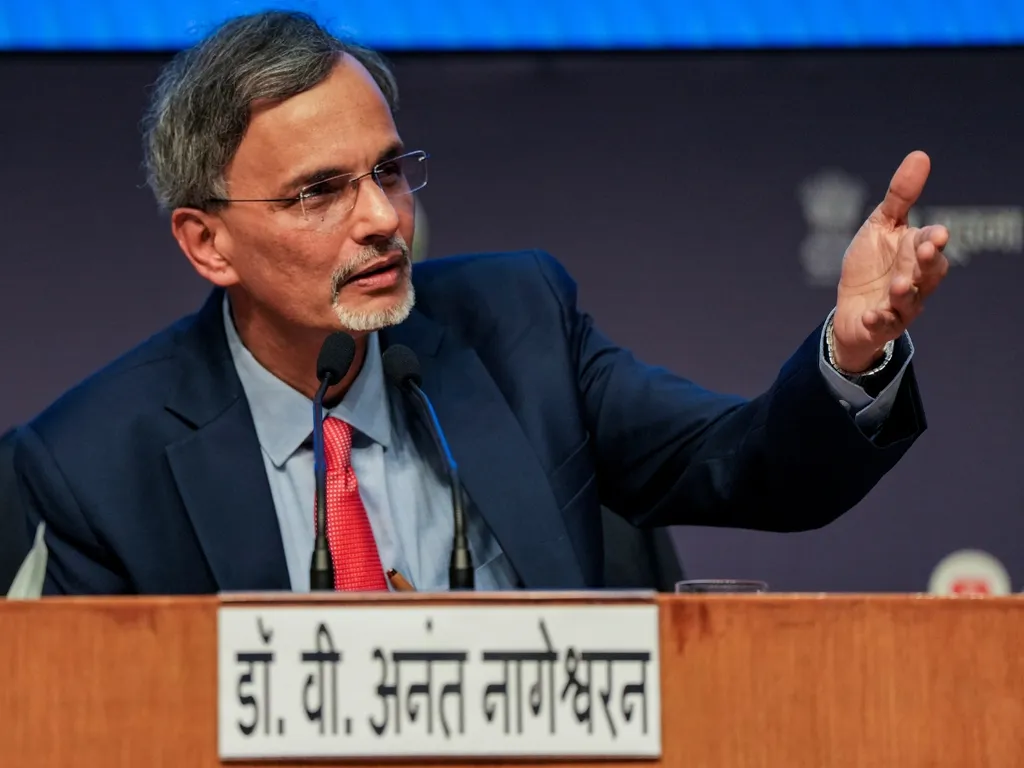
New Delhi, Bureau. The impact of deepening tensions at the global level is now clearly visible on the Indian economy. Amidst the ongoing crisis in West Asia (Middle East), a big news is coming out regarding the economic pace of the country. After the Reserve Bank of India (RBI) reduced the country’s GDP growth rate estimate, now the Government’s Chief Economic Advisor (CEA) V. Ananth Nageswaran has also agreed to it. He has admitted that considering the current global conditions, the growth rate may remain below 7 percent in the near future. However, he has also shown a ray of hope that this recession is not permanent and the Indian market will bounce back soon.
Know why the country’s growth rate estimate was reduced
Chief Economic Advisor V. Ananth Nageswaran very candidly outlined the economic situation of the country during a press conference. He said that the Reserve Bank of India has made a very correct and accurate assessment of the current global and domestic circumstances. The central bank has solid reasons for reducing this estimate, so there is no reason to question it.
In fact, due to the ongoing tension in West Asia, there is an atmosphere of uncertainty in the markets around the world. This is also having a direct impact on India’s trade and import-export. At present, the Finance Ministry will not release any separate economic projections of its own, rather it is preparing further policies completely keeping in mind the RBI data and the risks indicated by them.
So will we have to wait for economic recovery till 2028?
The biggest question in the minds of economic analysts and the general public is that when will the economy pick up again? On this, the Chief Economic Advisor has assured that the government is not sitting idly by. He said that even if the growth rate slips below 7 percent as per the RBI estimate, there is no need to panic.
The steps being taken by 정KAR for macroeconomic stability and arrangements to improve the supply chain will bear fruit. He expressed hope that in the financial year 2027-28, or as soon as external conditions become even slightly favourable, the country will once again return to the path of a strong growth rate of more than 7 percent.
Government’s master plan to deal with West Asia crisis
The Indian government has geared up to reduce the side effects of this global crisis. According to the Chief Economic Advisor, many major and reformative steps have been taken in very important and sensitive sectors like Energy, Trade, Agriculture and Industry.
It is a matter of relief that there is a continuous increase in investment activities within the country. He described the improvement in private final consumption expenditure and the 8.2 percent growth rate of gross fixed capital formation as extremely satisfactory and encouraging. This strong trend of investment is clearly visible in the quarterly figures also.
New data from RBI and concern about rising inflation
If we look at the figures, India’s real GDP growth rate in the financial year 2025-26 was 7.7 percent, whereas in its fourth quarter it was recorded at 7.8 percent. But in view of the changing circumstances, the Reserve Bank has reduced the estimate of real GDP growth rate for the upcoming financial year 2026-27 from 6.9 percent to 6.6 percent.
Not only this, RBI has also expressed the possibility of it going down further. Along with this, the estimate of Retail Inflation (CPI), which impacts the pockets of the general public, has also been increased to 5.1 percent, there is a risk of it going up further. Because of this, the economic scenario is likely to be quite challenging and complex in the coming days.
There is still huge demand in these sectors
Even after two months of all these challenges and the beginning of the West Asia conflict, good news is coming from the Indian markets. If we look at the economic indicators between January and April, it shows that domestic demand in the country is still very strong.
There has been a steady demand in vehicle sales, steel, cement, capital goods and infrastructure sectors in both urban and rural areas. The Chief Economic Advisor says that it is too early to draw a final conclusion as to which direction inflation and growth rates will take in future, but the foundation of the Indian market is completely strong.

Comments are closed.