
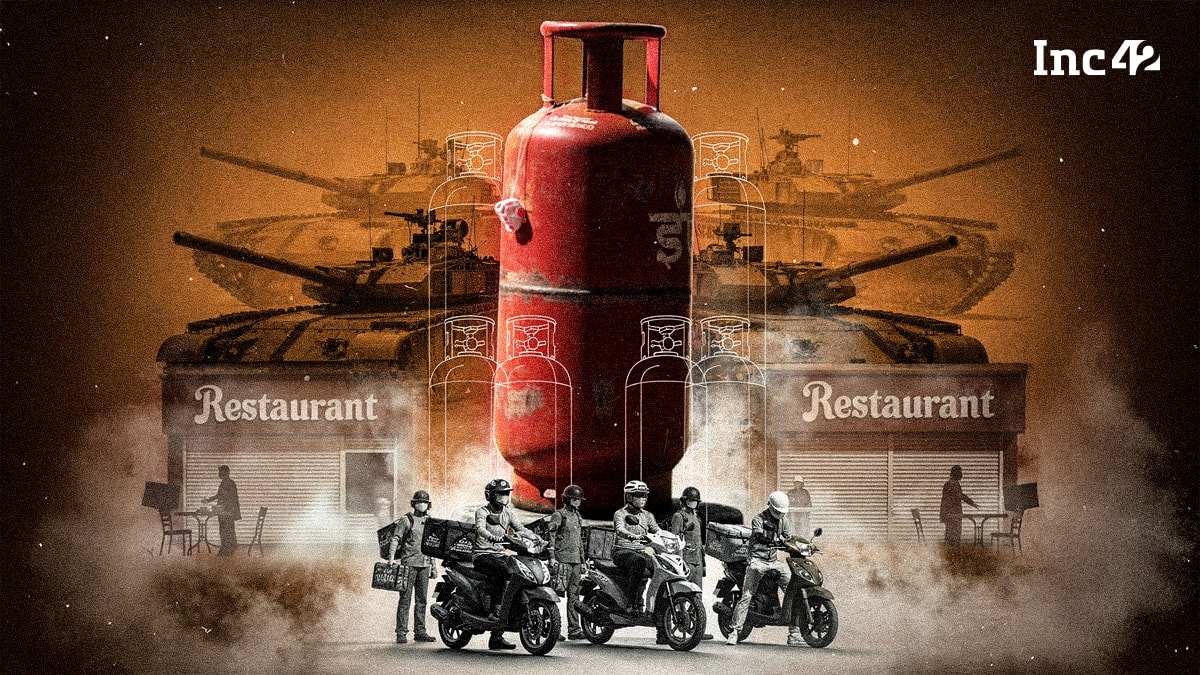

Escalating tensions involving United States, Israel and Iran have disrupted LPG shipments via the Strait of Hormuz, raising supply concerns for Indian restaurants
Restaurants and cloud kitchens face operational risks due to commercial LPG shortages, potentially impacting food delivery platforms like Swiggy and Zomato
The disruption has also weighed on stocks of QSR operators such as Jubilant FoodWorks, Devyani International and Sapphire Foods India amid concerns over falling restaurant activity
As geopolitical tensions between the United States, Israel and Iran continue to escalate, one of the most feared ripple effects on India’s economy is beginning to materialise, that is a shortage of liquefied petroleum gas (LPG).
The disruption stems from the closure of the Strait of Hormuz, a critical maritime chokepoint through which a majority of India’s LPG imports pass, raising fresh concerns over the country’s energy security.
India imports nearly 62% of its total LPG requirements, and an overwhelming 85%–90% of these imports , largely sourced from Gulf nations such as Saudi Arabia, typically transit through the now-blocked strait. With shipments disrupted, supply constraints are already beginning to surface across the country, particularly in the commercial LPG segment.
The impact is expected to be felt most sharply by businesses reliant on commercial cylinders, including hotels, restaurants and small food enterprises. This comes at a time when India’s annual LPG consumption stands at about 31.3 Mn tonnes, with the domestic household segment accounting for nearly 87% of demand, while the remaining 13% is consumed by commercial and industrial users, a segment that now faces the immediate brunt of the supply crunch.
LPG Crunch Weighs On Food Delivery
The impact is already beginning to surface in major urban food hubs such as Bengaluru, Pune and Chennai, where eateries are heavily dependent on commercial LPG cylinders.
According to media reports, as many as 50–60% of restaurants could be forced to shut down within the next two to three days if the supply of commercial LPG cylinders is not restored, warned Sagar Daryani, president of the National Restaurant Association of India.
The ripple effects are also expected to hit food delivery platforms such as Swiggy and Zomato (Eternal), which may see a dip in order volumes as restaurants begin recalibrating operations amid constrained cooking gas supplies.
Multiple restaurants and cloud kitchens Inc42 spoke to said they have already begun reducing menu options and are on the verge of suspending operations if the situation persists. Early signs of disruption are already visible. A source at a major food delivery platform said that order volumes have started declining in cities such as Bengaluru, Pune and Mumbai, adding that platforms did not anticipate the crisis unfolding this quickly and currently do not have a contingency plan in place.
“Commercial kitchens run almost entirely on LPG. Without a steady supply of cylinders, restaurants have very limited alternatives in the short term, which is why many are already cutting down menus or preparing to pause operations,” said a restaurant industry executive on the condition of anonymity.
Both Swiggy and Zomato declined to comment on the issue for now.
The disruption fears also spilled over to the stock market, dragging down shares of food delivery and quick service restaurant (QSR) operators during the trading session. Shares of food delivery platforms Swiggy and Eternal fell over 2% intraday amid concerns that a prolonged LPG shortage could dent restaurant operations and order volumes.
The broader QSR pack also came under pressure. Shares of Jubilant FoodWorks, the operator of Domino’s in India, declined 2% during the session, while Devyani International, which operates Pizza Hut and KFC in the country, saw its stock slip around 1%.
Meanwhile, shares of Sapphire Foods India, another major franchisee of KFC and Pizza Hut , dropped 2.5%.
After Strong Q3, Food Delivery Faces New Disruption
The disruption comes at a time when India’s leading food delivery platforms, Swiggy, and Zomato, had just begun regaining growth momentum in the October–December quarter after a phase of relatively slower expansion.
The recovery was largely driven by higher order volumes during the festive season, affordability-focused offerings and a steadily expanding user base.
According to Swiggy’s Q3 FY26 shareholder letter, the company’s gross order value (GOV) rose 20.5% year-on-year to INR 8,959 Cr, marking its fastest growth in the past three years.
Similarly, Zomato reported improving growth trends in its food delivery segment during the quarter.
The company posted 16.6% year-on-year growth in net order value (NOV) to INR 9,846 Cr in the December quarter, translating into 21.3% growth in GOV. This also marked an acceleration from the 13.8% growth recorded in the September quarter.
However, the emerging LPG supply disruption now threatens to derail this recovery, potentially impacting order volumes and restaurant operations in the final quarter of FY26.
A market analyst tracking the foodtech sector said that while the current disruption may be temporary, restaurant-side constraints could quickly reflect in platform metrics. “Food delivery platforms are heavily dependent on restaurant partners’ ability to operate kitchens. Even a short-term LPG shortage could translate into fewer active restaurants, reduced menu availability and lower order volumes which will trigger investor reaction” the analyst said.

Comments are closed.