
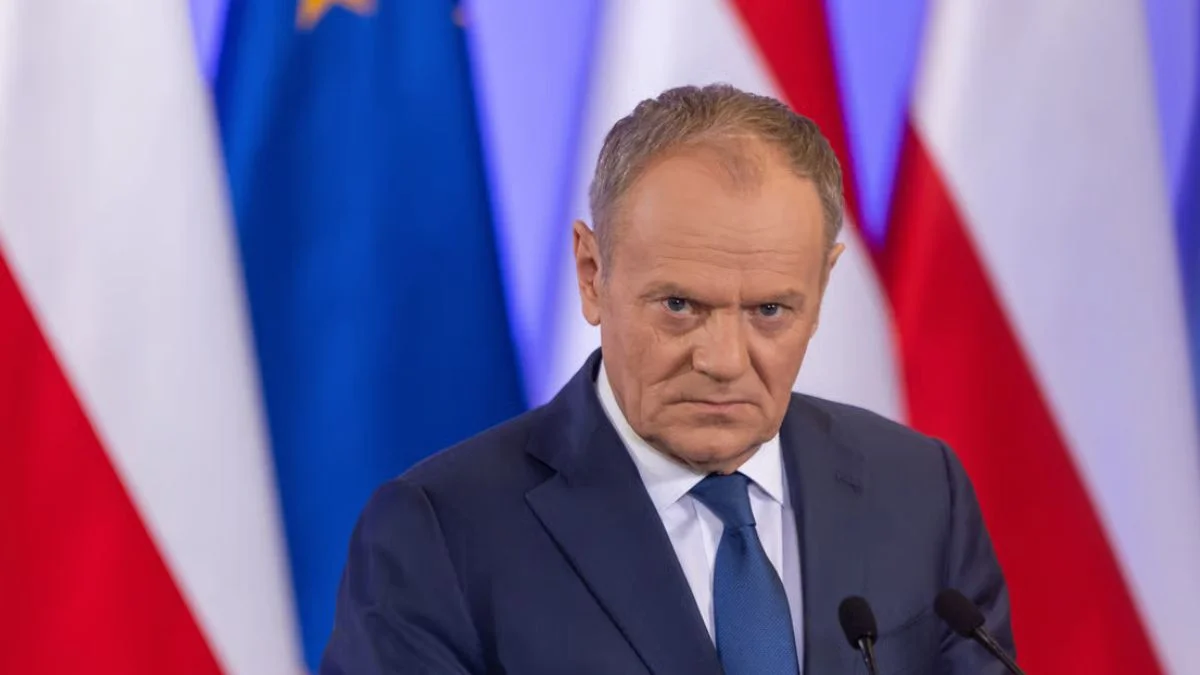

A dispute over European defense funding has triggered a broader legal and policy debate in Poland, as Prime Minister Donald Tusk warned that an election victory for the opposition Law and Justice Party (PiS) could place the country’s European Union membership at risk.
The warning came after Polish President Karol Nawrocki vetoed legislation designed to implement the EU-backed Security Action for Europe (SAFE) program, a major financial mechanism intended to expand defense investment across the bloc. The veto has triggered a constitutional and policy dispute over how Poland should finance its military modernization and cooperate with European defense initiatives.
SAFE is a €150 billion initiative established by EU institutions to strengthen Europe’s defense capabilities through long-term preferential loans to member states. The program emerged partly in response to shifting geopolitical dynamics and growing security concerns in Europe following Russia’s invasion of Ukraine (2022) and evolving transatlantic security priorities.
Poland had positioned itself as one of the largest prospective beneficiaries of the scheme, applying for approximately €43.7 billion in financing. The program was expected to support large-scale military procurement and defense infrastructure projects. However, Nawrocki’s veto halted the government’s legislative framework that would have allowed Poland to access the funds through domestic legal mechanisms.
In a statement posted on social media, Tusk argued that the dispute reveals a broader policy divide over Poland’s future within European institutions. He suggested that the next parliamentary election could become a decisive moment determining whether Poland continues its current pro-EU integration strategy or shifts toward a more eurosceptic policy direction.
Opposition figures associated with PiS have defended the veto, arguing that the conditions attached to the SAFE loans could expose Poland to political pressure from EU institutions in the future. The party previously clashed with Brussels over judicial reforms implemented during its period in government between 2015 and 2023. Those reforms triggered legal disputes with EU authorities over rule-of-law standards and resulted in financial penalties and frozen EU funds.
PiS-aligned officials have instead proposed an alternative defense financing approach known as “SAFE 0%.” The concept, supported by central bank governor Adam Glapińskisuggests partially financing military investments through national financial reserves, including potential revaluation gains from Poland’s gold holdings.
However, several economists and policy analysts have questioned the feasibility of the proposal, arguing that relying on such mechanisms could introduce financial instability or weaken investor confidence in Poland’s currency and fiscal framework.
Following the presidential veto, Tusk said his government is exploring alternative legal pathways to secure funding for defense modernization. One option involves channeling resources through the “Polska Zbrojna” program, a government resolution designed to support military procurement. However, the current legal structure of that mechanism limits eligibility primarily to the armed forces and excludes other security institutions such as the police and border guard.
The dispute highlights broader tensions within Poland’s constitutional system, where presidential veto powers can block legislation passed by parliament and force governments to seek new policy approaches. It also reflects ongoing debate over how EU member states should balance national sovereignty with collective defense financing initiatives.
Government officials, including State Assets Minister Wojciech Balczunhave argued that continued cooperation with EU institutions remains essential for Poland’s economic stability and security policy. Meanwhile, protests have taken place in Warsaw supporting participation in the SAFE program and criticizing the presidential veto.
As the policy dispute unfolds, analysts say the issue could shape future legislative debates over defense funding, EU integration, and constitutional authority in Poland. With parliamentary elections approaching, the controversy surrounding SAFE may also become a central campaign issue, reflecting broader divisions over the country’s legal and strategic alignment with European institutions.

Comments are closed.