
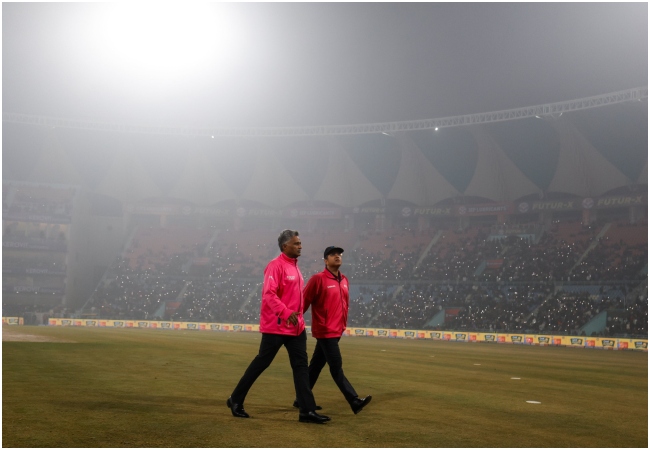

BCCI Venue Rotation Policy: The fourth match of the T20I series between India and South Africa was to be played on Wednesday at Ekana Cricket Stadium in Lucknow. But, match abandoned without toss due to dense fog and poor visibility. The match was to start at 7:00 pm on Wednesday evening, but the fans kept waiting patiently till 9:00 pm for the match to happen. He had to return disappointed. After which people’s anger erupted on social media. Meanwhile, questions are also being raised on BCCI’s venue-rotation policy.
Read :- Codeine and cough syrup racket started from the area of Prime MP is a matter of great concern for the country, this is a scam worth thousands of crores: Akhilesh Yadav
In fact, the reason for cancellation of the fourth T20I match may have been cited as dense fog and poor visibility. But, AQI of Lucknow cannot be ignored. Players were seen wearing masks while warming up at the Ekana Cricket Stadium on Wednesday. Now fans are raising questions that fog, poor air quality and excessive dew are common in North India during winter, so despite these circumstances, how can BCCI hand over hosting of international matches to these cities? However, fans need to understand the BCCI’s venue-rotation policy, which ensures that international cricket in India does not remain the domain of a few traditional centres.
What is BCCI’s venue-rotation policy?
The objective of BCCI’s venue-rotation policy is to provide equal opportunity to all associations and venues across the country. There are many venues in India that are capable of hosting international matches, and the board rotates those venues so that new and smaller associations can also get a chance to host big matches. This equates to equality, spreading matches across different regions and rewarding investment in infrastructure. Along with this, there is also an effort to bring the national team among those fans who have perhaps seen their favorite players only on TV screens. This policy prevents the monopoly of some traditional centers of international cricket.
Need to consider venue-rotation policy
Read :- Akhilesh Yadav’s big statement before the UP Assembly session, said – ‘The government wants to discuss Vande Mataram to avoid public issues…’
BCCI may not have a set formula for its venue-rotation policy, but it depends on commercial and broadcast needs and other factors. It has been seen on many occasions that even those grounds were handed over to host international matches for which there was no expectation. However, BCCI needs to reconsider organizing the matches keeping in mind the geographical conditions and weather of India along with all these things. For example, to deal with the problem of dew, matches could be held during the day instead of in the evening. Apart from this, BCCI should include the matches of South India where there is scorching heat in its calendar in the winter season.

Comments are closed.