
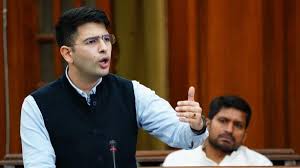
Will the chair of Raghav Chadha and other MPs be saved? Understand the twist of anti-defection law that changed the game: – ..

News India Live, Digital Desk: There was a political uproar in Delhi, the center of the country’s politics, on Friday when 7 out of 10 Rajya Sabha MPs of Chief Minister Arvind Kejriwal’s Aam Aadmi Party (AAP) simultaneously sounded the bugle of rebellion. Angered by the internal discord of the party and his removal from the post of deputy leader, Raghav Chadha not only left the party by creating an explosion in the Constitution Club of Delhi, but also announced to join the Bharatiya Janata Party (BJP). Now the biggest question is whether these MPs will save their membership by switching sides mid-term or will they be disqualified?
Magic figure of 2/3: How ‘safe’ are the rebel MPs?
of the Indian Constitution 10th schedule According to (anti-defection law), if an MP or MLA leaves his parent party, his membership can be cancelled. But there is a very important exception to this law.
Provision of law: If any party two-thirds (2/3) If one or more members separate together and merge with another party, then the anti-defection law does not apply to them.
Raghav Chadha clarified in the press conference that AAP has a total of 10 MPs in the Rajya Sabha, out of which 7 (Harbhajan Singh, Swati Maliwal, Vikram Sahni, Rajinder Gupta, Sandeep Pathak, Ashok Mittal and Raghav Chadha himself) are with him. This number is of total MPs 70% Which fulfills the mandatory condition of 66.6% (two-thirds). Due to this technical ‘break’, there does not seem to be any threat to the membership of these MPs at present.
‘Signed document’ handed over to the Chairman
Raghav Chadha told that he has handed over the signed letters of all the 7 MPs to the Chairman of Rajya Sabha this morning itself. Legally, if this group of MPs merges their group with another party (BJP), it will not be considered ‘defection’ but ‘merger of party’. In such a situation, neither will he have to resign nor will his seat become vacant.
1985 to 2003: How much has the law changed?
52nd Amendment (1985): The main objective of this law was to stop ‘Aya Ram, Gaya Ram’ politics and horse-trading. There was a provision then that if 1/3 of the members separated, the membership would not go away.
91st Amendment (2003): Atal Bihari Vajpayee government made it more strict. Now only 1/3 does not suffice, but 2/3 members It was made mandatory to be together. Besides, a ban was also imposed on giving ministerial posts to the disqualified members.
Big political blow for AAP
Raghav Chadha said, “We had only two options, either leave politics or use our energy for positive politics.” This step of Chadha is a big blow for the Kejriwal government not only in Punjab but also in Delhi, because the party’s strength in the Rajya Sabha will now be reduced to only 3 MPs (Sanjay Singh, ND Gupta and Sushil Gupta).

Comments are closed.