
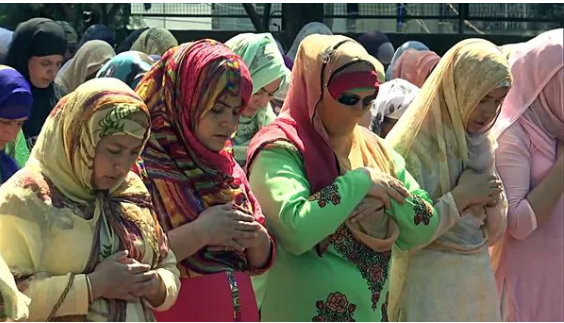

NEW DELHI, Apr 25: In a significant upshot for Muslim women seeking permission to offer prayers inside mosques, the All India Muslim Personal Law Board (AIMPLB) has admitted before the Supreme Court of India that there was no restriction in Islam on women entering mosques to offer namaz.
Senior advocate MR Shamshad, appearing for the Board, made the submission before a nine-judge Bench headed by Chief Justice of India Surya Kant hearing the Sabarimala reference case, with related petitions on women’s entry into mosques tagged to the case as they too involve constitutional questions with respect to Articles 25 and 26.
The question of the right of women to enter mosques stemmed from a PIL petition filed in March 2019 by a Pune-based couple, Yasmeen Zuber Ahmad and her husband Zuber Ahmad Nazir Ahmad Peerzade. The husband-wife duo had requested the Mohmidiya Jama Masjid in Pune to allow women entry to offer prayers. However, the request was denied following which Ms Yasmeen approached the Supreme Court seeking relief under the writ of mandamus.
In the ongoing case, Mr Shamshad said Islamic practice did not bar women from entering mosques, though their participation in congregational prayers was not mandatory. When asked by the Chief Justice of India on whether women are allowed to enter a mosque, Mr Shamshad said there was broad agreement across Islamic denominations on this point. “The Prophet himself said, ‘Don’t stop women coming to the mosque.’ There is clarity on this,” he said.
The senior advocate pointed out that while it was essential for men to attend congregational prayers in the mosque, women had a choice. They were exempted, not prohibited. “For a woman, it is preferable that she stays at home and prays, and she gets the same religious reward. But if a woman wants to come, she can come,” he said.
“Since there is no sanctum sanctorum inside the mosque, nobody can insist to stand at a particular place or, for that matter, to be the first to lead the namaz,” he said. However, he pointed out that there was a certain procedure, “certain discipline that has to be followed” inside the mosque.
Mr Shamshad said while Islam did not bar women from visiting mosques, they cannot insist on entering through the main door or demand the removal of physical barriers separating men and women inside mosques.
Incidentally, there are separate gender-specific halls for men and women in Islamic places of pilgrimage at Mecca and Medina in Saudi Arabia. Women participate in five daily prayers besides the Friday prayers. They perform Hajj too. In India, mosques are designed keeping in mind only men with almost no attention paid to women worshippers.
Also, while the small Ahl-e-Hadith sect welcomes women worshippers, most other sects while not expressly prohibiting women worshippers, reiterate that a woman’s best prayer for worship is at her home.
(Rohit Kumar)

Comments are closed.