

Speaking at the Tourism Industry Conference 2026 on May 8, Minister-in-charge of Trade Relations Grace Fu said the government is studying the feasibility of building the new cruise and ferry terminal next to the existing Marina Bay Cruise Centre Singapore, according to The Straits Times.
The proposed terminal could support three cruise berths and up to 10 ferry berths, expanding Singapore’s maritime tourism capacity as cruise demand across Asia continues to rebound.
Officials are also planning a new MICE (meetings, incentives, conferences and exhibitions) hub near Marina Bay MRT station.
The venue is expected to complement existing convention and exhibition precincts such as Marina Bay Sands, Suntec City and Raffles City, helping Singapore preserve its edge in the lucrative business events industry, Channel News Asia reported.
Singapore is preparing a major refresh of its famed Orchard Road shopping belt, betting that immersive attractions, art installations and lifestyle experiences can help transform the area into a more dynamic destination for both tourists and locals.
The makeover forms part of the new Orchard Road Rejuvenation Initiative, which will launch in mid-2026 as Singapore accelerates broader efforts to modernize its tourism offerings and maintain its appeal amid changing traveler expectations.
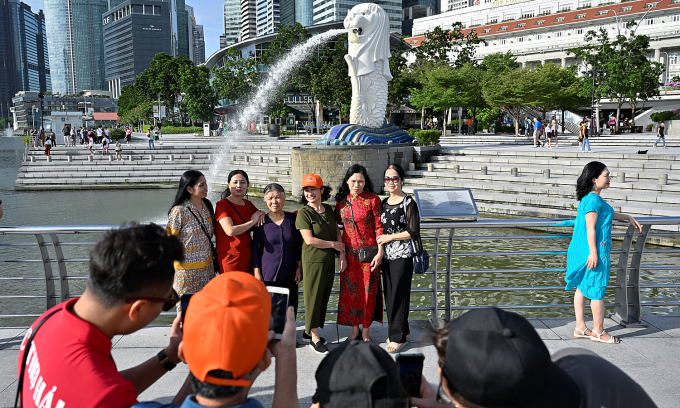
Tourists pose for photographs at Merlion Park in Singapore, Jan. 27, 2023. Photo by Reuters |
Authorities have increasingly emphasized the need for Singapore to move beyond traditional sightseeing by creating immersive, experience-driven attractions capable of drawing both leisure travelers and business visitors.
The developments are closely tied to the country’s Tourism 2040 ambitions, a long-term roadmap focused on sustaining visitor growth while adapting to changing travel trends and intensifying regional competition.
Tourism remains a critical pillar of Singapore’s economy.
Tourism receipts reached a record S$32.8 billion (US$25.84 billion) in 2025, up 10% from the previous year, while international visitor arrivals climbed to 16.9 million, Fu said.
The government expects arrivals to increase further in 2026 to between 17 million and 18 million visitors, with tourism receipts forecast at between S$31 billion and S$32.5 billion.
To support those ambitions, Singapore is sharply increasing state investment in the sector.
The government announced a S$740 million tourism funding package, more than twice the S$300 million allocated under the Tourism Development Fund in 2024, to strengthen long-term industry resilience and support Tourism 2040 initiatives.
Still, officials acknowledged mounting external risks.
Fu warned that global uncertainties, including the ongoing Middle East energy crisis and its potential impact on consumer spending, could pose challenges for the tourism sector, according to The Straits Times.
Even so, Singapore appears determined to maintain its momentum through continuous urban reinvention and premium visitor experiences.
Industry analysts say the city-state’s strategy reflects growing competition among Asian destinations, many of which are aggressively expanding airports, cruise terminals, entertainment districts and convention facilities to capture rising regional travel demand.
According to British publication The Economist, Singapore recorded a GDP per capita of US$90,700 in 2025, ranking second globally behind Switzerland at US$100,000. Norway placed third with GDP per capita of US$86,800.
Comments are closed.