
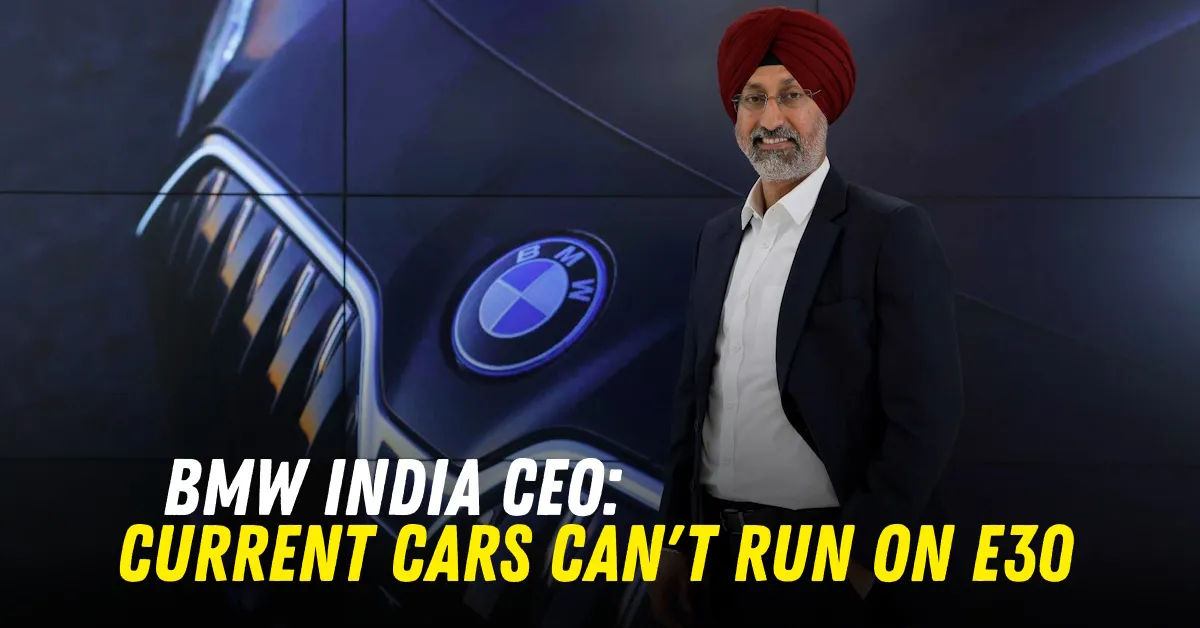

BMW Group India’s President and CEO Hardeep Singh Brar has confirmed publicly that existing cars on the road cannot be upgraded or retrofitted to run on E30 fuel. The statement, made in an interview, directly addresses a question that millions of car owners will face as the government pushes India’s ethanol blending programme beyond E20.
E30 is a fuel blend containing 30 per cent ethanol and 70 per cent petrol. The Bureau of Indian Standards has already notified specifications for E22, E25, E27, and E30 blends, laying the technical groundwork for their eventual introduction at fuel stations.
The government has also offered excise duty exemptions for these higher blends to make them economically viable. E30 is not yet available at retail pumps, but the policy direction is clearly toward it.
Brar’s statement is significant because it draws a hard line between vehicles engineered to handle higher ethanol blends and the existing fleet, most of which was designed and calibrated for E20 or lower. The word he used is important: these cars cannot be upgraded. Not that upgrading would be expensive or complex, but that it is not possible as an aftermarket modification.
Ethanol behaves differently from petrol in ways that affect the entire fuel system, not just the engine. It is corrosive to certain rubber compounds used in fuel lines, injector seals, and fuel pump components.
It attracts and absorbs moisture from the air, which can cause water contamination in the fuel system. It has a lower energy density than petrol, which means the engine management system needs to inject more fuel to produce the same power output, requiring a recalibrated ECU.
Cars engineered for E20, which have been manufactured to a specific BIS standard since 2023, have already incorporated changes to fuel system materials and ECU mapping to handle 20 per cent ethanol.
Running E30 in these vehicles over extended periods raises the risk of degraded rubber seals, fuel injector wear, and ECU confusion as the air-to-fuel ratio moves outside the calibrated range. On older vehicles built to E10 or lower specifications, the risks increase further.
There is no aftermarket ECU remap or fuel system part replacement that adds up to a full E30-capable vehicle, because the changes required go across multiple systems simultaneously and would need to be validated by the manufacturer. No car company is going to extend that validation to vehicles already sold and out of warranty.
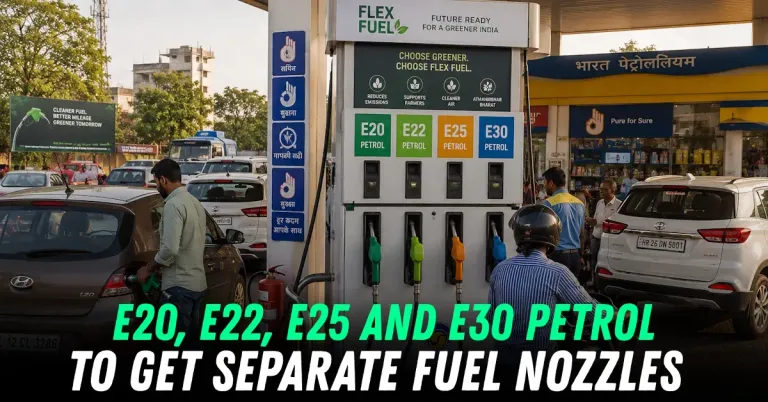
Every car being sold today is certified to run on E20. That certification does not extend to E30, even if the vehicle is new and BS6-compliant. When E30 becomes available at fuel stations, owners of current cars will face a practical question: is their car listed by its manufacturer as E30-compatible? For the overwhelming majority of vehicles on the road, including recent purchases from 2023 and 2024, the answer will be no.
The government’s E30 rollout is therefore only usable by vehicles specifically engineered for it from the factory. These will be future models, likely built on flex-fuel platforms or specifically recertified for E30. Maruti’s WagonR BioFlex, currently the only flex-fuel passenger car on sale, is calibrated for E20 to E100 because it was built that way from the start. That architecture is not transferable to other models through a software update or parts swap.
If you own a car bought in 2022, 2023, 2024, or 2025, run E20 from certified pumps and do not use higher ethanol blends until your manufacturer explicitly states E30 compatibility. Brar’s statement is not specific to BMW vehicles. The engineering reality he described applies equally to Maruti, Hyundai, Tata, Honda, and every other brand selling cars in this market today. The vehicles that can use E30 are the ones yet to be designed, built, and sold.
Comments are closed.