
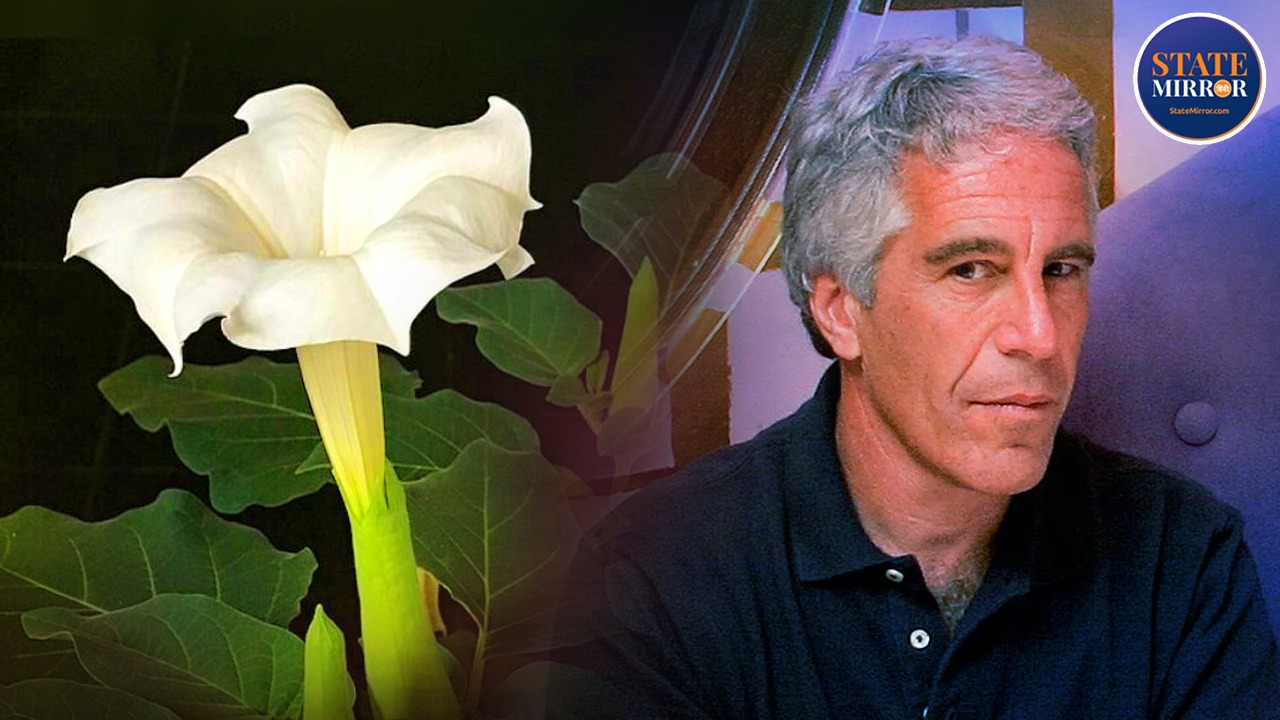
What is the Dhatura and Mahadev connection? Zombie Flower in Epstein Files Datura Scopolamine and Shiva Connection Hindu Purana Explained

surprising the whole world epstein files The sequence of a new revelation every day continues even today. Now the latest claim in a post that has surfaced regarding this issue is that American financier and child molester Jeffrey Epstein had grown ‘trumpet plants’ in his nursery. Trumpet plant is the same which is considered to be Dhatura flower in India. In the Puranas, it is especially offered to Bholenath during the churning of the ocean and in the worship of Mahadev in Mithilanchal and Terai region of Nepal. However, in the Epstein files it is mentioned as having ‘psychoactive properties’.
What are ‘psychoactive properties’?
After this matter came to light, even screenshots of emails are being shared on social media. This suggests that the financier had taken an interest in plants that were notorious for their powerful ‘psychoactive properties’.
‘Psychoactive properties’ means the ability of a substance (such as a drug, plant or chemical) to affect the brain and mental state. In simple words, anything that changes your mood, thinking, behavior, sensations or consciousness has psychoactive properties.
How does it affect?
Such substances affect the neurotransmitters of the brain (such as dopamine, serotonin), due to which a person can have different types of experiences. Like happiness or excitement, sleep or lethargy, nervousness or restlessness, confusion, intoxication or unconsciousness etc.
What is ‘Zombie Flower’ in the Epstein Files?
Similarly, the ‘zombie flower’ mentioned in the Epstein files is also in Hindu mythology. The Epstein files reveal that Jeffrey Epstein grew “trumpet plants” in his nursery. In India, the trumpet shaped Dhatura flower has a very distinct identity.
What is written in Epstein’s email?
The mail related to Datura flower in Epstein files is dated January 27, 2015. It seems that it has been forwarded by photographer Antoine Verglas. The message, whose subject line was ‘Scopolamine: Powerful drug growing in the jungles of Colombia that destroys free will’, was sent to Jeffrey Epstein.
What is Scopolamine and why is it called ‘Devil’s Breath’?
The forwarded message was an article from the Daily Mail and Vice, which described scopolamine as a substance “that can make people extremely suggestible.” Several key points were highlighted from the article, such as, “You can guide them wherever you want. It’s like they’re kids.”
What is the difference between Trumpet Plant, Brugmansia and Datura?
The term ‘Trumpet Plant’ is commonly used for Brugmansia and Datura species. Large hanging flowers, trumpet shape, presence of tropane alkaloids are their identity.
The third document is not a conversation with Epstein himself, but an email sent by Guillermo Fariñas to Juan Antonio Gonzalez on February 7, 2022, copied to Joseph Manjaro. In what has been described as a ‘victim impact statement’, Manjaro describes a disturbing incident in December 2014, in which he alleges he was given scopolamine. It is a tropane alkaloid produced by many plants, including the trumpet plant.
The statement clearly mentions scopolamine, claiming that the two men who were driving said, “I gave them a lot of scopolamine!” Then the author alleges memory loss and excessive sleep.
“Trumpet plants” appear three times in the email, and scopolamine is discussed in connection with these plants. At least this much is on record and has been given to us in these files.
What are ‘psychoactive properties’?
The trumpet plant usually symbolizes the Brugmansia or Datura species. These flowering plants are known for their large, pendulous, trumpet-like flowers. These plants are sometimes nicknamed ‘Devil’s Breath’ or ‘Devil’s Trumpet’ because they contain ‘tropane alkaloids’ compounds such as scopolamine, atropine and hyoscyamine.
According to medical journals, these compounds work on the central nervous system. Scopolamine has specific medical uses. It is prescribed for the treatment of motion sickness and post-operative nausea. However, in high doses it can cause confusion, hallucinations, restlessness, blurred vision and severe memory loss. In very severe cases, consuming it can cause coma or even death.
Brugmansia is a plant originally from South America, and its varieties grow in many parts of the world including India. These plants are ornamental and can be very beautiful, but every part of them is poisonous. Medical literature states that accidental ingestion, especially by children, can cause serious poisoning.
In Hindu tradition this Flower Connection to Mahadev?
In India, the trumpet shaped Dhatura flower has a very distinct identity. It has a deep connection with Lord Shiva in Hindu mythology and customs. According to stories, Datura emerged during the cosmic churning of the ocean, when poison came to the surface before the elixir of immortality. In a very famous story, Shiva drank deadly poison to save the universe, and held it in his throat, causing his throat to turn blue. Because Datura is a strong, wild plant that thrives in difficult conditions, it became a symbol of endurance and asceticism, qualities most associated with Shiva.
In many temples across India, Dhatura flowers and fruits are offered to Shiva as a form of worship, especially during Maha Shivaratri. The poisonous nature of this plant is acknowledged, but in the context of worship it shows surrender, devotion and the dilemma of converting poison into protection.
Dhatura (Dhattur) is mainly mentioned in the Puranas and Agama texts related to Shiva. It has been referred to in different ways at different places.
1. Shiva Purana
In contexts related to Shiva worship, Dhatura, Belpatra, Aak etc. have been described as dear to Shiva. It is mentioned in many chapters that the devotee who worships Shivalinga with Dhatura and Belpatra gets special virtue.
2. Linga Purana
Here the worship method of Shivalinga is described in detail. Dhatura (Dhatura) is also mentioned in the rules for offering flowers and leaves in the puja.
3. Skanda Purana
Some sections of Skanda Purana describe the rules and fasts of Shiva worship, where Dhatura and Belpatra are mentioned as favorite offerings to Shiva.
Why is there a special tradition of Dhatura in Mithilanchal?
In Mithilanchal (Northern Bihar-Terai region of Nepal) the tradition of offering Dhatura on Shivlinga on Sawan and Mahashivratri is especially prevalent. Here in rural areas, people themselves pluck Dhatura from fields and barns. In many places it is believed that offering Dhatura removes negative energy and obstacles. It is considered auspicious to offer Dhatura, Belpatra and Aak flowers together on Monday of Sawan.
Why is Dhatura offered in worship even though it is poisonous?
There is also a tradition of Tantric practice in Mithila region. Datura is also associated with Shakti and Tantra. Shiva is seen as the ‘Lord of Tantra’, hence offering Dhatura is also considered a symbol of Sadhana.
What is the symbolic meaning of Dhatura?
The thorny fruit and white/violet flowers of Datura are considered symbols of renunciation and penance. It teaches that even the ‘toxic’ circumstances of life can be purified by assimilating them like Shiva. In Mithilanchal, Dhatura is not just a flower, but is a part of Shiva devotion, folk faith and cultural identity. Offering it in the worship of Mahadev is a confluence of tradition, mythology and spiritual belief.

Comments are closed.