
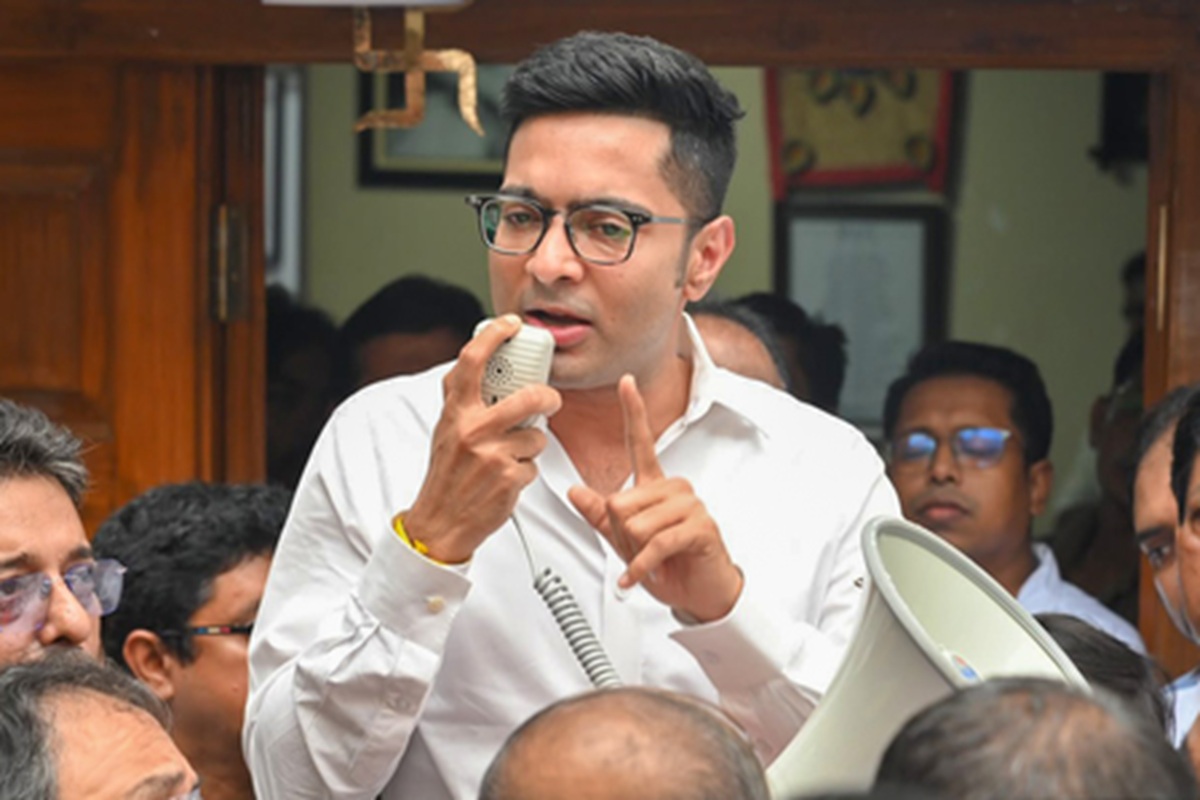

In the 2009 Lok Sabha elections, 19 Trinamool Congress MPs were elected, while in 2014 this number increased to 34. At that time the party tried to strengthen its position on the basis of increasing strength in Parliament. At the same time, the strength of the left parties, especially the CPI(M) in the Lok Sabha, was continuously declining.
At that time the parliamentary office of the CPI(M) was on the top floor of the old Parliament building (now Sanvidhan Sadan). Later Trinamool Congress also got its own office in Parliament.
However, on Monday, the first day of the monsoon session of Parliament, Trinamool Congress leader Abhishek Banerjee was allotted a seat in the Lok Sabha, behind his former colleague Sudip Bandyopadhyay as per the rules of the House.
Sudip Bandyopadhyay is now the leader of the National Citizens Party of India (NCPI). This party has 20 MPs in the Lok Sabha, while Trinamool Congress now has only 8 MPs left.
After the major split in Trinamool Congress, 20 MPs left the party and merged with NCPI. The Lok Sabha Speaker allowed this new group to sit separately, recognizing it as a separate parliamentary party on the basis of the Tenth Schedule of the Constitution and parliamentary traditions. With this change, the position of the ruling National Democratic Alliance (NDA) in the Lok Sabha has become stronger.
Trinamool Congress had won 29 seats in the 2024 Lok Sabha elections, but after facing setbacks in the assembly elections this year, internal differences in the party increased. Meanwhile, a seat also became vacant due to the death of an MP.
20 MPs, including Sudip Bandyopadhyay and Kakoli Ghosh Dastidar, formed a separate parliamentary group. Instead of staking claim in the name of Trinamool Congress, these leaders thought it better to merge with the Election Commission recognized National Citizens Party of India (NCPI). Although this party had never contested any Lok Sabha election before.
After this merger, NCPI suddenly became one of the major parliamentary groups in the Lok Sabha and an important ally of the BJP-led NDA.
According to the anti-defection law made under the Tenth Schedule of the Constitution, if an MP voluntarily leaves his party, his membership can be lost, but if at least two-thirds of the members of a parliamentary party agree to merge with another party, then he is not disqualified.
More than two-thirds of the total Trinamool Congress MPs had decided to merge with NCPI. Therefore, he cannot be immediately disqualified under the anti-defection law.
However, the Trinamool Congress leadership, including Abhishek Banerjee, has filed a petition with the Lok Sabha Speaker demanding disqualification of these MPs. But it is the right of the Speaker of the Lok Sabha to recognize parliamentary parties and decide the seating arrangement in the House.
The opposition is questioning the political and moral validity of this entire development, but as per the parliamentary procedure and the provisions of the Constitution, the steps taken so far are considered to be in accordance with the rules.
After the new numerical strength in the Lok Sabha, the position of NDA has become stronger, while the influence of Trinamool Congress has become much less than before.
India approves ‘Qudenga’, the first dengue vaccine for people aged 4 to 60 years!

Comments are closed.